The Invisible Code That Moves Billions: A Story About IBANs, Trust, and Global Money
It started with a failed payment.
 Antriksh Bansla5 min read·Just now
--
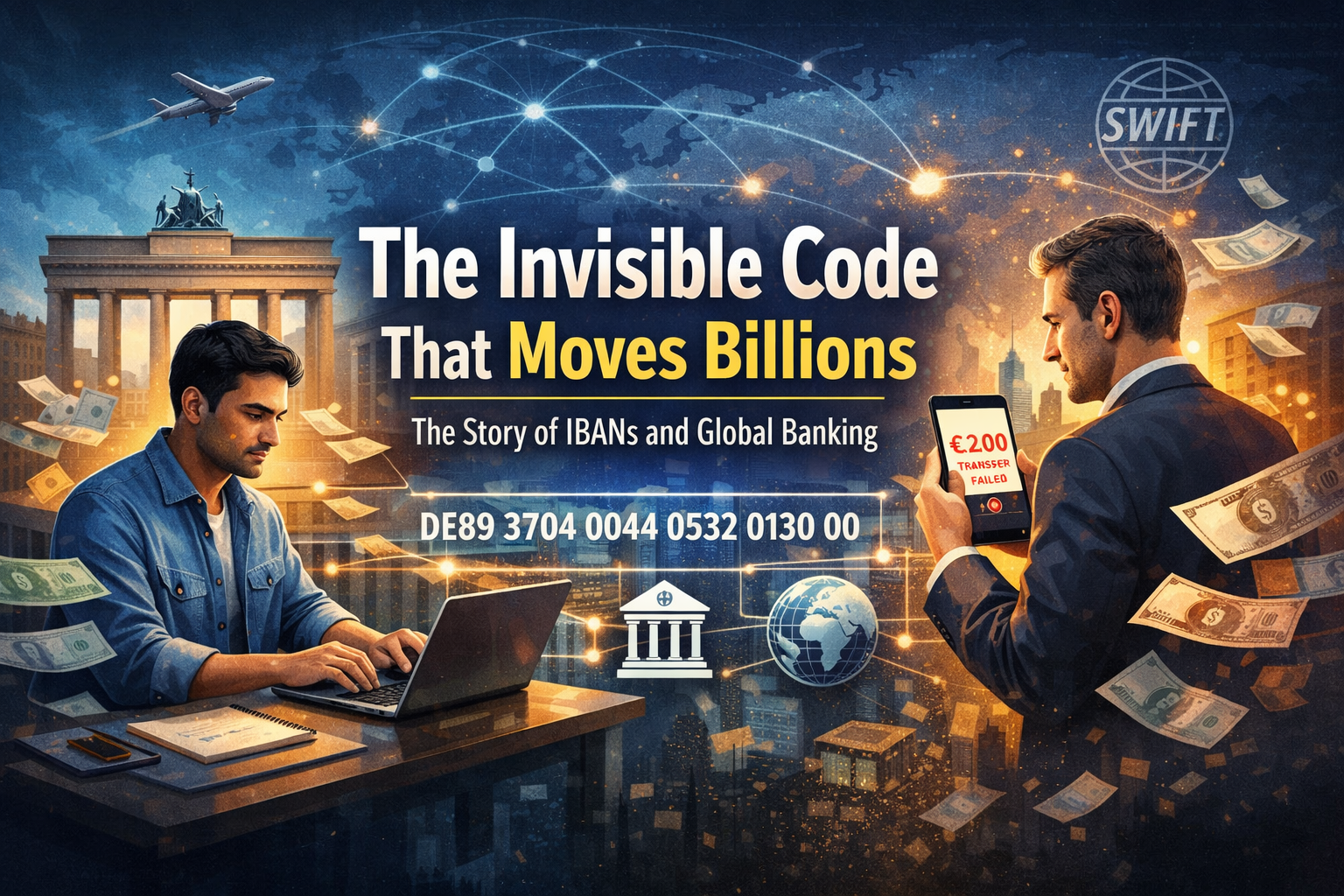
Arjun, a freelance designer from India, had just completed a branding project for a client in Germany. The work was smooth, the communication was great, and the invoice — €1,200 — was sent on time.
But when the client tried to pay him, the money bounced back.
No warning. No detailed explanation. Just a cold email from the bank:
“Invalid account details. Payment could not be processed.”
Arjun double-checked everything. The account number was correct. The SWIFT code was included. Still nothing worked.
The client finally replied:
“Can you send your IBAN again?”
Arjun paused.
IBAN?
That was the first time he realized something strange: the global financial system doesn’t speak one language. And sometimes, even when money is ready to move, it simply cannot — because it doesn’t understand the address.
The invisible problem behind global payments
We often imagine money moving instantly across borders, like sending a WhatsApp message.
But in reality, international banking is more like mailing a letter through multiple post offices, each with its own format, rules, and verification steps.
Before systems like IBAN existed, cross-border payments were messy:
· Account numbers differed in every country
· Banks used inconsistent formats
· Errors were common in manual entry
· Payments often got delayed or rejected
· Tracking money was almost impossible
A single missing digit could send your payment into a black hole of banking systems.
And for people like Arjun; freelancers, businesses, students abroad — this wasn’t just inconvenient. It was stressful and expensive.
Something had to change.
Enter IBAN: the global financial address
IBAN stands for International Bank Account Number.
At first glance, it looks like a random string of letters and numbers. But in reality, it is a carefully designed global standard that tells banks exactly where money should go.
An IBAN typically looks like this:
DE89 3704 0044 0532 0130 00
To a human, it feels confusing.
To a bank, it is precise instructions.
Every IBAN contains:
· Country code (like DE for Germany, FR for France, AE for UAE)
· Check digits (for error detection)
· Bank identifier
· Branch code (in some countries)
· Account number
It is like a postal address — but for money.
And unlike old systems, IBAN doesn’t leave room for guessing.
If something is wrong, the system knows immediately.
Why IBAN was created: a world losing money to mistakes
Before IBAN became widely adopted, Europe alone was losing millions every year due to failed or misrouted payments.
A single typo could cause:
· Salary delays for employees
· Missed supplier payments for businesses
· Frozen international transfers
· Banking reconciliation nightmares
Banks needed a system that could:
· Standardize account identification across countries
· Reduce human error
· Speed up cross-border transactions
· Improve trust between financial institutions
So IBAN was introduced as part of the SEPA initiative (Single Euro Payments Area) in Europe, and later adopted globally in many regions.
It wasn’t just a technical upgrade.
It was a trust upgrade.
Arjun’s second attempt
Arjun carefully opened the message from his client again.
“Please provide IBAN.”
This time, instead of guessing, he researched.
He discovered that his Indian bank did not use IBAN for domestic accounts. India relies on IFSC codes and account numbers. But for receiving international payments, intermediary systems like SWIFT are used instead.
He felt confused.
Why did some countries use IBAN and others didn’t?
The answer was simple but powerful:
Global banking is not unified, it is connected.
IBAN is used mainly in Europe, parts of the Middle East, and some other regions. Countries like India, the US, and Canada use different systems but still interact with IBAN-based systems through international networks.
It is not one system.
It is a system of systems.
The moment everything clicked
When Arjun explained this to his client, something interesting happened.
The client replied:
“Oh, then your bank might require SWIFT + account number instead of IBAN.”
That was the missing piece.
Arjun’s payment wasn’t failing because of money.
It was failing because of translation.
Between two banking systems speaking different “languages.”
Once corrected, the payment finally went through.
Two days later, Arjun received the email:
“Incoming transfer: €1,200 credited.”
It felt like relief — but also curiosity.
How could something so simple on the surface be so complex underneath?
The hidden intelligence inside IBAN
Most people think IBAN is just a long number.
But it is actually a smart system.
One of its most powerful features is error detection.
The check digits inside IBAN are not random. They are calculated using a mathematical formula called MOD-97.
This means:
· If you mistype a digit, IBAN can detect it instantly
· Banks can validate it before processing payments
· Wrong transfers are significantly reduced
It is like having a built-in spellcheck for money.
For example, if someone accidentally writes:
DE89 3704 0044 0532 0130 01
Instead of:
DE89 3704 0044 0532 0130 00
The system will immediately reject it.
That small feature alone saves billions in potential financial errors every year.
Why IBAN matters more than we realize
We rarely think about banking infrastructure until it fails.
But IBAN quietly powers:
· International salaries
· Freelance payments
· Import/export businesses
· Education fees abroad
· Global investments
· Remote work economies
Without it, global trade would slow down dramatically.
Imagine hiring talent from another country but not being able to pay them reliably.
Or a startup trying to pay overseas vendors but losing money due to errors.
IBAN reduces that friction.
It turns chaos into structure.
A human story behind a technical system
Months later, Arjun began working with more international clients.
He no longer feared payment delays.
He understood the system better.
But something stayed with him.
One small mistake had once delayed his income not because of effort or skill, but because of a missing standard.
It made him realize something deeper:
Technology doesn’t just solve problems. It defines trust.
IBAN is not just a banking format.
It is a promise that:
· Your money will reach the right place
· Systems will communicate correctly
· Errors can be detected early
· Global transactions can scale safely
Behind every smooth payment is an invisible structure holding everything together.
The future: will IBAN still matter?
With the rise of fintech, digital wallets, blockchain, and instant payment systems, some people believe traditional systems like IBAN may fade.
But reality is more layered.
Even modern systems still rely on banking rails underneath. IBAN continues to serve as a backbone in many regions.
However, the future may look like:
· Faster cross-border settlement systems
· Real-time international transfers
· AI-driven fraud detection on payment routes
· More unified global payment standards
Still, until the world fully unifies its financial language, IBAN remains essential.
It is not outdated.
It is foundational.
Final reflection
Arjun once thought banking details were just “technical information.”
Now he sees them differently.
They are not just numbers.
They are instructions.
They are identities.
They are bridges between economies.
And IBAN is one of the most important bridges ever built.
Because in a world where money moves faster than ever, clarity matters more than speed.
And sometimes, the difference between a failed payment and a successful one is not the money itself —
but the code that tells it where to go.