The Inverse Head and Shoulders Textbook Has One Rule Backwards
 Rene Haase7 min read·Just now
--
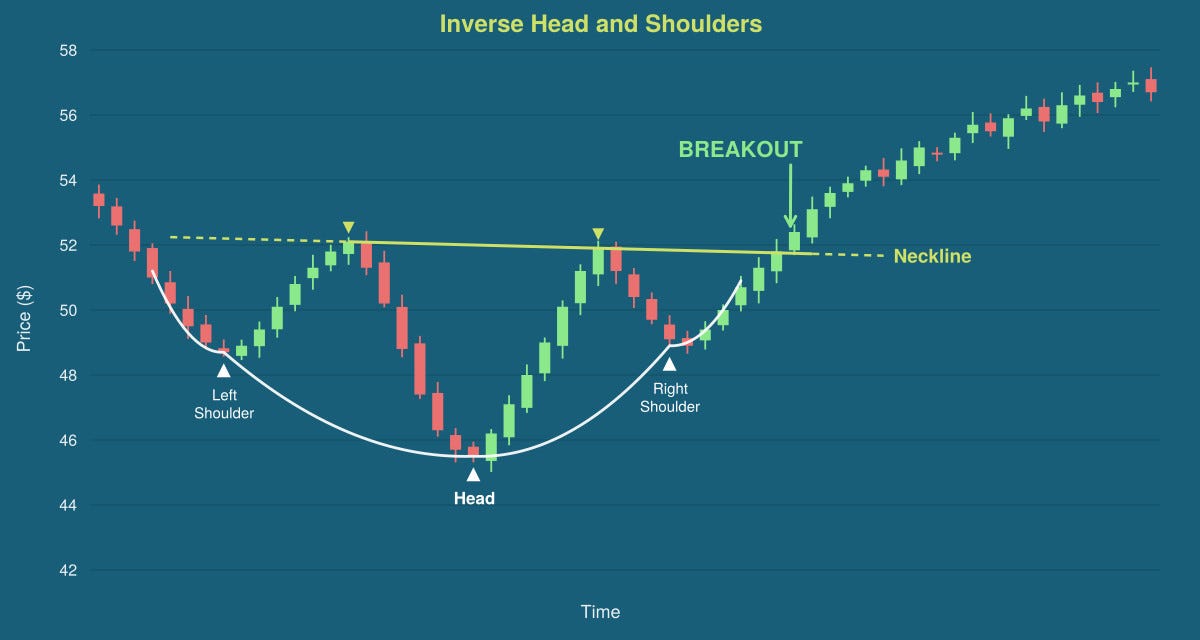
The Inverse Head and Shoulders is one of the most widely taught bullish reversal patterns in technical analysis. Bulkowski’s encyclopedia, Warrior Trading and TradingWithRayner are just a few, who discussed this chart pattern extensively. What almost none of those sources offer is real, segmented performance data. How often does the pattern actually win? Which setups are worth taking and which ones should you avoid? Where does the pattern work, where does it fail? How should you enter the trade?
At StockDataAnalytics, we scan roughly 6,000 stocks every trading day looking for sixteen bullish chart patterns and track what happens to each detection afterward. Our backtest now contains 67,041 completed Inverse Head and Shoulders trades. This article walks through the most surprising findings. The full analysis, with every table and every regime cut, lives on our blog.
The unfiltered Pattern is a Coin Flip
The first thing the data shows is that the Inverse Head and Shoulders without any quality filter is not a strategy. It is a coin flip with a slight tilt.
Across the lowest tier of detections, those scoring around 20 on our composite quality measure, we tracked 5,180 trades. The win rate landed at 47.2%. The market beat rate was 43.5%. The average return per trade was essentially zero. Move up to a quality score of 25 and the picture barely changes.
This is what most published studies of the pattern look like. They aggregate every detection into a single bucket and report the average. The average is unimpressive because it mixes the setups that work with the much larger pool of setups that do not.
That is the floor. It is also the credibility check on everything that follows. The edge comes from identifying statistical markers that separate high-quality patterns from the rest.
Scoring separates the Winners from the Noise
When we score each detection on structure, volume, and breakout readiness and produce a composite score, the population stops looking uniform. The scoring curve from score 30 through 39 tells the real story (visit the blog for the full table) :
The slope steepens hard above 34. Below 30, the pattern is barely earning its commissions. From score 35 onward, win rates jump into the sixties, then the seventies. By the time you reach score 37 and above, the population looks like a different pattern entirely from the one at the bottom.
That single shift, from “does the pattern work” to “which sub-segment of the pattern works,” is the practical lesson of the entire dataset. Every other finding in our analysis is an extension of it.
Day one tells you which trade you are actually in
Once you have a high-quality setup, the next question is how to trade it. The data points at two signals, both available within the first trading session after the pattern forms.
The first is the open gap. Stocks that open down at least 1.5% on the day of the recommendation end up as winners much more often than stocks that gap up. A score-30 setup with a baseline 55% win rate climbs to 68% if you only take the trades that gap down. The intuition that an enthusiastic gap-up confirms the pattern is the opposite of what the data shows. Strength on the open is, on average, a warning. Weakness on the open is, on average, where the winners hide.
The second is what happens during day one itself. When we bucket trades by how far the intraday low fell below entry on day one, the result is one of the cleanest monotonic curves in the dataset. Trades that held within half a percent of entry won 56.8% of the time. Trades that dipped three to five percent intraday won 43.9% and returned negative on average. Trades whose intraday low never dropped below entry at all won 78.6% of the time.
The practical rule: watch the first session. The decision to keep or cut the trade can be made at the close of day one, not days later. The full day-1 MAE table and the score-band breakdowns are in the full article.
The regime matters more than the textbooks admit
A reversal pattern is a bet on the market changing its mind. That bet should pay off differently in different environments. It does, but not in the direction most traders expect.
We tag every detection with a regime zone derived from the broader market state. The interesting result shows up when you compare the same quality of setup across the three bull regimes:
The same quality of pattern, in three different bull environments, produces wildly different outcomes. Score-37 setups in moderate and weak bull regimes win about 80% of the time. The same score in strong bull markets wins 36.9%. The gap is too large to be sample noise and it shows up at every score band we have data for.
The working theory: the Inverse Head and Shoulders is fundamentally a reversal. In moderate bull markets there is room to reverse a trend. Stocks finish corrections, base, and turn back up. In a strong bull regime almost everything is already going up, so the “reversal” is more often a temporary shakeout in something already trending, or a setup that triggers right before the broader market adjusts. The pattern has nowhere to actually reverse to.
The rule the textbooks got backwards
The single most interesting finding in our dataset is not about scoring or regimes. It is about pattern geometry.
Conventional trading advice states that shallow right shoulders are safer and deep right shoulders should be treated as a warning sign. The reasoning, stated most sharply by TradingWithRayner, is that a deep right shoulder creates extra selling pressure on the way back up to the neckline.
Our data rejects this cleanly and loudly.
Across 19,477 detections that we were able to measure the right shoulder depth on, the shallow bucket (depth 1.6 to 5.7% below the neckline peak) wins only 32.8% of the time with a two-week trade return of -0.07%. The medium bucket (7.2 to 8.9%) wins 53.9%. The deep bucket (11.1% to 25.8%) wins 66.5% with a 0.84% trade return. That is a 34-point spread in win rate from the same pattern at the same score level, and the difference is driven by the right shoulder depth alone, not by pattern quality. Shallow right shoulders are where the losers live.
This finding is not marginal. It is the strongest single independent geometric signal in the entire dataset, and it holds across every bull regime and into moderate bear markets. It is also directly inverted from the textbook advice every retail trader has read. You can see the detailed data in the full article.
We tested five geometric theories in total. Two held up (pattern efficiency, RSI divergence). Two were rejected (volume decline, shoulder symmetry). One, right shoulder depth, was inverted. The full geometry analysis walks through all five theories and includes data.
What this means for you
If you trade the Inverse Head and Shoulders, a few rules of thumb derived from the data are worth considering.
Filter on pattern quality first. Scores below 32 are barely worth the position. Scores of 35 and above generate serious returns.
Watch the next-day open. Soft gaps or down opens are a feature, not a bug. Wait for the boring entry, not the exciting one.
Use day one as a confirmation. If the stock holds within half a percent of entry through the close of day one, you are sitting in a population that wins meaningfully more than the baseline.
Mind the regime. Moderate and weak bull markets is where the high-quality setups deliver. High confidence bull markets is where they go to die.
And pay attention to the right shoulder. Deeper is better. The textbook is wrong on this one.
Read the full analysis
The full article on our blog includes every data table, the full scoring methodology, all five geometry tests side by side, the complete day-1 analysis breakdown across three score tiers, and the methodology and limitations disclosure. If this piece was useful, the deeper version is where the real reference material lives.
This is the first in a planned series. One of these analyses is coming out of StockDataAnalytics.com every two to three weeks, one pattern at a time, using the same systematic backtest methodology. If you want the series delivered as it publishes, follow me on Medium or subscribe at StockDataAnalytics.com.
Disclaimer: StockDataAnalytics.com is a financial data and analytics service. The information provided through our platform, including stock pattern detection, entry zones, stop losses, and price targets, is for informational and educational purposes only and does not constitute financial advice, investment advice, trading advice, or any other type of advice. We are not registered investment advisors, broker-dealers, or financial planners. Past performance of any pattern or recommendation does not guarantee future results. All investments involve risk, including the possible loss of principal. You should consult with a qualified financial advisor before making any investment decisions. By using our service, you acknowledge that all trading decisions are made at your own risk.