Most companies are deploying AI. Very few are redesigning themselves around it.
The next decade of competitive advantage will not belong to organizations that merely deploy models.
It will belong to enterprises that systematically accumulate, reuse, govern, and improve decision intelligence over time.
The critical question for boards and CEOs is no longer:
“Are we adopting AI?”
It is:
“Are we building an intelligence-compounding enterprise?”
AI Is Not a Productivity Tool. It Is a Decision Technology.
The internet connected people to information.
AI connects information to action.
That difference is structural.
The internet reduced the cost of distribution and communication.
AI reduces the cost of judgment, coordination, and execution — when designed well.
When decisions improve at scale, value doesn’t merely shift.
It expands.
That expansion is the core strategic opportunity.
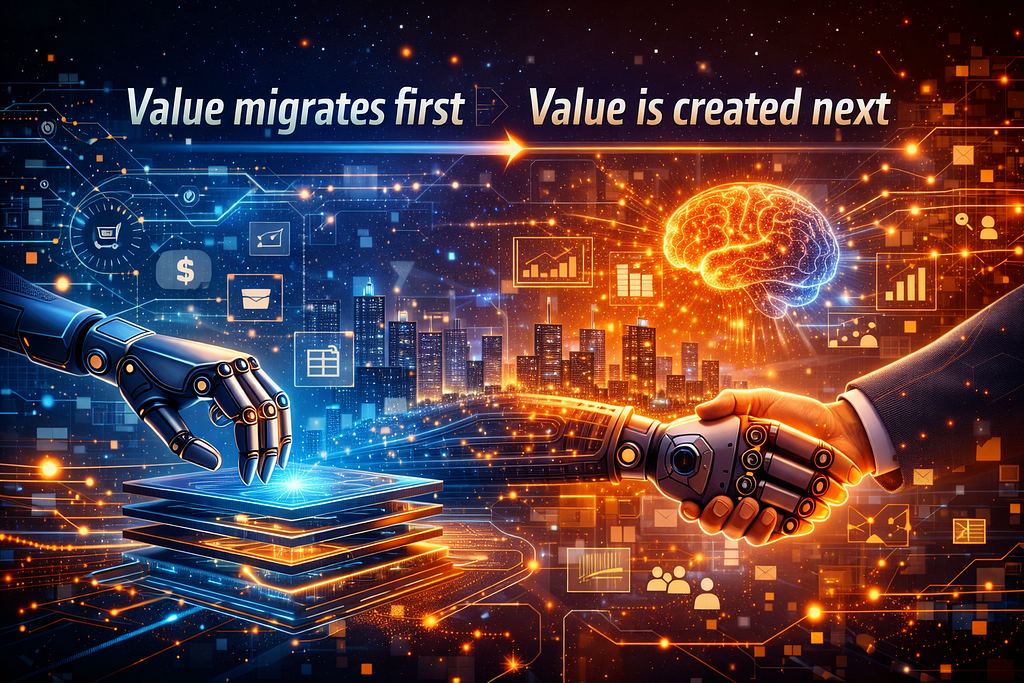
Value Migrates Inside Decisions First
Every major technology shift follows a predictable sequence:
- Value migration (quiet, structural)
- Value creation (visible, explosive)
- Institutional advantage (durable, compounding)
AI is currently in the migration phase.
The most valuable asset moving right now is not data.
It is decision quality.
Pricing decisions.
Credit decisions.
Hiring decisions.
Fraud decisions.
Risk decisions.
Supply chain decisions.
Boards that recognize this early move from experimentation to structural advantage.

Enterprises Can Finally Compound Institutional Intelligence
Most companies compound:
• Assets
• Distribution
• Capital
Very few compound decision quality.
AI makes something possible at scale that was historically fragmented:
Institutional learning loops.
A simple loop:
- Capture decision context
- Choose the best action
- Measure outcomes
- Learn what worked
- Improve the next decision
Repeat safely. Repeat fast. Repeat with governance.
That is compounding intelligence.

Six Structural Value Pools Enterprise AI Unlocks
1️⃣ Precision revenue (micro-level decision discipline)
2️⃣ Margin expansion (coordination friction removal)
3️⃣ Risk compression (earlier anomaly detection)
4️⃣ Decision velocity (signal → insight → action compression)
5️⃣ Intelligence-native products
6️⃣ New business models (decision-as-a-service, outcome contracts)
Efficiency is the surface benefit. Structural advantage is the real one.
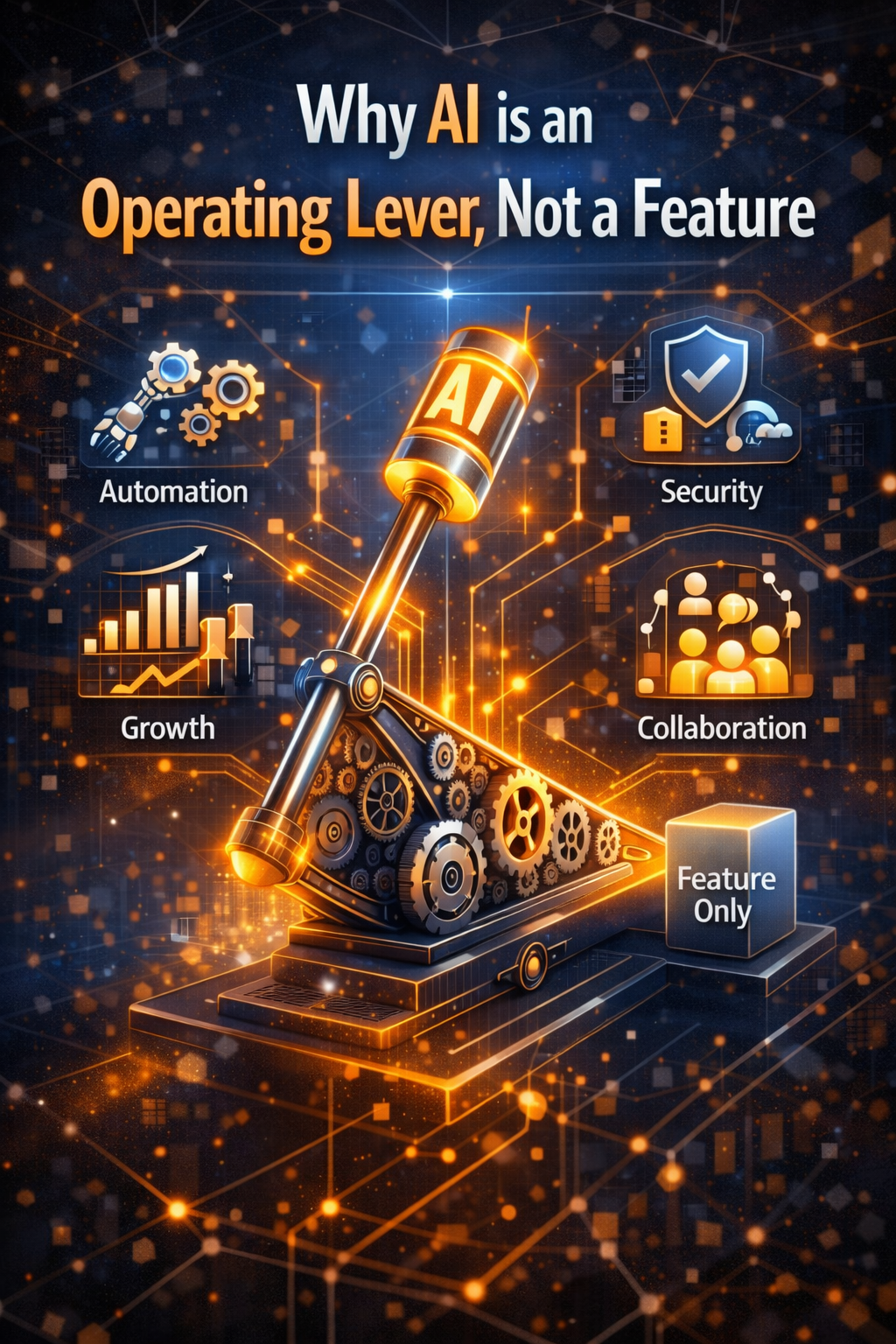
Why AI Is an Operating Lever — Not a Feature
AI creates value when it integrates:
• Perception (understanding messy data)
• Prediction (forecasting outcomes)
• Policy-aware action (acting within constraints)
When these capabilities are embedded directly into workflows — not bolted on — enterprises begin to compound intelligence.
This is why Enterprise AI is not an IT project.
It is an operating model redesign.
The Board Scoreboard
Each quarter, boards should ask:
• Which decisions improved measurably?
• Where did coordination friction decline?
• Which loops are self-improving with guardrails?
• Are we building reusable intelligence assets?
• Is trust strengthening as scale increases?
If you can answer clearly, you are already moving from migration to value creation.

The Intelligence Expansion
The internet created massive value by transforming communication and distribution.
AI will create massive value by transforming decisions and execution.
The winners will not be those with the most pilots.
They will be those who redesign institutions so intelligence compounds — safely, measurably, and structurally.
The expansion has begun.
The question is whether your enterprise is compounding — or just experimenting.
The Enterprise AI Doctrine: From Decision Scale to Institutional Redesign
Over the past few months, I’ve been building a structured doctrine around Enterprise AI — not as a technology trend, but as an institutional redesign agenda.
It unfolds in layers:
🔹 1️⃣ Decision Economics
- Decision Scale: Why Competitive Advantage Is Moving from Labor Scale to Decision Scale
https://www.raktimsingh.com/decision-scale-competitive-advantage-ai/
→ Establishes the core thesis: advantage is shifting from scaling labor to scaling decision quality.
🔹 2️⃣ Institutional Transformation
- The Future Belongs to Decision-Intelligent Institutions
https://www.raktimsingh.com/the-future-belongs-to-decision-intelligent-institutions/
→ Argues that AI leadership is not about tooling — it is about institutional architecture.
🔹 3️⃣ Sector-Level Redesign
- The Institutional Redesign of Indian IT: From Services Firms to Intelligence Institutions
https://www.raktimsingh.com/institutional-redesign-indian-it-intelligence-institutions/ - From Labor Arbitrage to Intelligence Arbitrage: Why Indian IT’s AI Reinvention Will Define the Next Decade
https://www.raktimsingh.com/from-labor-arbitrage-to-intelligence-arbitrage-why-indian-its-ai-reinvention-will-define-the-next-decade/
→ Examines how this shift reshapes industry structure, economics, and competitive positioning.
🔹 4️⃣ Economic Consequences
- The End of Averages: Why Precision Growth Will Define the Next Decade of Enterprise Strategy
https://www.raktimsingh.com/precision-growth-end-of-averages-enterprise-ai/ - What Is the AI Dividend? How Boards Capture Structural Gains from Enterprise AI
https://www.raktimsingh.com/ai-dividend-boards-structural-gains/
→ Explores how decision intelligence translates into measurable structural gains.
🔹 The Unifying Thesis
Together, these articles form a coherent framework:
- Competitive advantage is moving from labor scale to decision scale
- Institutions must evolve from services firms to intelligence institutions
- AI must shift from isolated pilots to structurally governed, economically accountable enterprise systems
This is not AI adoption. It is enterprise redesign.

Originally published at https://www.raktimsingh.com on February 16, 2026.
The Intelligence Expansion: Why Enterprise AI Is Redefining Value Creation for Boards and CEOs was originally published in DataDrivenInvestor on Medium, where people are continuing the conversation by highlighting and responding to this story.