The Highest-Edge Prediction Market Strategies in 2026
 Benjamin-Cup5 min read·Just now
--
Here’s a more polished Medium-style article version with practical examples and a professional flow.
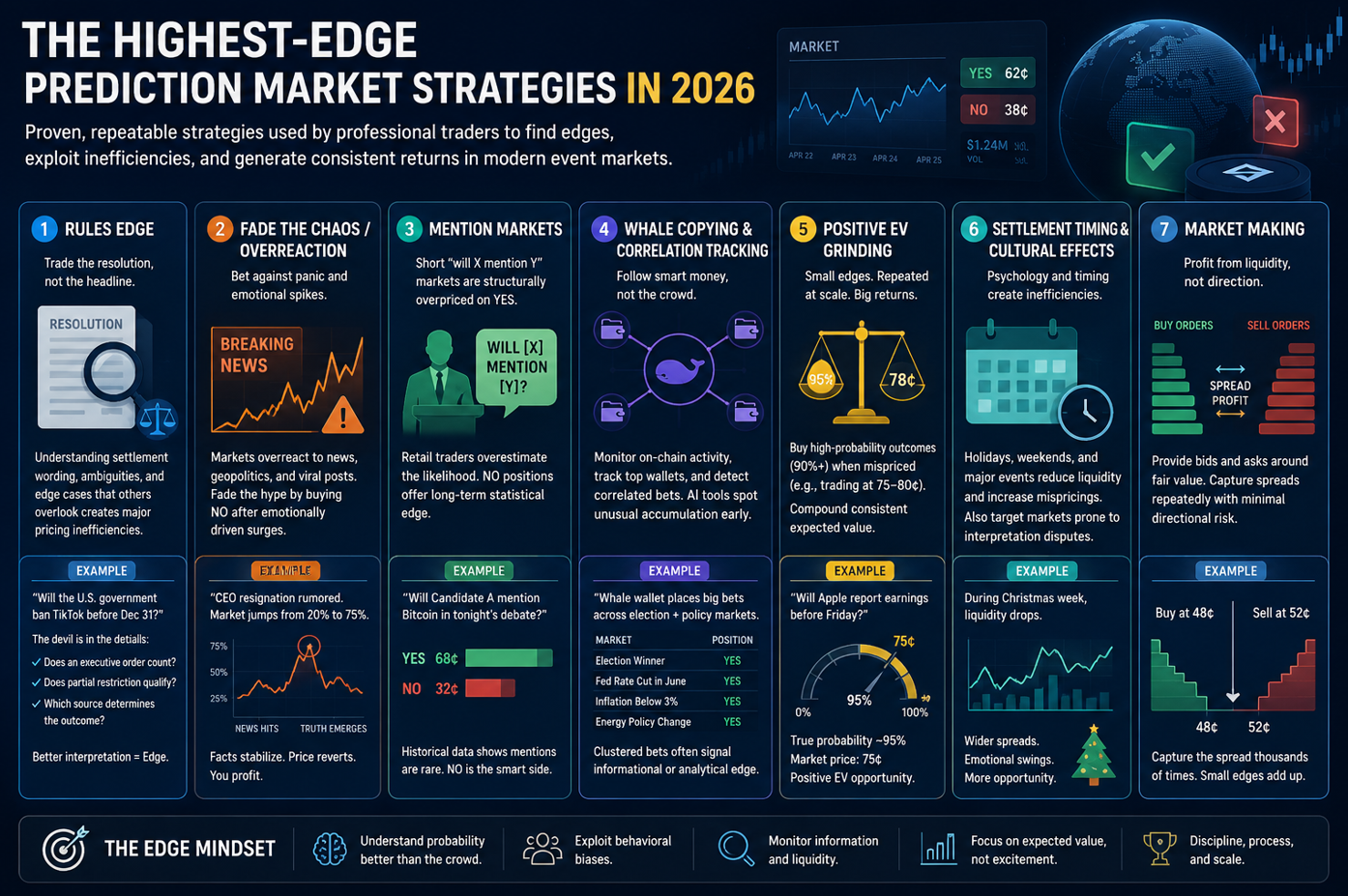
The Highest-Edge Prediction Market Strategies in 2026
Prediction markets have evolved from niche internet experiments into highly sophisticated financial ecosystems where traders analyze politics, economics, sports, AI, and global events in real time.
As liquidity has increased, so has competition. Simple “gut feeling” betting is no longer enough. The traders consistently generating returns in 2026 are using structured frameworks based on probability, behavioral psychology, liquidity flows, and market mechanics.
Below are some of the most effective strategies currently used by professional prediction market participants — along with real-world examples of how they work in practice.
1. Rules Edge: Trading the Resolution, Not the Headline
One of the biggest advantages in prediction markets comes from understanding how a market resolves, rather than simply predicting the event itself.
Most retail traders focus only on the headline question. Professionals read the fine print.
Markets with ambiguous wording, subjective criteria, or unusual settlement rules often create major pricing inefficiencies.
Example
A market asks:
“Will the U.S. government officially ban TikTok before December 31?”
Retail traders may immediately buy “YES” after dramatic political headlines.
However, experienced traders look deeper:
- Does an executive order count?
- Does a court injunction delay resolution?
- Does partial restriction qualify as a “ban”?
- Which source determines the official outcome?
If the resolution criteria are narrow, the probability of settlement may be much lower than the market assumes.
In many cases, traders profit not from predicting politics correctly, but from understanding legal and procedural nuance better than the crowd.
2. Fade the Chaos: Betting Against Panic
Prediction markets are highly emotional environments.
Breaking news, geopolitical tensions, viral social media posts, and misinformation frequently cause dramatic short-term overreactions.
Experienced traders often do the opposite of the crowd during moments of peak fear or hype.
Example
Suppose a sudden news alert claims a major tech CEO is about to resign. The market instantly jumps from 20% to 75%.
Professional traders ask:
- Is the source verified?
- Is the information already denied?
- Is the market reacting emotionally rather than rationally?
If evidence remains weak, they may aggressively buy “NO” while panic buyers pile into “YES.”
As the news cycle cools and facts emerge, probabilities often normalize — creating profitable mean reversion opportunities.
This strategy works because humans systematically overweight recent and emotionally charged information.
3. Mention Markets: Exploiting Retail Bias
“Will X mention Y?” contracts are among the most consistently mispriced markets.
Retail traders tend to overestimate how often politicians, CEOs, or public figures will say specific words during speeches, interviews, or debates.
The excitement around a possible mention inflates “YES” prices far beyond realistic probability.
Example
A debate market asks:
“Will Candidate A mention Bitcoin during tonight’s debate?”
Retail traders may buy “YES” simply because Bitcoin is trending online.
But experienced traders understand:
- Debate topics are tightly controlled
- Candidates follow prepared talking points
- Many popular online topics never appear on stage
As a result, “NO” positions frequently offer better long-term expected value.
Many professional traders treat these markets statistically rather than emotionally, exploiting structural overpricing repeatedly across hundreds of contracts.
4. Whale Copying & Correlation Tracking
Large traders (“whales”) increasingly influence prediction markets through concentrated capital deployment.
Sophisticated participants monitor blockchain activity and identify wallets with strong historical performance.
The goal is not blind copying — it’s pattern recognition.
Example
A high-performing wallet suddenly places:
- Large “YES” positions on an election market
- Simultaneous bets on related cabinet appointments
- Correlated positions in economic policy markets
This cluster may signal:
- Private information
- Superior political modeling
- Institutional research
AI tools now scan blockchain transactions in real time to detect these coordinated patterns before broader market participants react.
Some traders specialize entirely in whale analytics, treating prediction markets similarly to hedge fund flow analysis.
5. Positive EV Grinding: Small Edges, Large Scale
Most profitable traders are not searching for 100x outcomes.
Instead, they focus on consistently capturing positive expected value (EV) opportunities.
The principle is simple:
- If an event has a true 95% probability
- But the market prices it at 78%
- The trade may be mathematically favorable over time
Example
A market asks:
“Will Apple release quarterly earnings before Friday?”
Historically, Apple almost never misses scheduled reporting windows.
If panic or temporary liquidity imbalance pushes the contract down to 80 cents, professional traders may buy heavily despite the relatively small upside.
The edge is not exciting individually — but repeated hundreds of times, these trades compound efficiently.
This approach resembles quantitative trading more than gambling.
6. Settlement Timing & Cultural Calendar Effects
Markets are heavily affected by human behavior patterns.
Liquidity often drops during:
- Holidays
- Weekends
- Major sporting events
- Global vacation periods
Lower participation creates temporary inefficiencies and exaggerated price swings.
Example
During Christmas week, a political market may experience sharp volatility despite minimal new information simply because fewer active traders are online.
Professionals often prepare for these periods in advance by:
- Providing liquidity when spreads widen
- Exploiting emotional price swings
- Anticipating delayed settlement disputes
Timing psychology can matter just as much as underlying fundamentals.
7. Market Making: Profiting Without Predicting
Not all traders attempt to predict outcomes directly.
Some operate as market makers, continuously placing buy and sell orders around fair value to capture bid-ask spreads.
Rather than betting on direction, they profit from liquidity provision.
Example
Suppose a contract trades:
- Buy at 48¢
- Sell at 52¢
A market maker may:
- Buy from impatient sellers
- Sell to aggressive buyers
- Capture the spread repeatedly
Over thousands of transactions, these small edges accumulate into relatively stable returns.
In mature prediction markets, disciplined market makers can generate consistent low-volatility performance while maintaining limited directional exposure.
Final Thoughts
Prediction markets in 2026 increasingly resemble a hybrid of:
- behavioral finance,
- quantitative trading,
- information arbitrage,
- and social sentiment analysis.
The most successful participants are rarely the loudest or most emotional traders. Instead, they are systematic operators who:
- understand probability,
- exploit crowd psychology,
- monitor liquidity flows,
- and focus relentlessly on expected value.
In modern event markets, edge rarely comes from predicting the future perfectly.
More often, it comes from understanding how other participants misprice uncertainty.
🤝 Collaboration & Contact
If you’re interested in building trading bots, buy trading bots, collaborating, exploring strategy improvements, or discussing about this system, feel free to reach out.
I’m especially open to connecting with:
-Quant traders
- Engineers building trading infrastructure
- Researchers in prediction markets
- Investors interested in market inefficiencies
📌 GitHub Repository
This repo has some Polymarket several bots in this system.
You can explore the full implementation, strategy logic, and ongoing updates about 5 min crypto market here: https://github.com/Bolymarket/Polymarket-arbitrage-trading-bot-python
This is my Polymarket trading Public Account with Trading bot.
https://polymarket.com/@benjamin-rustyedge4
Contact Info
Email
[email protected]
Telegram
https://t.me/BenjaminCup
If you want to get new ideas and strategies for Prediction market Strategy, please read my series of articles.