The Hidden Stage— Trading in the Month of Maia
 Veyrain Paperrain8 min read·Just now
--
Structure Before the Move — May, Maia, and the Patience of the Root
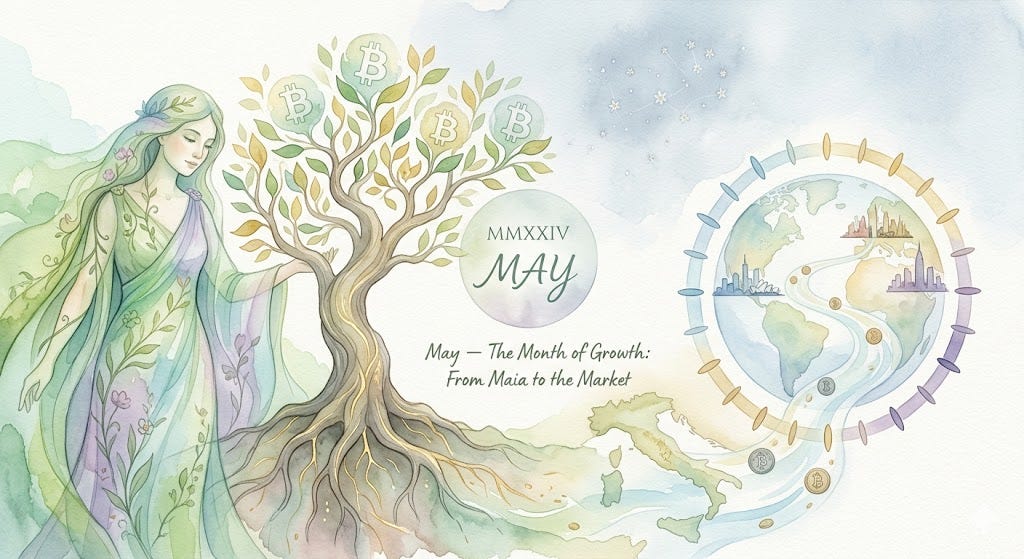
May — The Month of Growth
From Maia to the Market
Every month carries a name.
But most names, if you trace them back far enough, turn out to be accidents of power. July was Quintilis — the fifth month — until the Roman Senate, in a moment of flattery that has lasted two thousand years, renamed it for Julius Caesar in 44 BC. August was Sextilis, the sixth, until Augustus decided the calendar needed his name on it too. September, October, November, December still carry their Latin numerals — seventh, eighth, ninth, tenth — even though they haven’t been the seventh, eighth, ninth, or tenth months since before the Common Era.
The calendar we use is, in many ways, a palimpsest of political decisions and forgotten reorganizations.
May is the exception.
May was not renamed for anyone. It was not inherited from a number that no longer applied. It was given its name deliberately, at the beginning — shaped around something that no emperor could claim as his own.
A force of growth.
I. Maia — The Name Behind the Month
To understand why May carries that name, you have to go back to a Rome that most people never picture when they think of Rome.
Not the Rome of senators debating in marble halls. Not the Rome of legions marching through Germania. But the Rome of a farmer in the Campanian plain, sometime in the early Republic, standing at the edge of his field in the first week of the fifth month, looking at soil that was already alive with things he could not yet see.
That farmer knew Maia.
She was one of the Pleiades — the seven daughters of the Titan Atlas, who in myth were said to have been transformed into stars after their deaths, placed in the sky where they could still be seen but never quite reached. The Greeks knew her too, and in their telling she was the mother of Hermes — a woman quiet enough that even Zeus visited her in secret, in a cave on Mount Cyllene, away from the noise of Olympus.
But in Roman religious practice, Maia took on a character slightly different from her Greek counterpart. She became associated with the earth’s capacity to increase. With fertility not in the narrow sense, but in the older, broader sense — the tendency of living things to build on what came before. Her name, in Latin, was understood to echo maiores: the elders, the ancestors, the great ones who had made room for what followed. Some scholars trace it further, to a Proto-Indo-European root simply meaning great or increase.
Whatever the etymology, the meaning bent in one direction.
Something that does not appear all at once. Something that gathers.
Farmers honored Maia at the height of the growing season — not at the moment of planting, which had already happened in the cold weeks of February and March, and not yet at harvest, which was still months away. May was the middle of the story. The roots were already reaching. The stems were already rising. And it was precisely here, in this active and unresolved middle, that Maia’s presence was most felt — because what she represented was not any single stage of growth, but the force that carried growth through every stage. The seed’s faith in darkness. The root’s patience underground. The stem’s reach toward light. The bloom’s final declaration. Maia was the spirit of the whole cycle, honored in May because May was where the cycle was most visibly alive.
On the first of May, the Flamen Volcanalis — a specialized priest whose ritual calendar was older than the Republic itself — would oversee a sacrifice made not as a plea for miracles, but as a contract. A formal acknowledgment of the relationship between the farmer and the forces that governed whether his fields would yield or fail. You could not bribe Maia. You could only signal that you understood the terms: that growth required its conditions, that those conditions required patience, and that patience required the willingness to commit to a process whose outcome you could not yet see.
The farmers of the Campanian plain understood something that is easy to forget in an era of instant information: the most important work happens before anything is visible.
And Maia — who presided over every hidden stage of that work — was the goddess who reminded them not to look away before the cycle was complete.
II. May in the Bitcoin Market
A Month of Transition
In the two thousand years between those Campanian farmers and the global Bitcoin market, a great deal has changed. The mechanism of growth has changed. The instruments of exchange have changed. The participants — scattered now across every time zone, every language, every tradition — have changed almost beyond recognition.
But the rhythm has not.
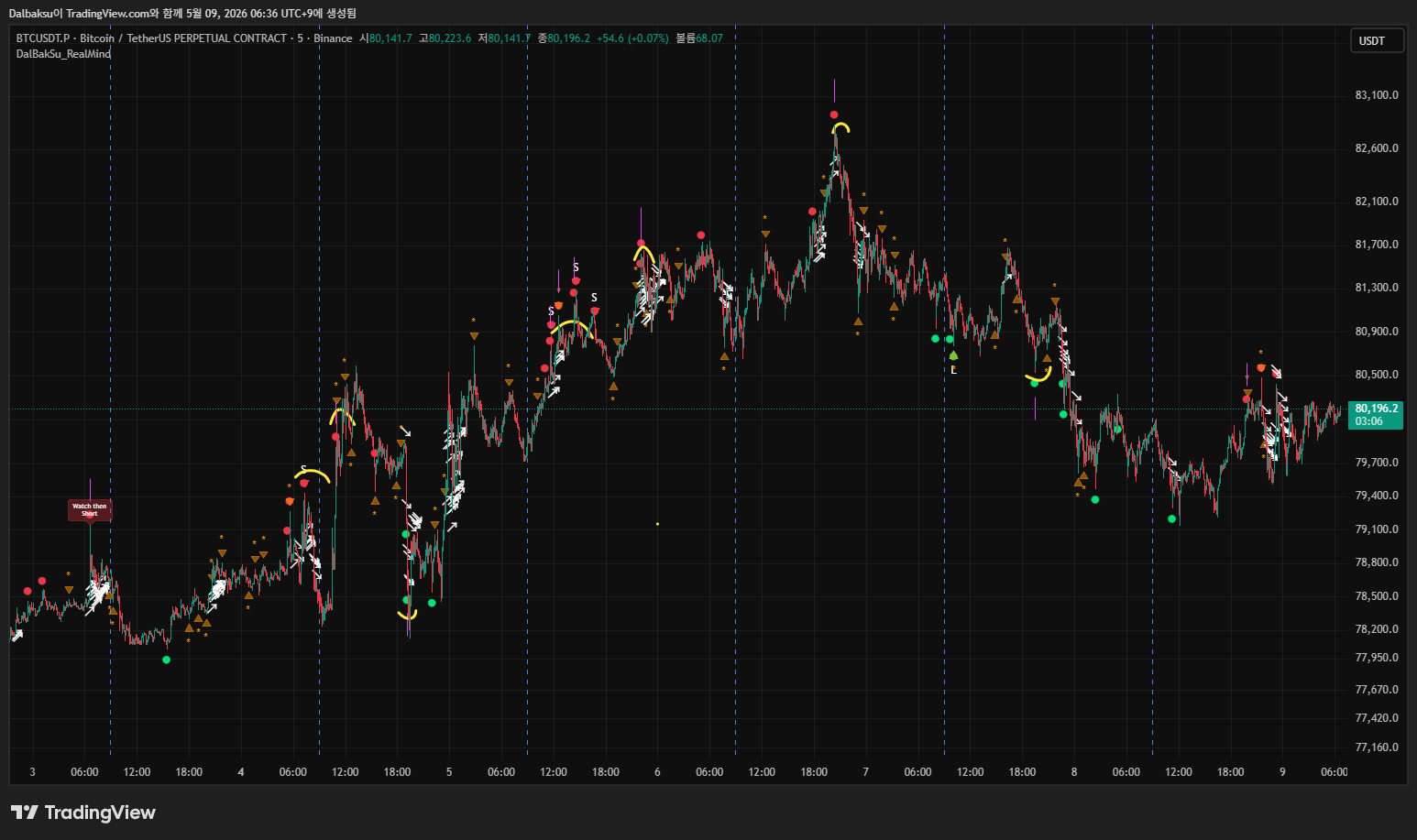
We are in May 2026. Bitcoin made its all-time high late last year — a moment of arrival that felt, for a few weeks, like resolution. Then came the correction. Sharp, then slow, then quiet. The kind of quiet that is not peace but recalibration.
Now the market is recovering. Not loudly. There is no euphoria in the order books, no headlines declaring a new era. Just structure, returning gradually — like soil that has absorbed enough rain to begin, again, to hold shape.
This is the part that is hardest to sit with. The move has already happened. The next move has not yet declared itself. What remains is the in-between: liquidity finding its level, conviction being tested without resolution, the market breathing in a register that most participants mistake for stagnation.
It is not stagnation.
It is the middle of the story. The roots are deciding their direction. The work being done right now — invisible, unannounced — is exactly the work that Maia presided over. Not the planting. Not the harvest. The part that happens in between, when patience is the only instrument that matters.
The Roman farmer standing at the edge of his field in the first week of May would have recognized this feeling exactly.
III. Maia and the Market
Growth as a System
There is a reason this series begins with Maia rather than with a chart.
It is not nostalgia for mythology. It is not an attempt to make financial analysis feel more poetic than it is. It is because the ancients who built Maia’s significance into the calendar were, in their way, doing what good analysts do: they were identifying the structure beneath the visible surface.
They had observed — across generations of farming, across enough seasons to see patterns that a single lifetime might miss — that growth was not random. It was staged. It followed a sequence that could be understood, even if it could not always be predicted.
Seed. Root. Stem. Bloom.
Each stage different from the last. Each requiring different conditions, different patience, different kinds of attention. The darkness and moisture that help a seed germinate would rot a flower. The wide light that opens a bloom would be wasted on a root that isn’t ready for it. You cannot accelerate the sequence by wanting the later stages to arrive sooner. You can only understand where you are in it, and act accordingly.
Markets move the same way.
Not because markets are natural — they are human constructions, complicated and strange. But because the humans who move through them are still, underneath everything, the same kinds of creatures who stood at the edge of fields in the Campanian plain, watching soil that had not yet shown them what it would become.
And within a single day, this sequence plays out in miniature — not over weeks or months, but over hours.
The market opens in Sydney. It is early morning, liquidity is thin, and the session moves with the tentative quality of something just beginning — probing direction before most of the world is watching. Tokyo receives what Sydney started and gives it structure: building, stabilizing, establishing the shape of the day. London arrives and the tone changes — participation deepens, volume increases, the move that was taking form in Asia begins to declare itself. New York completes the picture. What was planted in the first hours of the day either holds or it doesn’t.
Four sessions. Four stages.
Not separate events, but a single continuous process — a growth cycle compressed into twenty-four hours, carrying within it the same essential logic that Maia represented two thousand years ago.
The Framework of This Series
This series will follow that process — session by session, stage by stage — as a practical way of reading how market structure develops through a trading day.
Sydney — The Seed. Direction begins before most participants are watching. Low liquidity, early signals, the first suggestion of what the day might become.
Tokyo — The Root. Structure forms in relative quiet. The work of the root: not visible, but necessary. What builds here will either support what follows, or won’t.
London — The Stem. Momentum arrives with participation. The move becomes visible. The day starts to commit to its direction.
New York — The Bloom. Revelation. The day shows what it actually was. Confirmation or contradiction, but rarely ambiguity.
Together, they form a system — one that the Roman farmers who honored Maia on the first of May might not have named in these terms, but would have, perhaps, understood.
Growth moves in stages.
Each stage prepares the one that follows.
And the month that carries Maia’s name — this month, this threshold where the cycle is most visibly alive — is, in both its ancient and its modern meanings, exactly where that understanding matters most.
May is not the month when growth begins.
May is the month when growth becomes visible.
And visible growth, for those who have learned to read the stages that preceded it, is not an ending.
It is a beginning of a different kind.
A Closing Verse, After the Old Manner
Before the name of emperors was pressed upon the year, Before the Senate bent the months to flatter those in power, There was a word the farmers kept — worn smooth, but held sincere — The name of one who asked for nothing, only tended every hour.
Old Maia knew the root’s dark work, the seed’s long silent wait, The way that growth withholds itself before it breaks the ground — She did not grant the harvest, only kept the process straight, And offered to the patient ones the yield they’d one day found.
So now the market breathes the same, in sessions old as trade, In Sydney’s dark and Tokyo’s calm and London’s rising tide — The structure forms before the move, the bloom before the blade, And New York only shows the fruit the roots had grown inside.
Then read the month for what it is: not crisis, not a wall, But Maia’s oldest teaching — that the hidden stage is all.