The Hidden Cost of Fragmented Care in Therapy
 EvoCare Holding AG3 min read·Just now
--
Why continuity, coordination, and connected care journeys matter more than ever
One of the most underestimated problems in therapy is not access alone.
It is fragmentation.
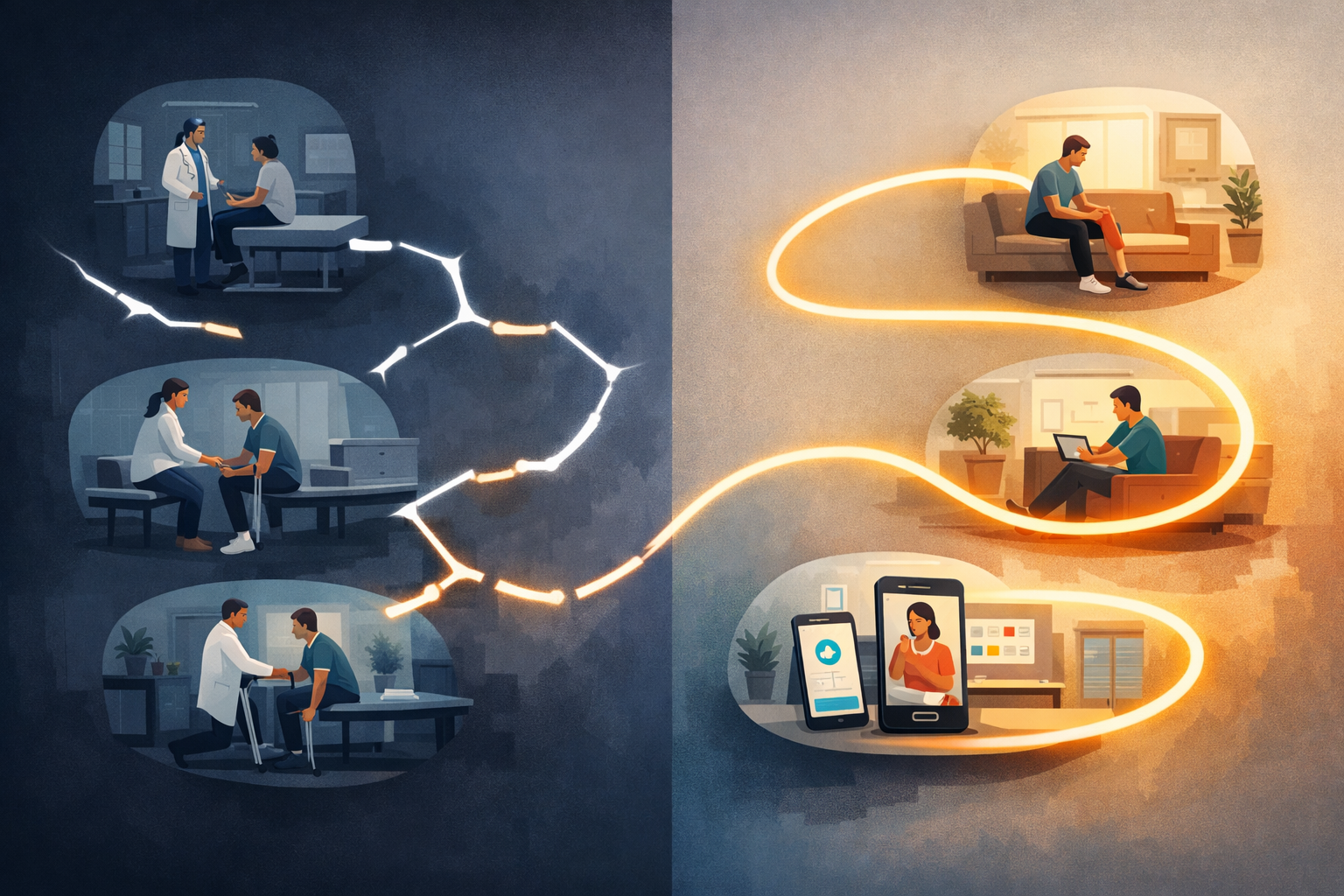
Many patients do not move through therapy in one smooth, connected journey. Instead, they move across different providers, care settings, systems, and treatment phases. Information gets repeated. Monitoring becomes inconsistent. Administrative friction increases. Even when the quality of an individual session is high, continuity across the broader care journey can still break down.
And that has consequences.
Therapy does not happen in isolated moments
Therapy outcomes are not shaped only by what happens in one session.
They are also shaped by what happens between sessions, across treatment stages, and at the handoff points between different parts of the system. Progress depends on continuity, coordination, visibility, and follow-up over time.
When that continuity is missing, even good therapy can become harder to sustain.
Patients may lose momentum.
Support may become inconsistent.
Follow-up may weaken.
And progress can be slowed down by avoidable breaks in the care journey.
Fragmentation creates friction at every handoff
A fragmented care journey rarely fails all at once.
Instead, it creates small points of friction again and again.
That can look like:
- repeated patient information across providers
- unclear next steps after treatment phases
- weak follow-up after appointments
- disconnected home-based support
- inconsistent monitoring and progress tracking
- administrative effort that slows down care delivery
Each individual gap may seem manageable. But together, they create a system that is harder to navigate, harder to coordinate, and harder to scale.
This is why fragmentation is not just an operational issue.
It is a strategic one.
Why continuity matters so much in therapy
In therapy, continuity is not a nice-to-have.
It is part of the therapeutic value itself.
Patients benefit when support feels connected over time.
Therapists benefit when pathways are structured and follow-up is easier to maintain.
Healthcare systems benefit when care becomes more coordinated, visible, and efficient.
Better access is important.
But access without continuity can still lead to weaker outcomes.
That is why the conversation in digital health should not only focus on getting people into therapy. It should also focus on how people stay supported throughout the full therapeutic journey.
Connected digital infrastructure can change this
This is exactly where connected digital infrastructure becomes meaningful.
The goal should not simply be to digitize isolated steps.
The goal should be to connect the journey.
That means enabling:
- clearer workflows
- better coordination across touchpoints
- more structured follow-up
- easier access to ongoing support
- better visibility into progress over time
When digital systems are designed well, they can reduce fragmentation rather than add to it. They can help therapy become more usable, more consistent, and more effective over time.
Why this matters for EvoCare
For a platform like EvoCare, this is a core principle.
The goal is not just to put therapy online.
The goal is to create a more connected therapeutic environment in which digital programs, professional supervision, therapeutic content, and patient pathways interact more seamlessly.
That is an important distinction.
Digital therapy should not mean disconnected tools or isolated features.
It should mean better-connected care.
This is where EvoCare’s broader platform approach becomes relevant: linking patients, therapists, digital support, and structured pathways in a way that improves continuity across the care journey.
The real opportunity is not only better access, but better connected care
Healthcare often talks about access, capacity, and efficiency.
Those are all important.
But continuity deserves much more attention.
Because in many cases, the real hidden cost of fragmented care is not just inconvenience.
It is lost momentum, weaker engagement, reduced visibility, and a less connected therapeutic experience for everyone involved.
Better therapy does not only require access.
It also requires continuity.
Looking ahead
The future of therapy should not only be more digital.
It should also be more connected, more structured, and better coordinated across the full care journey.
That is the direction healthcare needs.
And that is the direction EvoCare is building toward.
To learn more about EvoCare and our vision, visit:
evocare.healthcare