The Hard Money Barbell
Navigating the Schiff-Saylor Liquidity Divide
--
by Sheni Ogunmola
Capital capture is not about predicting the future; it is about establishing asymmetric leverage.
Right now, the macroeconomic landscape is dominated by a fierce ideological battle. On one side, traditional hard-money advocates point to sticky inflation and geopolitical instability as the ultimate catalyst for physical gold and silver. On the other, digital asset proponents argue that software-based scarcity is the only logical lifeboat for the coming tsunami of global M2 expansion.
If you are deploying capital based on ideological loyalty to one of these camps, you are operating with a massive blind spot. Here is the objective data driving my current market positioning, and why I am aggressively enforcing the Dhandho methodology to protect capital.
The Macro Reality: Diagnosing the Disease Both sides of the aisle have correctly identified the underlying macroeconomic disease: fiat debasement is structurally inevitable.
The debt burdens of sovereign nations guarantee that central banks must eventually expand the money supply to service their obligations. At the same time, localized supply chain disruptions and energy shocks are keeping inflation uncomfortably sticky.
The traditionalists are right: When inflation runs hot, physical scarcity acts as a necessary anchor. The digital maximalists are also right: When global liquidity expands, capital naturally flows to the most frictionless, verifiable networks.
The flaw is in believing you must choose only one.
The Dhandho Pivot: The Barbell Strategy My entire operational framework is built on a single principle: “Heads I win, tails I don’t lose much.” This principle demands that downside risk is tightly capped before any upside is considered.
In the current environment, taking a maximalist position in any single asset class violates the margin of safety. Instead, I am executing a strict Barbell Strategy:
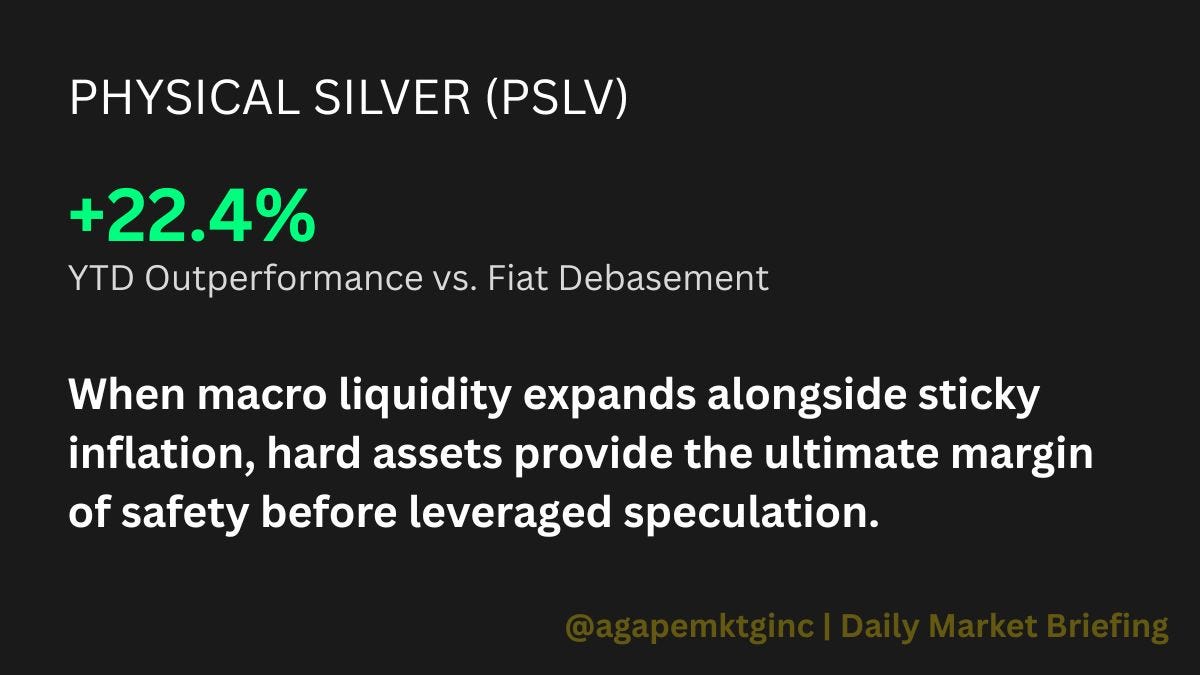
The Margin of Safety (Physical Assets): I am securing the downside by accumulating physical metals and highly efficient royalty companies (specifically $PSLV, $PHYS, and $WPM). These assets possess zero counterparty risk and provide a localized hedge against sticky inflation. They ensure the baseline value of the portfolio survives the immediate turbulence.
The Asymmetric Upside (Digital Assets): With the baseline protected, I am leveraging the current delayed-rate-cut washout to selectively accumulate high-conviction Layer-1 protocols like $ETHA at a significant discount. I am not trading the volatility; I am acquiring digital scarcity while the market prices in short-term fear.
This is the essence of defensive accumulation. I am not attempting to time the absolute bottom of either market. I am establishing a margin of safety, protecting the downside, and letting the mathematics of compounding take over once the macro liquidity settles.
The Infrastructure of Leverage Retail markets trade on ideology and short-term news cycles. Institutional capital allocates based on structural reality. The difference is not intelligence; it is the infrastructure used to filter the data.
You do not need to predict the future, and you do not need to pick a side in the timeline wars. You need a system that ensures your upside is uncapped while your downside is strictly protected.
I built the Risk Matrix Pro Terminal to enforce this exact discipline. It is the proprietary architecture I use to isolate market anomalies, track liquidity expansion, and force a strict margin of safety before capital is ever deployed.
Stop trading the on prediction models, charts and emotions. Start building measurable leverage by calculating you entry and exit points, and you gains and possible losses before you make each trade using the Risk Matrix Pro Terminal.
The Influencer Reply Strategy (Copy & Paste Framework) To siphon traffic natively, you must reply to Schiff or Saylor within the first 60 minutes of them posting. Do not drop links. Use this script to drive them to your profile:
If Michael Saylor posts about fiat collapsing:
“Structurally entirely correct on the M2 expansion timeline. But the immediate Dhandho play requires a margin of safety while rates remain sticky. I’m accumulating the discounted layer-1s, but anchoring the downside with $PSLV first. The Barbell strategy survives the chop.”
If Peter Schiff posts about Gold/Silver breaking out or Crypto crashing:
“The breakout in $PSLV and $WPM is confirming the sticky inflation data perfectly. Physical scarcity is the ultimate margin of safety right now. But dismissing the asymmetric upside of discounted digital networks during this washout leaves leverage on the table. Capital requires both.”