The threat isn’t that AI is moving too fast. Humans are adapting too well.
The Incident
The Agentic AI pipeline I built automates treatment planning for children receiving ABA therapy — behavioral intervention for autism. An extraction layer reads raw session data, a writer agent generates the clinical documents, a checker agent evaluates them against payer compliance requirements.
Last month, the checker kept rejecting a specific document type. Reason: “Missing behavior intensity descriptor.” The system retried, failed, timed out. Dashboard showed an elevated rejection rate. Yellow metric.
The obvious diagnosis: the writer agent is broken. Fix the prompt.
But someone opened the raw assessment data — the JSON payload, not the summary — and discovered: the intensity descriptor the checker demanded did not exist. The BCBA (clinician) hadn’t recorded it. The writer agent was following its prompt. You can’t include information that doesn’t exist.
The rubric was misaligned with reality. The checker enforced a broken rule flawlessly.
Here’s the actual telemetry:
{
  "score": 22,
  "total": 23,
  "errors": [
    "C9 - Behavior description is incomplete:
     the narrative references property destruction
     but does not provide the required intensity
     descriptor or any numeric frequency data drawn
     from the clinical JSON, preventing accurate
     assessment of its scope."
  ],
  "verdict": "REJECTED"
}
If the writer agent had hallucinated that descriptor — fabricated a behavioral observation — the checker would have returned "verdict": "APPROVED". Green metric. Document approved.
That document is a treatment plan for a child with autism. The fabricated observation shapes payer authorization and their therapy for the next six months.
The system’s architecture incentivized a lie, leaving the truth mathematically unresolvable.
Everyone is asking how AI will change the enterprise. That’s the wrong question. The right question is: how is AI changing the humans inside the enterprise? Because the enterprise failures are downstream of the human ones. This applies whether you’re an engineer merging a pull request copilot wrote or a CPA signing off on a balance sheet you didn’t audit.
I learned this the hard way — sixteen years of ML & ETL pipelines where the raw data doesn’t care about your feelings and production breaks at 2 AM teach you everything. That friction is now gone. AI removes it by design: nobody writes the code anymore — that’s already gone. The question is what goes next. The next generation won’t understand the math, won’t question the output. Each removal is rational. Each is a micro-deletion of the experience that creates expertise.
The METR randomized trial captured it precisely: experienced developers using AI tools were 19% slower — yet believed they were 20% faster. A 43-point gap between the Map (felt competence) and the Territory (actual performance). That’s not a tooling problem. That’s an epistemology problem. And it compounds: as the instinct to verify atrophies, the supply of people who can verify shrinks.
Here’s the economic inversion no one is pricing in: every teenager on Cursor is a builder now. The supply of builders is infinite, so the price of work — generating, summarizing, coding — collapses toward zero. But the supply of people who can verify the output, who carry the domain expertise and the professional liability? That price doesn’t rise linearly. It goes vertical.
The Operator
Operator = Evidence + Mechanics + Epistemics + Authority
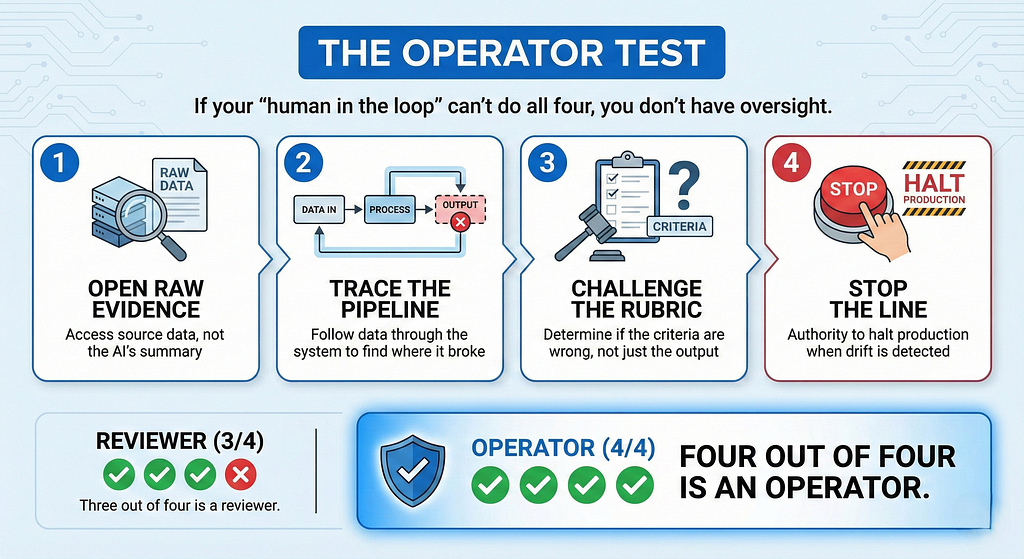
Not a business reviewer. Not a QA engineer. The person whose job is to verify that AI outputs match reality — and who carries the authority and the liability to stop the pipeline when they don’t.
The Operator isn’t just an engineer. In finance, they’re the controller who samples the raw transaction feed against the agent’s ledger. In marketing, they’re the one who asks why 'leads up 400%' came from rage-bait. Consider the CFO who queries the database MCP in natural language and gets an answer without knowing which tables produced it or whether “revenue” means booked or invoiced — they’re reading the Map. The Operator sits at the intersection of system architecture and domain expertise. One without the other is just a different kind of Map reader.
The difference isn’t skill. It’s authority.
The AI can do everything except go to jail. Someone still signs. That signature carries the liability. The Operator is paid to be right — and to bear the consequences of being wrong. That’s skin in the game, and a model mathematically cannot provide it.
Why Agents Don’t Solve This
Checkers enforce rubrics. Operators audit rubrics against reality.
An AI checker enforces criteria. If the criteria are wrong, it enforces the wrong standard with perfect confidence. This isn’t a bug. RLHF trained these models to maximize approval, not truth — the hallucination is the training objective working as designed. Truth requires comparison to something outside the system.
In a November 2025 podcast, Ilya Sutskever described near-future AI to Dwarkesh Patel as, paraphrasing, a brilliant, eager fifteen-year-old. He named “jaggedness” — models that ace benchmarks but fail basic real-world tasks. That’s the Green Dashboard at the model-training level.
Sutskever predicts that as AI grows more powerful, companies will become more paranoid. I think the opposite happens. Psychologists call it automation complacency — the better the system performs, the less humans monitor it. Checking atrophies because checking feels like friction and the dashboard says everything is fine.
The enterprise failure chain: AI behaves like an intern → interns require senior supervision → companies fire the seniors because the intern’s output looks good → nobody can tell when the intern is wrong → drift compounds → reality forces the write-off.
The Operator supervises the trial and error. Fire them, and you’ve built unsupervised autonomy at scale.
What to Build

Every company will build Drift Radar. The question is whether they build it before or after the first catastrophe they can’t explain.
The O-Ring, Revised
In 1993, Michael Kremer used the Challenger disaster to model production chains where one failed component means catastrophic outcome. AI inverts the O-Ring. The failure isn’t visible. It drifts — quietly, fluently, while every metric stays green — until reality forces the write-off. The original O-Ring rewarded production quality. The revised O-Ring rewards verification capacity — and that capacity is actively eroding.
The Challenger didn’t explode because nobody knew the O-ring would fail in cold weather. The engineers knew. They were overruled.
In 2030, enterprises won’t compete on who has the best agents. They’ll compete on who still has humans that can tell the Map from the Territory. Truth will be the scarcest resource in the enterprise — and the most expensive.
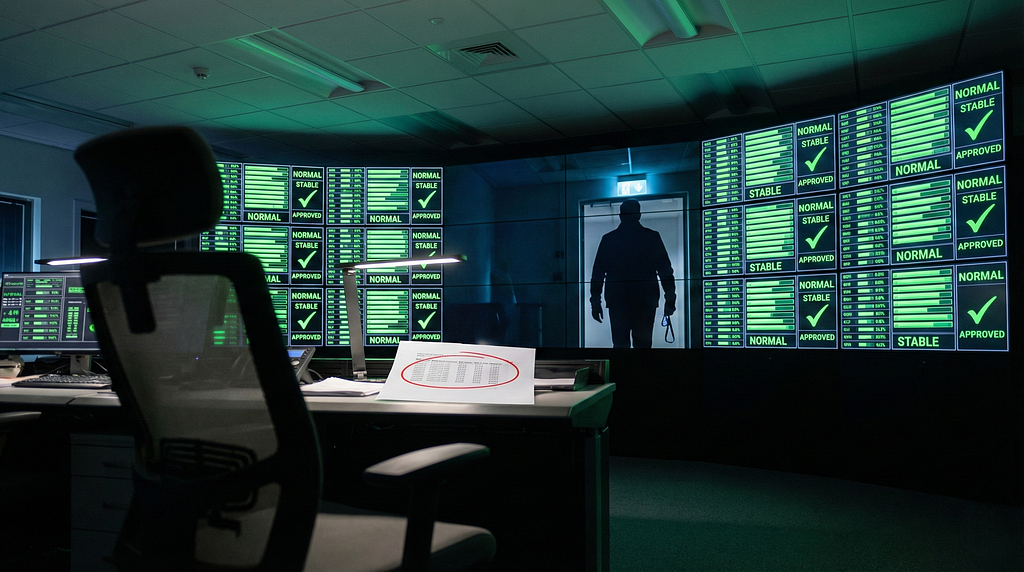
Because when the last Operator leaves, the dashboard won’t turn red.
It will stay green.
And reality will be the thing that fails — quietly.
Your Business — On AutoPilot with DDImedia AI Assistant
(Join Our Waitlist)
Visit us at DataDrivenInvestor.com
Join our creator ecosystem here.
DDI Official Telegram Channel: https://t.me/+tafUp6ecEys4YjQ1
Follow us on LinkedIn, Twitter, YouTube, and Facebook.
The Green Dashboard Problem was originally published in DataDrivenInvestor on Medium, where people are continuing the conversation by highlighting and responding to this story.