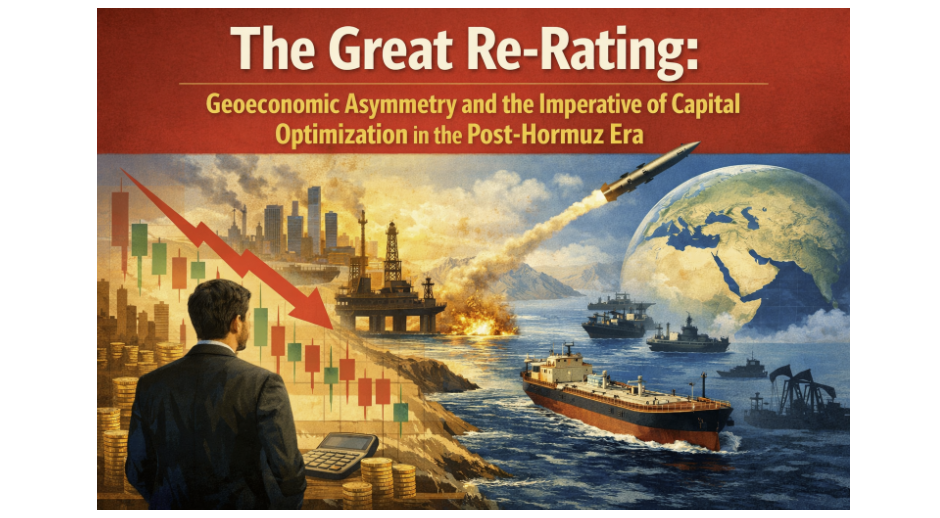
The Great Re-Rating: Geoeconomic Asymmetry and the Imperative of Capital Optimization in the Post-Hormuz Era
 Ferran Frances-Gil7 min read·Just now
--
Introduction
The global economy of 2026 stands at a precipice, characterized by the catastrophic disruption of energy flows through the Strait of Hormuz. Following the definitive declaration by Fatih Birol, Executive Director of the International Energy Agency (IEA), that this represents the most severe energy crisis in human history — surpassing the shocks of 1973, 1979, and 2022 combined — the financial architecture of the industrial world is under existential pressure. This paper argues that the traditional methods of managing capital are insufficient to meet a crisis of this magnitude. By integrating the paradigms of “Strategic Capital Optimization” and “Decentralized Financial Disintermediation,” this study proposes a radical shift in how multinational corporations and financial institutions must utilize SAP-driven architectures to navigate the scarcity of capital. Through the lens of real-time intelligence and the “Financial P2P” model, we explore a future where capital is not merely a compliance metric but a dynamic, optimized strategic resource.
I. The Hormuz Nexus: A New Paradigm of Scarcity
The closure of the Strait of Hormuz in early 2026 has fundamentally rewritten the rules of global energy security. As the International Energy Agency (IEA) recently confirmed, the world is no longer dealing with a temporary supply-side fluctuation but a systemic collapse of the energy-finance equilibrium. Fatih Birol’s recent statements to Le Figaro underscore a grim reality: the blockade has choked off approximately 20% of the world’s petroleum and liquefied natural gas (LNG) supplies. This is not merely a crisis of “prices” but a crisis of “availability,” leading to a cascading effect across global supply chains.
The IEA’s assessment highlights a “Triple Shock” — the simultaneous disruption of oil, gas, and food security. Unlike the 1970s, where the global financial system was less interconnected, the 2026 crisis hits an economy already burdened by high debt levels and fragile just-in-time logistics. The resulting geoeconomic asymmetry has led to “The Great Re-rating,” where the cost of capital is being recalibrated against the backdrop of energy-driven inflation and logistical paralysis.
In this environment, capital itself has become the scarcest resource. The traditional “buffer” of cheap liquidity has evaporated, replaced by a desperate need for what we term “Capital Intelligence.” To survive this era, organizations must move beyond passive accounting and toward the active orchestration of capital.
“We are witnessing the first truly global energy crisis; the world has never seen a disruption of this complexity, depth, and scale, making the shocks of the 1970s appear localized by comparison.” — Fatih Birol, IEA Executive Director, April 2026.
II. Orchestrating Capital Optimization Through SAP Planning
As we navigate this “Great Re-rating,” the primary challenge for large-scale enterprises is the optimization of Risk-Weighted Assets (RWA) and the preservation of the Economic Value of Equity (EVE). The current crisis demands a transition from static financial reporting to a dynamic SAP-enabled planning environment.
The first pillar of the solution lies in the concept of Capital Optimization as a Strategic Lever. Traditionally, capital management has been relegated to the treasury department as a secondary function of cash management. However, in the post-Hormuz economy, capital is a finite strategic asset. By utilizing advanced SAP modules such as SAP Bank Analyzer, SAP Financial Products Subledger (FPSL), and SAP Profitability and Performance Management (PaPM), organizations can achieve a level of granular visibility previously thought impossible.
The “Clean Core” Strategy
Central to this optimization is the “Clean Core” strategy. The complexity of legacy IT landscapes often hides “trapped capital” — liquidity and assets that cannot be efficiently deployed due to fragmented data. A standardized, “Clean Core” SAP architecture allows for the real-time flow of financial information. This is essential for managing the volatility caused by the Hormuz crisis. When energy prices swing by 15% in a single trading session, a company’s capital requirements shift instantly. Only an integrated planning environment can provide the simulation capabilities necessary to predict how these shifts affect RWA and overall solvency.
RWA and EVE Dynamics
In a high-inflation, high-risk environment, the optimization of Risk-Weighted Assets becomes the difference between growth and bankruptcy. SAP PaPM enables organizations to perform complex calculations at the speed of business, allowing for the simulation of “What-If” scenarios. For instance, what is the impact on the balance sheet if the Hormuz blockade lasts another six months? How does the volatility in the Persian Gulf affect the cost of hedging? By automating these calculations through a unified data model, firms can optimize their capital structure in real-time, ensuring that every dollar of equity is supporting the highest possible value-add activity.
“In an era of structural scarcity, capital is no longer a passive accounting entry but a strategic variable that must be orchestrated with the same precision as a physical supply chain.” — Industry Analysis on Treasury Transformation, 2025.
III. Radical Financial Disintermediation: The SAP-Enabled P2P Model
While internal optimization is crucial, the macro-level solution to the capital crisis requires a radical rethinking of how financial capital is distributed globally. If the Hormuz crisis has taught us anything, it is that centralized dependencies — whether in energy routes or financial clearinghouses — are points of failure.
This brings us to the second pillar: The Financial Disintermediation Model, or what has been termed “Financial P2P” (Peer-to-Peer). In the current landscape, corporate banking often acts as a friction-heavy intermediary, adding costs and delays to the movement of capital.
The “Financial Airbnb” Concept
Imagine a decentralized system where corporate entities can directly trade capital and credit capacity without the traditional banking “spread.” This model utilizes the massive global data footprint of SAP systems. Because SAP handles approximately 77% of the world’s transaction revenue, the data for a “Financial P2P” network already exists within the SAP ecosystem.
By leveraging this data, companies can create a “Financial Airbnb” for capital. If a multinational in Germany has excess liquidity while a manufacturer in Brazil faces a capital crunch due to energy costs, they could, in theory, engage in a direct financial transaction facilitated by a trusted, data-driven platform. The SAP system acts as the “Truth Provider,” verifying the financial health and collateral of both parties in real-time.
Disintermediation and Resilience
This radical shift serves as a direct counter-measure to the Hormuz crisis. When traditional banking channels become congested or risk-averse during a global shock, a P2P finance model provides an alternative “vascular system” for the global economy. It democratizes access to capital and reduces the systemic risk of a “credit crunch.”
This model does not eliminate banks but redefines them. Banks must transition from being “gatekeepers” to being “service providers” within a P2P ecosystem — offering specialized risk assessment, legal frameworks, and advanced SAP-integrated treasury services.
“The democratization of corporate credit through peer-to-peer frameworks represents the ultimate resilience strategy against the systemic failures of centralized financial gatekeeping.” — Global Finance Report: The Digital Synthesis, 2026.
IV. Synthesis: The Digital Synthesis of Energy and Finance
The synthesis of these frameworks — one focusing on internal Capital Optimization and the other on external Financial Disintermediation — provides a comprehensive roadmap for the 2026 economy.
Phase 1: Internal Intelligence. Companies must first fix their “digital house” by adopting a Clean Core SAP strategy. This provides the “Capital Intelligence” needed to understand their own RWA and EVE exposure in the face of the IEA’s warned “Triple Shock.”
Phase 2: Collaborative Optimization. Once internal visibility is achieved, organizations can move toward SAP-enabled planning, where capital is moved dynamically within the enterprise to where it is most needed to combat energy-driven disruptions.
Phase 3: Ecosystem Disintermediation. Finally, the global SAP community can move toward a P2P finance model. This creates a more resilient, decentralized global financial architecture that is less susceptible to the geopolitical “choke points” like the Strait of Hormuz.
“Survival in the post-Hormuz landscape requires a dual-track approach: radical internal data discipline coupled with the external decentralization of capital flows.” — Strategic Review on Geoeconomic Asymmetry, 2026.
V. Conclusion: Beyond the Crisis
Fatih Birol’s warning about the Strait of Hormuz is a wake-up call. We are moving into a “Long Emergency” where the old assumptions of cheap energy and abundant capital are dead. The “Great Re-rating” is the market’s way of pricing in this new reality.
However, within this crisis lies the opportunity for a “Digital Synthesis.” By treating capital as a strategic resource to be optimized via advanced SAP architectures and by embracing the radical potential of P2P financial disintermediation, we can build a more robust global economy. The tools for this transformation — SAP Bank Analyzer, PaPM, FPSL, and the global SAP data network — already exist. The challenge now is not technological, but one of architectural vision and strategic will. We must transition from being victims of geoeconomic shifts to being architects of capital intelligence.
“The crisis of the present is the laboratory of the future; where the physical world closes its gates, the digital world must open its networks to ensure the persistence of global value.” — Perspectives on Economic Continuity, 2026.
Connect and Stay Informed:
Join the Conversation: Connect with fellow professionals in the SAP Banking Group on LinkedIn. https://www.linkedin.com/groups/92860/
Stay Updated: Subscribe to the SAP Banking Newsletter for the latest insights. https://www.linkedin.com/newsletters/sap-banking-6893665983048081409/
Join my readers on Medium where I explore Capital Optimization in depth. Follow for actionable insights and fresh perspectives https://medium.com/@ferran.frances
Explore More: Visit the SAP Banking Blog for in-depth articles and analyses. https://sapbank.blogspot.com/
Connect Personally: Feel free to send a LinkedIn invitation; I’m always open to connecting with like-minded individuals. [email protected]
I look forward to hearing your perspectives.
Kindest Regards,
Ferran Frances-Gil.
#FinancialTwin #SAP #S4HANA #UniversalJournal #CapitalOptimization #DigitalFinance #EnterpriseArchitecture #PredictiveAccounting #ContinuousClose #SAPBusinessNetwork #SupplyChainFinance #AssetCollaboration #RealTimeFinance #CFOAgenda #AutonomousEnterprise #GreenLedger #FerranFrances