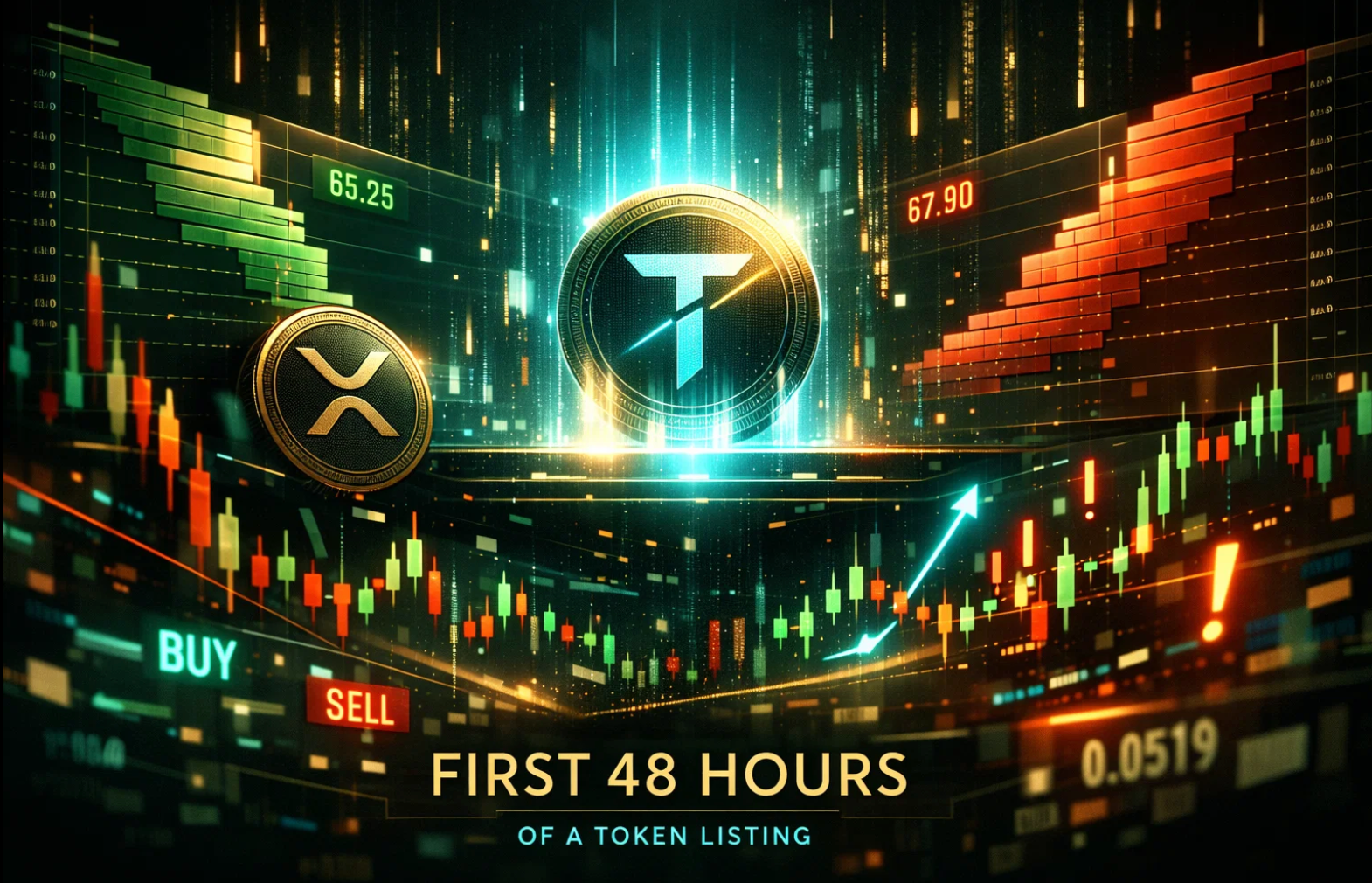
The First 48 Hours: Why Most Crypto Listings Fail (And How to Win)
 Sergio Larkins3 min read·Just now
--
The first 48 hours after a token listing are not just important — they are decisive. This is the phase where narrative meets execution, and in most cases, execution quietly loses.
While retail participants focus on short-term price action — watching 1-minute candles and chasing momentum — more experienced players are looking elsewhere: order book structure, liquidity provisioning, and how well the launch was actually engineered. Even in a market where majors like XRP are moving aggressively, a poorly structured listing will underperform. Momentum alone doesn’t fix weak infrastructure.
Where Most Listings Break
The failure patterns are surprisingly consistent.
The first issue is the absence of a defined market-making strategy. Without clear parameters — spreads, depth targets, volatility control — the price becomes reactive rather than managed. In this vacuum, bots dominate the flow, creating artificial volatility and quickly eroding confidence.
Liquidity is the second weak point. Thin order books and wide spreads are not just cosmetic issues — they directly affect execution quality. In low-depth environments, even relatively small orders can move the price significantly. For larger participants, this is a red flag. If entering or exiting a position introduces measurable slippage, they simply stay out.
Tokenomics often amplify the problem. A low circulating supply paired with a high fully diluted valuation creates structural imbalance. Launching with 1–2% of supply unlocked at an inflated valuation might look attractive on paper, but in practice, it leaves no room for sustainable price discovery. What follows is usually a slow bleed rather than a sharp correction.
Then comes the unlock dynamic. Vesting schedules are public, but absorption strategies rarely are. When early investors begin to realize liquidity, the market often lacks sufficient buy-side depth to absorb that supply. The result isn’t always immediate — but it is predictable.
Finally, there’s the misconception that listing equals completion. In reality, listing is just the starting point. Without a post-listing activation strategy — whether through trading incentives, ecosystem engagement, or sustained narrative — the initial demand premium fades quickly. In many cases, within the same 48-hour window.
Context That Quietly Matters
Recent market structure only reinforces these dynamics. Liquidity across altcoins remains fragmented, with capital heavily concentrated in majors and ETF-driven flows. This creates a more selective environment, where new listings are competing not just with each other, but with established assets offering tighter spreads and deeper markets.
At the same time, funding rates and short-term speculative positioning tend to spike around new listings, often exaggerating early moves. Without proper liquidity support, these conditions accelerate both the upside — and the unwind.
None of this guarantees failure. But it does set the baseline.
What Actually Determines Survival
A successful listing is rarely about hype. It’s about coordination.
Projects that treat liquidity as infrastructure — not as an afterthought — tend to stabilize faster. Those that align tokenomics with actual market depth avoid unnecessary volatility. And teams that plan beyond the listing moment itself are the ones that retain attention after the initial spike fades.
In other words, the first 48 hours don’t just reflect demand. They reveal whether the market is dealing with a tradable asset — or just another short-lived event.
👉 Check out the full breakdown and more reasons in the latest article here.