The Fallback Framework: Why 99.9% Uptime is No Longer Enough for High-Risk Success
 Chloe Johnson5 min read·1 hour ago
--
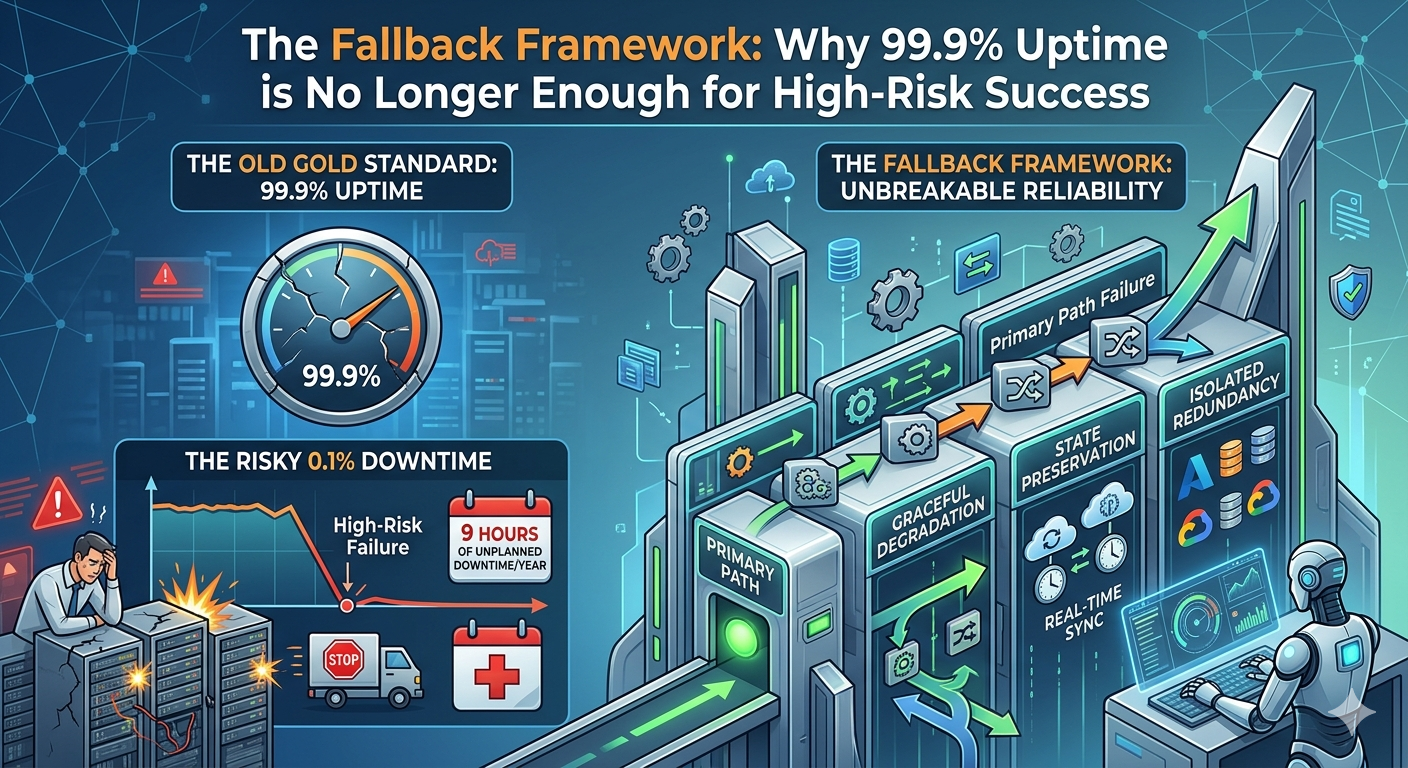
In the digital age, we have long been conditioned to view “three nines” — 99.9% uptime — as the gold standard of reliability. For a decade, this metric represented the pinnacle of engineering achievement for most SaaS platforms and digital services. However, as we move further into an era defined by autonomous systems, high-frequency financial shifts, and integrated global infrastructure, that remaining 0.1% of downtime has transformed from a minor inconvenience into a catastrophic liability. In high-risk environments, “mostly reliable” is just another way of saying “eventually broken.”
To achieve true high-risk success, organizations must shift their philosophy from simple uptime tracking to a Fallback Framework. This approach acknowledges that failure is inevitable and focuses on how a system behaves when the primary path disappears.
The Illusion of Three Nines
When we talk about 99.9% uptime, we are essentially agreeing to nearly nine hours of unplanned downtime every year. In a standard consumer application, nine hours of outages spread over twelve months might result in a few frustrated tweets and a dip in quarterly engagement. But in high-risk sectors — think robotic surgery, automated power grids, or real-time clearing houses — nine hours of “darkness” can result in the loss of millions of dollars per minute or, worse, the loss of human life.
The problem with the 99.9% metric is that it measures existence, not quality or context. A system might be “up,” but if its latency has spiked to the point of being unusable, or if its data integrity is compromised, that “uptime” is a lie. High-risk success requires us to look past the binary of on/off and toward a more nuanced understanding of system resilience.
Defining the Fallback Framework
The Fallback Framework is a strategic pivot. Instead of pouring every resource into making the primary system “unbreakable,” an organization accepts the fragility of complex systems and builds sophisticated, automated secondary and tertiary pathways. It is the difference between building a sturdier dam and building a dam with a series of intelligently routed spillways.
A robust Fallback Framework relies on three core pillars: Graceful Degradation, State Preservation, and Isolated Redundancy.
1. Graceful Degradation: The Art of Failing Well
Most systems are designed to be all-or-nothing. When a database connection fails, the entire front end throws a 500 error. In a Fallback Framework, we utilize graceful degradation. If the high-intensity personalization engine fails, the system should automatically revert to a static, “good enough” version of the interface.
In high-risk scenarios, this means prioritizing critical functions over “nice-to-have” features. If a logistics network loses its AI-driven route optimization, it should immediately fall back to a pre-cached, rule-based routing system. The goal isn’t to keep the whole ship running perfectly; it’s to ensure the ship doesn’t sink while you fix the engines.
2. State Preservation and Seamless Handoffs
One of the most dangerous moments in any system failure is the “handoff.” When a primary server fails and a backup takes over, there is often a “memory gap” where the last few seconds of data are lost. In high-stakes environments, those seconds are everything.
Modern reliability requires “hot-warm” or “hot-hot” configurations where state is synchronized in near real-time across geographically dispersed nodes. This ensures that if the primary system vanishes, the fallback system isn’t starting from scratch — it knows exactly where the user was, what the sensor read, and what the last command issued was.
3. Isolated Redundancy: Breaking the Chain
Traditional redundancy often fails because the backup is too similar to the primary. If a bug in a specific Linux kernel causes the primary server to crash, and the backup server is running the exact same kernel, it will likely crash too. This is known as a correlated failure.
High-risk success demands isolated redundancy — using different codebases, different cloud providers, or even different hardware architectures for the fallback systems. This “diversity of tech” ensures that a single systemic vulnerability cannot take down the entire operation.
The Cost of Silence: Why We Overlook Resilience
Building a Fallback Framework is expensive and unglamorous. It involves writing code that you hope will never run and buying hardware that you hope will sit idle. Because of this, many executives struggle to justify the ROI. However, the cost of a fallback system must be weighed against the “Total Cost of Failure.”
When a high-risk system fails, the costs aren’t just technical. They are legal, reputational, and regulatory. In 2026, the “move fast and break things” era has been replaced by the “be resilient or be replaced” era. Clients and stakeholders are no longer asking how fast your system is; they are asking how it handles a crisis.
Implementing the Framework: A Cultural Shift
Transitioning to this level of reliability isn’t just a job for the DevOps team; it’s a cultural shift. It requires “Chaos Engineering” — the practice of intentionally breaking parts of your system in a controlled environment to see how the fallbacks perform.
- Audit Your Dependencies: Map out every third-party API and service. If one fails, does your system stay standing?
- Automate the Switch: Human intervention is too slow for high-risk success. The move to a fallback must be algorithmic and instantaneous.
- Test the Recovery: It’s not enough to fall back; you must be able to “fall forward” back to the primary system once it’s healthy, without duplicating data or causing new errors.
Conclusion: The New Standard of Excellence
99.9% uptime is a relic of a simpler digital age. In a world where our physical and digital realities are inextricably linked, we cannot afford the “one-in-a-thousand” failure. High-risk success is not defined by the absence of errors, but by the presence of a sophisticated, invisible safety net.
The Fallback Framework isn’t about avoiding the storm; it’s about ensuring that no matter how hard the wind blows, the lights stay on. It is time to stop measuring how often we are “up” and start measuring how well we handle being “down.”
#ReliabilityEngineering #Uptime #TechLeadership #SystemResilience #HighRiskSuccess #DevOps #DigitalInfrastructure #FallbackFramework #TechStrategy #FutureOfTech