The Evolution of the Internet: From Static Pages to the Decentralized Future
--
Remember when the internet was just a place to look up basic information, or maybe you had a personal website with a flashing banner and painfully slow-loading pages? Fast forward to today, where we’re all on social media, making purchases in seconds, and even owning pieces of virtual art.
What happened in between? Why has the internet changed so much, and more importantly, how do you fit into this change? To understand where we are going, we have to look at where we started.
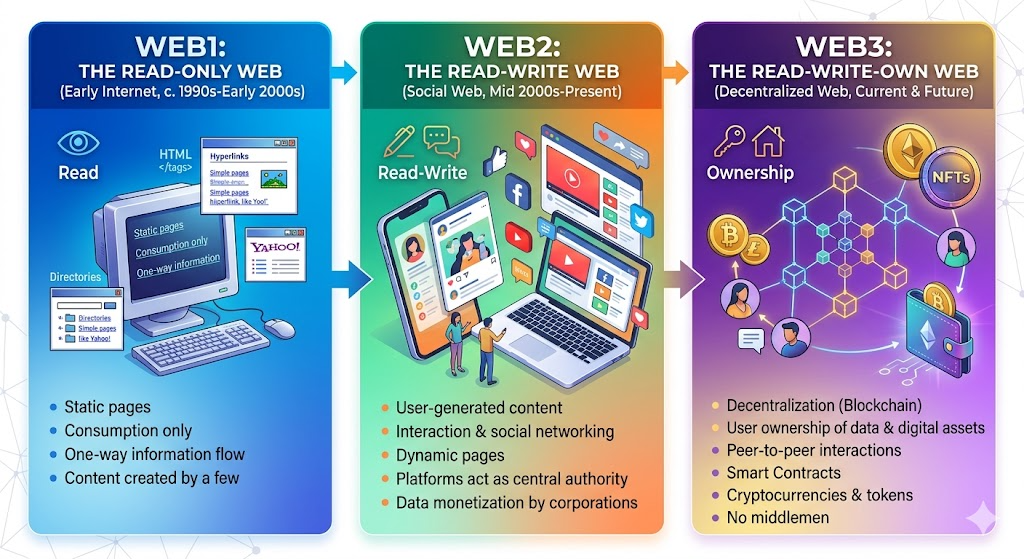
The internet has evolved through three distinct phases:
- Web1: A digital library of static information.
- Web2: The rise of social interaction and user-generated content.
- Web3: A decentralized, user-owned, and blockchain-powered web.
1. What is Web1? The Static, Early Web
Think of Web1 as a “read-only” version of the internet. In the 90s and early 2000s, the web was essentially a giant digital encyclopedia. You could go online to read information, but you couldn’t really “talk back” to the website. There were no “likes,” no comment sections, and definitely no “sharing” to a feed.
Visual: A look back at where it all began
The Experience: If you wanted to contribute to the web in the Web1 era, you usually had to know how to code basic HTML and host your own site. For most people, it was a one-way street: you consumed what companies put out.
Fun Fact: Did you know the first-ever website, created by Tim Berners-Lee in 1991, is still online? It’s a simple page explaining what the World Wide Web is. It’s the ultimate example of the “Static Web.”
2. What is Web2? The Social, Interactive Web
Around 2004, everything changed. This is the era we are most familiar with today. The internet evolved from a library into a “social square.” It became dynamic, user-driven, and highly interactive.
In Web2, you aren’t just a consumer; you are a creator. Whether you’re posting a photo on Instagram, writing a tweet, or uploading a video to YouTube, you are building the content that makes the internet what it is.
Visual: The era of connection and platforms
The Trade-off: Web2 gave us incredible convenience, but it came with a catch. Large tech companies became the central hubs of our lives. They own the platforms, they host our data, and often, they profit from our information. This led to the rise of “surveillance capitalism,” where our privacy is often the price of admission.
3. What is Web3? The Decentralized Web
Web3 is the next chapter. If Web1 was “read” and Web2 was “read-write,” Web3 is “read-write-own.”
Instead of big corporations owning the platforms, Web3 uses blockchain technology to give power back to the users. It’s a decentralized web where information isn’t stored on one company’s server, but across a network of computers. This means more privacy, better security, and true ownership of your digital assets.
Visual: Decentralization and Blockchain
How it works in the real world:
- Ethereum: A platform that allows developers to build apps (dApps) that run without a middleman.
- NFTs (Non-Fungible Tokens): A way for artists and creators to sell their work directly to fans while proving digital ownership.
- DeFi (Decentralized Finance): Banking and trading without needing a traditional bank.
4. Web1 vs. Web2 vs. Web3 — A Quick Comparison Table
To help visualize the shift, here is a breakdown of how the three generations compare:
Content Type
- Web1: Static, read-only.
- Web2: Dynamic, user-generated.
- Web3: Decentralized, user-owned.
Interactivity
- Web1: Minimal (mostly reading).
- Web2: High (likes, comments, social feeds).
- Web3: High (blockchain, smart contracts, digital assets).
Data Ownership
- Web1: Owned by the website creator.
- Web2: Owned by central corporations (Big Tech).
- Web3: Owned by the users themselves.
Monetization
- Web1: Static banners and basic ads.
- Web2: Targeted ads, subscriptions, selling user data.
- Web3: Tokens, cryptocurrencies, and NFT sales.
5. Why Should we Care? The Impact on our Life
Web3 might still feel like something out of a sci-fi movie, but it is already changing lives:
- For Creators: You no longer need a gallery or a massive platform to take a huge cut of your earnings. You can sell directly to your audience via NFTs.
- For Consumers: You gain more control over your privacy. You can choose exactly what data you want to share and with whom.
- For Professionals: Decentralized Finance (DeFi) is reimagining how we save and invest, potentially making financial tools accessible to everyone, not just those with access to traditional banks.
6. Conclusion: What’s Next for the Web?
We’ve watched the internet evolve from a simple digital library into a massive social ecosystem. But Web3 is just the beginning. It asks us to imagine an internet where we are the owners, not just the products.
The future is still unfolding. Will you be a passive observer, or will you be part of the decentralized revolution that’s reshaping our digital world?
Call to Action: Join the Web3 Revolution!
Ready to explore? Start your journey today!
- Get a Wallet: Explore MetaMask, the most popular gateway to Web3.
- Browse NFTs: Check out OpenSea to see how digital ownership is changing the art world.
- Learn the Tech: Visit the Ethereum Foundation website to learn how decentralized apps work.
The internet is evolving — will you be part of the change?