For decades, IT Service Management (ITSM) was the “anchor” of the organisation — keeping things from moving too fast and breaking.
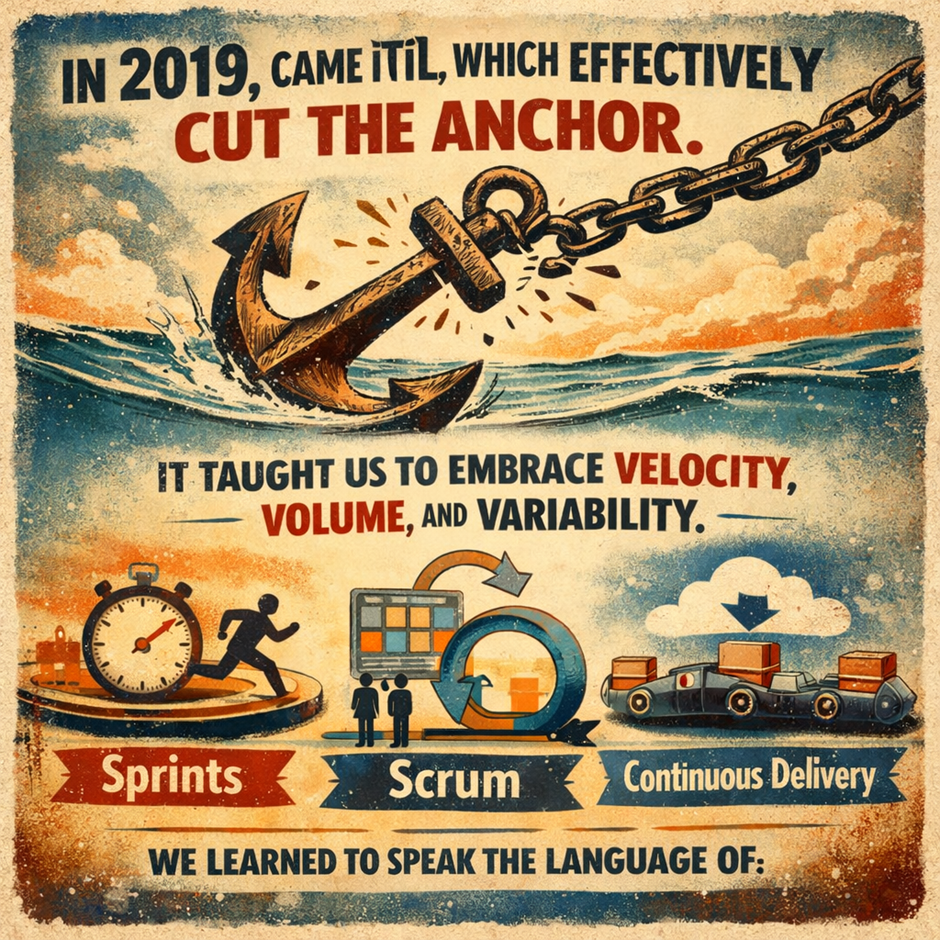
Then came ITIL 4 in 2019, which effectively cut the anchor. It taught us to embrace velocity, volume, and variability. We learned to speak the language of “Sprints,” “Scrum,” and “Continuous Delivery.” ITIL 4 effectively teaches us to embrace velocity through the Service Value System (SVS). But by 2026, we’ve realised that moving fast is only a virtue if you’re heading in the right direction.
But by 2026, we’ve realised that moving fast is only a virtue if you’re heading in the right direction. The “Agile” dream often turned into a treadmill that never stopped.
The “Agile” dream often turned into a treadmill, and the cracks in the ITIL 4 framework began to show under the weight of modern complexity.
The “Speed Trap” of the 2020s: Real-World Consequences
While ITIL 4 introduced the SVS, it didn’t fully account for the “human debt” and “technical silos” created by modern observability and AI.
1. The Burden of “Invisible Work” and Data Silos
In the rush to hit deployment deadlines, teams began ignoring the connective tissue of IT. Furthermore, the advent of advanced Application Performance Monitoring (APM) shifted the focus toward system sustainability, yet ITIL 4 lacked the specific processes to facilitate “Collective Resolution.”
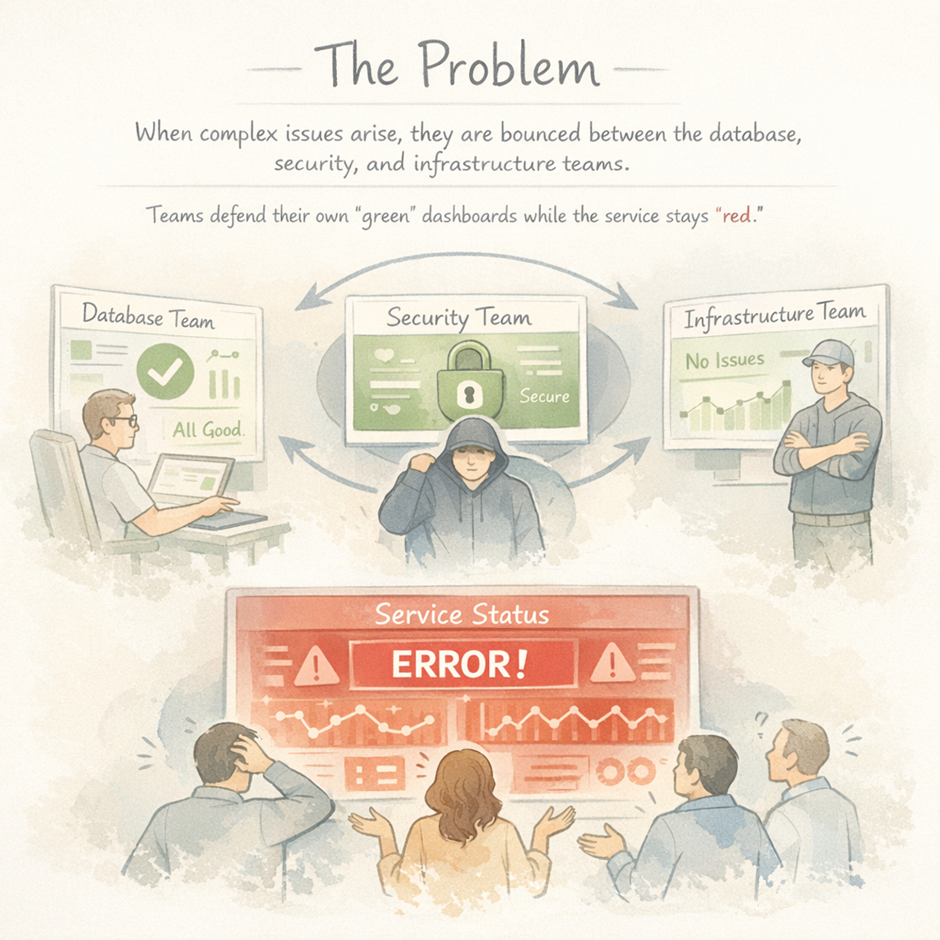
· The Problem: When complex issues arise, they are often bounced back and forth between the database, security, and infrastructure teams. Without a unified process for collective investigation, teams use observable data sets as shields rather than solutions — defending their own “green” dashboards while the service remains “red.”
· The Human Impact: This leads to “Information Tribalism,” where data is used only to defend a point of view rather than to drive business outcomes. The result? Increased resolution times and deeper organisational silos.
· The Example: A banking app team releases three new features a month. To stay on schedule, they skip updating the internal troubleshooting documentation. Six months later, a junior developer spends twelve hours on a Saturday trying to fix a bug that was “documented” only in the head of a senior developer who just left the company. It is experiencing leakage — the slow drain of institutional knowledge in exchange for short-term speed.
2. Operational Burnout and “Contextless Alerting”

ITIL 4 helped us manage a high volume of tasks, but it didn’t prevent them from piling up.
· The Problem: APM and observability tools generate mountains of data, but a lack of context-based review means teams are drowning in noise.
· The Human Impact: Humans are not the best choice for high-frequency, low-meaning tasks. Cognitive overload sets in, and critical system failures go unnoticed because they look exactly like the 499 “noise” alerts that preceded them.
· The Example: A DevOps team flooded with 500 “low priority” automated alerts a day. Because ITIL 4 focused on managing these alerts, the team built faster dashboards to clear them. The “velocity” of alerts caused cognitive overload, leading to critical system failures because they looked exactly like the 499 “noise” alerts preceding them.
3. AI Fragmentation (The “Shadow AI” Crisis)
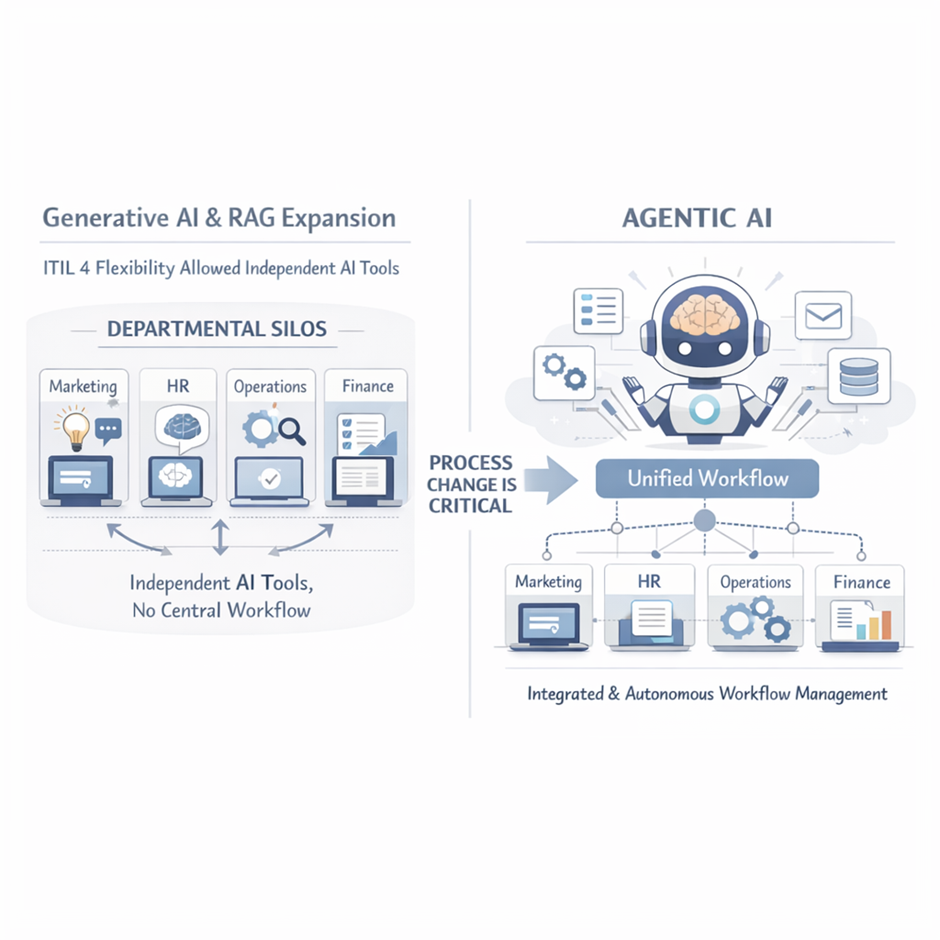
As Generative AI and RAG exploded, ITIL 4’s flexibility allowed departments to adopt tools independently, without a central workflow. The Agentic AI will address the workflow problem; the process change is critical.
· The Problem: Marketing, HR, and Engineering adopt siloed AI tools that lack a shared security policy or data lineage.
· The Impact: IT leaders lose sleep over “Siloed Intelligences” that create inconsistent employee experiences and massive security holes. ITIL 4’s governance models weren’t prescriptive enough to account for the autonomyof AI agents.
· The Example: Marketing starts using one AI for copy, HR uses another for resumes, and Engineering uses a third for code — none of which talk to each other or follow a central security policy. Employees become frustrated by inconsistent data (“Why does the HR bot say I have 10 vacation days but the Payroll bot says 5?”). IT leaders lose sleep over the massive, unmanaged security holes created by these “siloed” intelligences.
The Shift to ITIL 5: From “Doing” to “Being”
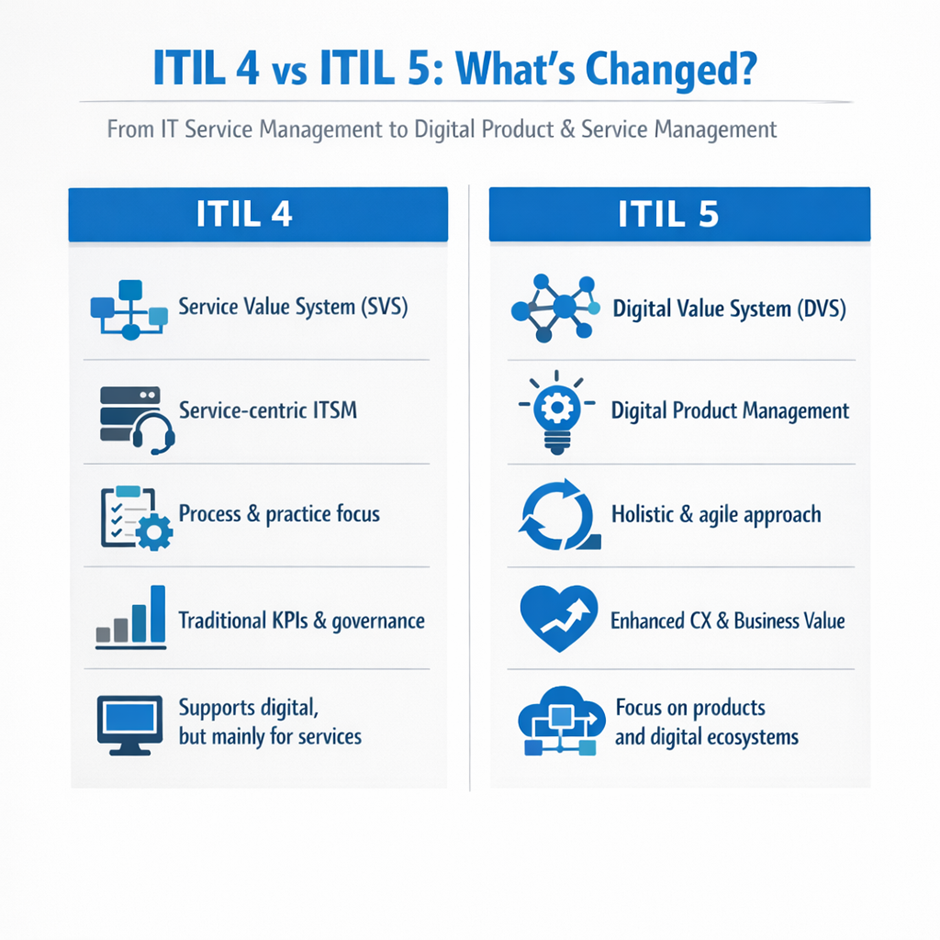
ITIL 5 acknowledges a hard truth: Speed is no longer a competitive advantage. In 2026, everyone is fast. The new advantage is Complexity Management and Contextual Alignment.

Under ITIL 4, success was measured by how quickly you closed a ticket. In ITIL 5, we have moved toward a Product Thinking approach.
From “Closing Tickets” to “Owning Products”
· The Change: Instead of an “Email Support Team,” you have a “Communication Experience Team.”
· The Impact: When a failure occurs, the collective team (Apps, DB, Security, and Infra) doesn’t just fix the error; they analyse the entire lifecycle. They use APM data not to deflect blame, but to ensure the service is sustainable and aligned with the business’s bottom line.
The Evolution of the Professional

In ITIL 5, the IT professional is no longer a “mechanic” fixing a machine; they are a curator of digital value. We are moving away from the “3 Vs” (Velocity, Volume, Variability) and toward the 3 Es: Ethics, Experience, and Ecology (Sustainability).
A helpdesk agent in 2026 spends less time resetting passwords (which AI does automatically) and more time acting as a consultant, ensuring that the technology stack isn’t just “running,” but is actually propelling the business forward without burning out the people who build it.
ITIL 4 was the engine that taught us how to drive fast. ITIL 5 is the GPS and the safety system that ensures we don’t run out of fuel, crash into a “complexity wall,” or leave our passengers (the employees) exhausted at the side of the road.
The Evolution of ITIL 5: Why ITIL 4 Was No Longer Enough was originally published in DataDrivenInvestor on Medium, where people are continuing the conversation by highlighting and responding to this story.