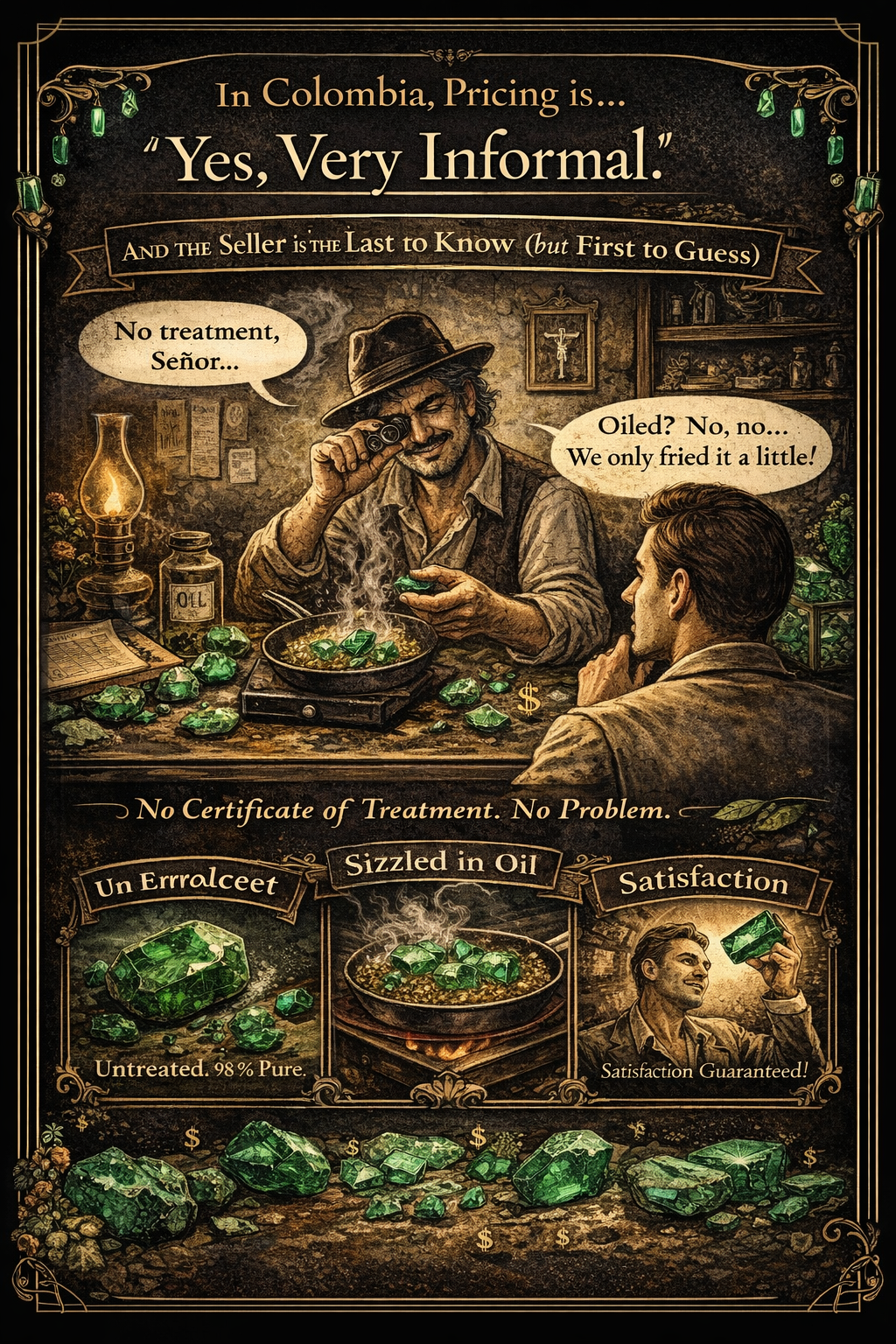
The Emerald Illusion
 The Luxury Dean3 min read·Just now
--
Informality, Intermediaries, and the Cost of Opacity in Colombia
Colombia produces some of the finest emeralds in the world.
From the mountains of Chivor and Muzo to the jewellery stores of Bogotá, the country is synonymous with deep green fire.
Luxury brands celebrate “Colombian origin” as a mark of prestige.
But between the mine and the final client lies a complex ecosystem — often informal, highly fragmented, and frequently opaque.
And opacity is where risk lives.
The Informal Market Structure
Unlike diamonds, which operate under globally standardized grading systems and certification protocols, emeralds — especially in Colombia — have historically been traded through personal networks.
Transactions often happen:
- In private offices
- In hotel rooms
- Through verbal agreements
- Without standardized documentation
- Without laboratory certification
Trust is personal.
Documentation is optional.
Responsibility can become diffuse.
In such an environment, the buyer — especially a foreign one — carries significant vulnerability.
The Chain of Intermediaries
An emerald rarely moves directly from miner to international client.
Instead, it may pass through:
- Local buyers near the mine
- Regional traders
- Bogotá-based dealers
- Export brokers
- Jewellery manufacturers
Each layer adds margin.
Each layer reduces traceability.
By the time the stone reaches the final customer, its story has been rewritten several times.
And when responsibility is distributed, accountability weakens.
The Problem of Valuation
Emerald valuation is complex.
Color, transparency, inclusions, origin, oil treatment, cut quality — all influence price.
However, in informal markets:
- Stones may be sold without independent lab certification
- Treatments may not be fully disclosed
- Origin claims may rely on verbal assurance
- Return policies may not exist
Unlike structured retail systems, informal transactions often operate under:
“Once sold, responsibility ends.”
For inexperienced buyers, this creates asymmetry.
The seller knows the stone’s weaknesses.
The buyer often does not.
Oil Treatment and Disclosure
Most emeralds undergo oil treatment to enhance clarity. This is standard industry practice worldwide.
The issue is not treatment itself.
The issue is disclosure.
Without proper documentation:
- The degree of treatment may be unclear
- Stability over time may not be explained
- Future resale value becomes uncertain
In a market built on personal negotiation, information becomes leverage.
Tourism and Quick Transactions
Bogotá’s emerald district attracts tourists and international investors looking for opportunity.
But rapid transactions combined with:
- Lack of certification
- No formal invoice structure
- Cash-based deals
- No enforceable return guarantees
create conditions where misunderstandings — or worse — can occur.
Informality protects flexibility.
But it weakens protection.
Why Informality Persists
Colombia’s emerald trade developed historically under:
- Regional mining control
- Decades of conflict
- Limited state oversight
- Strong private networks
Trust-based systems worked within local circles.
But global luxury markets demand:
- Transparency
- Certification
- Traceability
- Clear legal responsibility
When informal systems meet international buyers, friction appears.
The Real Structural Issue
This is not about labeling every intermediary as dishonest.
Many operate with integrity.
The structural issue is this:
When transactions lack documentation,
When valuation lacks independent verification,
When responsibility is not contractually defined,
risk shifts to the least informed party.
And in luxury, opacity destroys long-term credibility.
The Opportunity Colombia Is Missing
Colombia produces the finest emeralds on Earth.
Yet it has not fully institutionalized:
- National standardized certification systems
- Transparent origin tracking
- Strong export compliance branding
- Consumer protection guarantees
If Colombia wants to move from raw prestige to structured luxury dominance, the industry must evolve from informal trading culture to transparent global standards.
Luxury is not just rarity.
Luxury is trust institutionalized.