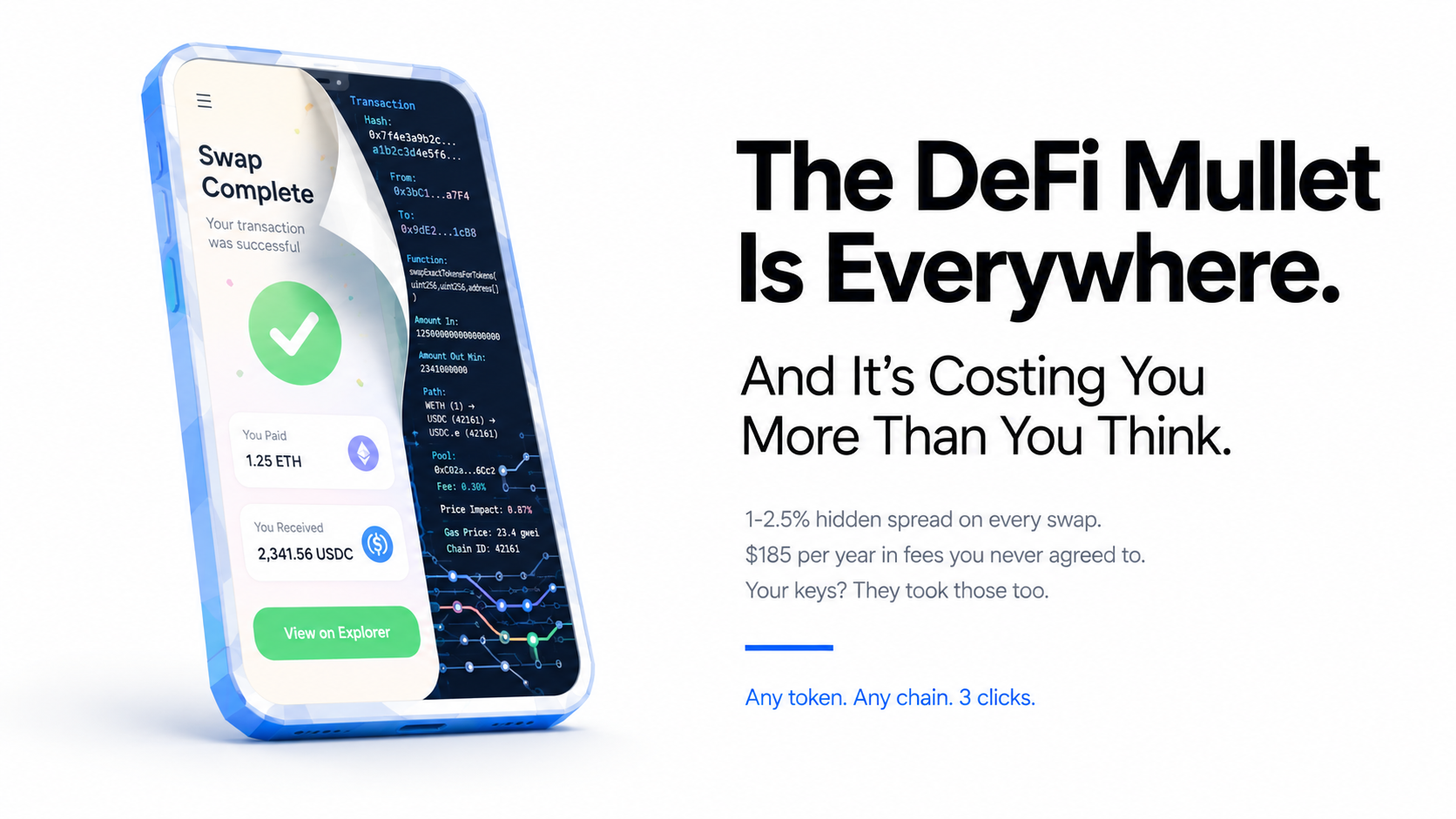
The DeFi Mullet Is Everywhere. And It’s Costing You More Than You Think.
 Blueice Finance9 min read·1 hour ago
--
There’s a phrase that keeps showing up in every crypto boardroom, VC pitch deck, and protocol roadmap in 2026.
The DeFi Mullet.
Fintech in the front. DeFi in the back.
A clean, familiar app you already know how to use. Decentralized protocols running underneath that you’ll never see. You tap “Earn 5%” or “Send $200” and the machine handles the rest. You never touch a wallet. You never see a chain name. You never know you’re using DeFi at all.
It sounds like progress. It looks like the future. Every major player in crypto is adopting it. Coinbase integrated the lending protocol Morpho for Bitcoin-backed loans and within months drove Morpho’s total value locked from $700 million to over $3.3 billion. PayPal offers yield on PYUSD that runs through DeFi rails the user never sees. Bybit announced Byreal, a full DEX on Solana routed directly from its centralized exchange app. Binance pushed millions of users into its keyless wallet through its Alpha points program, dominating what analytics dashboards call “wallet market share” without those users ever learning what a wallet actually is.
The mullet is winning.
And if you’re using any of these products, you’re already wearing one. You just don’t know what it’s costing you.
What the Mullet Actually Does Behind Your Back
The DeFi Mullet isn’t a technology decision. It’s a custody decision disguised as a UX improvement.
When you use a mullet product, here’s what happens behind that clean interface:
They take your keys. The app takes custody of your assets. You no longer hold crypto. You hold a balance in someone else’s database. That balance is an IOU. If the company freezes your account, gets hacked, goes bankrupt, or decides you’re “high risk,” your access disappears until they decide to return it. This is not a theoretical risk. FTX held customer funds. Celsius held customer funds. BlockFi held customer funds. Voyager held customer funds. All of them failed. All of them took customer money with them.
They hide the route. Every swap, every transfer, every yield position goes through one execution path that the app chose for you. You don’t see alternatives. You don’t know if you got the fastest route, the cheapest route, or the route that paid them the biggest kickback. You see “Confirmed” and you trust. You have no receipt showing what actually happened, what you actually paid, or what you could have paid instead.
They skim the spread. Most custodial crypto apps mark up the exchange rate by 1% to 2.5% on every transaction. On a $500 swap, that’s $5 to $12.50 that never appears on any receipt. They call it “the spread.” It never shows up as a line item. It’s the fee you pay without ever agreeing to it.
They wall off the ecosystem. The full DeFi universe — hundreds of DEXes, dozens of blockchains, every liquidity pool built in the last decade — is available to anyone with a self-custodial wallet, right now, for free. The mullet app shows you only what’s inside its walls. Want to catch an opportunity on Solana? Too bad, they only support Ethereum and Base. Want to access a new protocol on Arbitrum? Wait six months for them to “add support.” Your money sits on their leash, in their garden, behind their gate.
The DeFi Mullet doesn’t simplify DeFi. It privatizes it.
It takes the open, permissionless infrastructure that was built to give everyone equal access, wraps it in a corporate interface, and charges you a toll to walk through a door you could have opened yourself for free.
The Real Math Nobody Shows You
Let’s stop talking philosophy and start talking money.
You have $500 in USDC. You want to swap it for ETH.
Inside a mullet app: → You tap “Swap.” → The app executes at a rate it chose. You see “500 USDC → 0.189 ETH.” → What you don’t see: the mid-market rate would have given you 0.194 ETH. → The difference — 0.005 ETH, roughly $13 — went to the company as spread. → You also paid a “network fee” of $2.50 that doesn’t break down what chain, what route, or what gas price was used. → Total hidden cost: ~$15.50. You saw $2.50.
On a self-custodial cross-chain DEX: → You connect your wallet. Nobody takes your keys. → You select USDC on Polygon. You select ETH on Ethereum. → You see four route options: Fastest (8 seconds, $1.20 fee), Cheapest ($0.04 fee, 45 seconds), Safest ($0.80 fee, 12 seconds, max slippage 0.1%), Recommended ($0.60 fee, 15 seconds). → You pick Cheapest. You confirm. → You receive 0.194 ETH. The full mid-market amount. → You get a receipt: exact route, exact fee, exact time, exact slippage. On-chain. Permanent. Verifiable. → Total cost: $0.04. You saw $0.04. Because that’s all there was.
Do that swap once a month for a year.
The mullet app takes approximately $186 from you in hidden spreads and opaque fees. The self-custodial route takes approximately $0.48.
The difference is $185.52. That’s not rounding error. That’s a system designed to extract value from people who don’t know they have a choice.
Why the Mullet Exists (And Why It Keeps Winning)
Here’s the honest part. The DeFi Mullet didn’t emerge because companies are evil. It emerged because DeFi’s original interface was genuinely, objectively terrible.
For ten years, using DeFi meant:
→ You needed the right gas token on the right chain. Moving USDC on Arbitrum? You need ETH on Arbitrum specifically. Not ETH on Ethereum. Not ETH on Optimism. The right ETH, on the right chain. If you didn’t have it, your transaction failed. Nobody explained why.
→ You needed to understand bridges. Want to move tokens from Ethereum to Solana? You need a bridge. Which bridge? There are dozens. Some have been hacked for hundreds of millions of dollars. Ronin: $624 million. Wormhole: $325 million. Nomad: $190 million. Over $2.8 billion lost in bridge exploits total. And you’re supposed to pick one and trust it with your money.
→ You needed to manage slippage, gas estimation, transaction approval, token allowances, RPC endpoints, and a dozen other concepts that have nothing to do with what you actually wanted to do, which was just move your money.
→ You needed a friend. Someone who’d already made all the mistakes. Someone you could text at midnight when a transaction failed for a reason the wallet didn’t explain.
Most normal people tried DeFi once. Lost $12 or $18 on gas for a swap that should have cost pennies. And never came back.
The fintech companies saw that failure and built the mullet on top of it. They said, “Give us your keys and we’ll handle it.” Millions of people said yes because the alternative — raw DeFi — was genuinely unusable.
The mullet didn’t win because it was good. It won because the alternative was worse.
The Third Path Nobody Built (Until Now)
The crypto industry in 2026 has offered exactly two paths for years:
Path 1: The Mullet. Give up your keys. Accept hidden fees. Get “simple” at the cost of ownership, transparency, and sovereignty.
Path 2: Raw DeFi. Keep your keys. Lose your mind. Navigate gas tokens, bridge hell, failed transactions, and a learning curve that punishes mistakes with real money.
Both are broken. One steals your sovereignty. The other punishes you for wanting it.
But there’s now a third path emerging — one that was always theoretically possible but nobody built until the infrastructure matured enough to make it real.
Self-custodial DeFi that’s actually easy.
Not easy because someone took your keys and hid the complexity. Easy because the interface was finally engineered to handle the complexity for you without ever asking for your keys.
This is what cross-chain DEX aggregators with route intelligence now deliver. You connect your existing wallet. You pick what you have and what you want. The engine scans 60+ blockchains simultaneously, evaluates hundreds of possible routes across bridges, DEXes, and liquidity pools, and presents you with options ranked by speed, cost, and safety.
You choose. You confirm. You get a receipt.
3 clicks. Your wallet. Your keys. Your choice. Your receipt.
No gas token management. No bridge selection. No chain-switching. No slippage calculation. No PhD required. The complexity still exists — someone has to solve it — but it’s solved by the routing engine, not by you.
That’s not a mullet. It’s the anti-mullet. Same simplicity. Zero custody compromise.
What Route Intelligence Actually Changes
Most people hear “DEX aggregator” and think “it finds the cheapest price.” That was true in 2022. In 2026, route intelligence does something fundamentally different.
When you swap USDC on Polygon for SOL on Solana, the route intelligence engine evaluates:
→ Every available bridge between the source and destination chain. Their current liquidity depth. Their historical reliability. Their fee structure at this exact moment.
→ Every DEX on both chains. Uniswap, SushiSwap, Orca, Raydium, Curve, Balancer — hundreds of pools, each with different prices, different slippage curves, different gas costs.
→ Multi-hop paths. Sometimes the cheapest route from Polygon to Solana goes through Arbitrum first. Sometimes the fastest goes direct. Sometimes the safest splits the order across two bridges.
→ Gas costs on every chain involved. Not just the destination. Every hop. Every approval. Every settlement.
Then it presents four options: Fastest. Cheapest. Safest. Recommended.
And here’s the part that matters: you choose.
No other aggregator does this. Every competitor picks one route for you and executes it. They optimize for their metric — usually “best price” — and you accept whatever they decided. You never see the tradeoff between speed, cost, and safety. You never get to decide that right now, speed matters more than saving $0.30. Or that right now, safety matters more than shaving 3 seconds.
Route intelligence doesn’t just find a path. It gives you informed consent over your own money. That’s a concept the mullet deleted entirely.
The Receipt Changes Everything
There’s one more thing the mullet took from you that nobody talks about enough.
Accountability.
When you swap inside a custodial app, what do you get? A notification. “Swap complete.” Maybe an email. Maybe a line in your transaction history that says “0.189 ETH received.” No route. No fee breakdown. No slippage data. No execution timestamp down to the second. No on-chain proof.
If something went wrong — if you got a worse price than you should have, if the spread was wider than normal, if the execution was delayed — you have no evidence. You have a notification and a phone number for customer support.
On a self-custodial cross-chain swap with a proper receipt system, every transaction generates a permanent, on-chain, publicly verifiable record of exactly what happened. The route taken. The fee paid. The slippage experienced. The time of execution. The destination confirmed.
That receipt doesn’t just protect you. It disciplines the system. When every transaction is auditable, platforms can’t hide spreads. They can’t route your order through the path that pays them the most. They can’t charge you $15 and show you $2.50. The receipt is the regulator that never sleeps.
DeFi was supposed to be trustless. The mullet reintroduced trust — in a company, in a database, in a customer support team. Receipts return DeFi to its original premise: verify, don’t trust.
The Person DeFi Forgot
There’s a person at the center of all of this who both the mullet builders and the raw DeFi builders forgot about.
She holds some crypto. She believes in ownership. She doesn’t want to depend on a bank, or a fintech app, or anyone else to control her money. But every time she tried DeFi — the gas error, the failed transaction, the $14 fee to move $30, the bridge that looked sketchy — she gave up. Not because she’s not capable. Because the system was badly built.
The mullet looked at her and said: “You can’t handle this. Give us your keys.”
The right answer was always: “The system failed you. Let us fix the system.”
The person DeFi forgot is not less capable. The old DeFi was just badly built.
The third path — self-custodial, route-intelligent, 60+ chain, 3-click, receipt-verified DeFi — is what happens when you respect that person enough to build for them without taking their keys.
That’s not marketing. That’s a design philosophy. And it’s what separates the next generation of DeFi tools from the mullet era that’s trying to convince you that custody is a feature.
The Choice in Front of You
Right now you have two options, and nobody is going to make this decision for you.
Option 1: Use a mullet app. Give up your keys. Accept hidden spreads. Never see the route. Get “simple” at the cost of everything crypto was supposed to fix about traditional finance.
Option 2: Use self-custodial DeFi with route intelligence. Keep your keys. See your routes. Choose your priority. Pay transparent fees. Get a receipt for every action. Own the money you thought you already owned.
One of these is the past dressed up as the future.
The other is the promise crypto made in 2015, finally delivered in an interface anyone can use.
Freedom isn’t something someone gives you. Freedom is something you choose when the door finally opens.
The door is open.
Any token. Any chain. 3 clicks. Your route. Your control.
Primary keywords: DeFi Mullet, cross-chain DEX aggregator, self-custody DeFi, non-custodial swap, best DEX aggregator 2026, swap without gas fees, route intelligence, DeFi for beginners, fintech vs DeFi, cross-chain swap, multi-chain DEX, chain abstraction, any token any chain
Secondary keywords: DeFi UX problem, custodial vs non-custodial crypto, hidden crypto fees, bridge risk DeFi, Coinbase Morpho DeFi mullet, DEX aggregator comparison, swap across blockchains 2026