The Death of Web2 Trading Bots: Why SaaS Fails in DeFi
 SCAI: SOCIAL AI NETWORK6 min read·1 hour ago
--
Why paying monthly rent for trading automation makes no sense in an on-chain economy
For years, traders have accepted a strange contradiction.
They want to trade the most advanced financial markets ever created: decentralized, permissionless, 24/7, global, programmable markets. Yet the tools they use to automate those trades often still belong to the Web2 era.
Monthly subscriptions. Centralized dashboards. API keys. Exchange lock-ins. Hidden latency. Fixed fees that drain capital whether the trader wins or loses.
This is the irony of modern crypto trading: people are using software from yesterday to compete in markets built for tomorrow.
The promise of trading bots was simple: automation should give the trader an edge. It should remove emotion, execute faster, manage risk, and unlock strategies that would be impossible manually.
But for many retail and mid-sized traders, that promise has turned bitter. Not because automation is wrong, but because the business model behind most trading bots is broken.
The real problem is not the bot.
The problem is SaaS.
The Hidden SaaS Tax
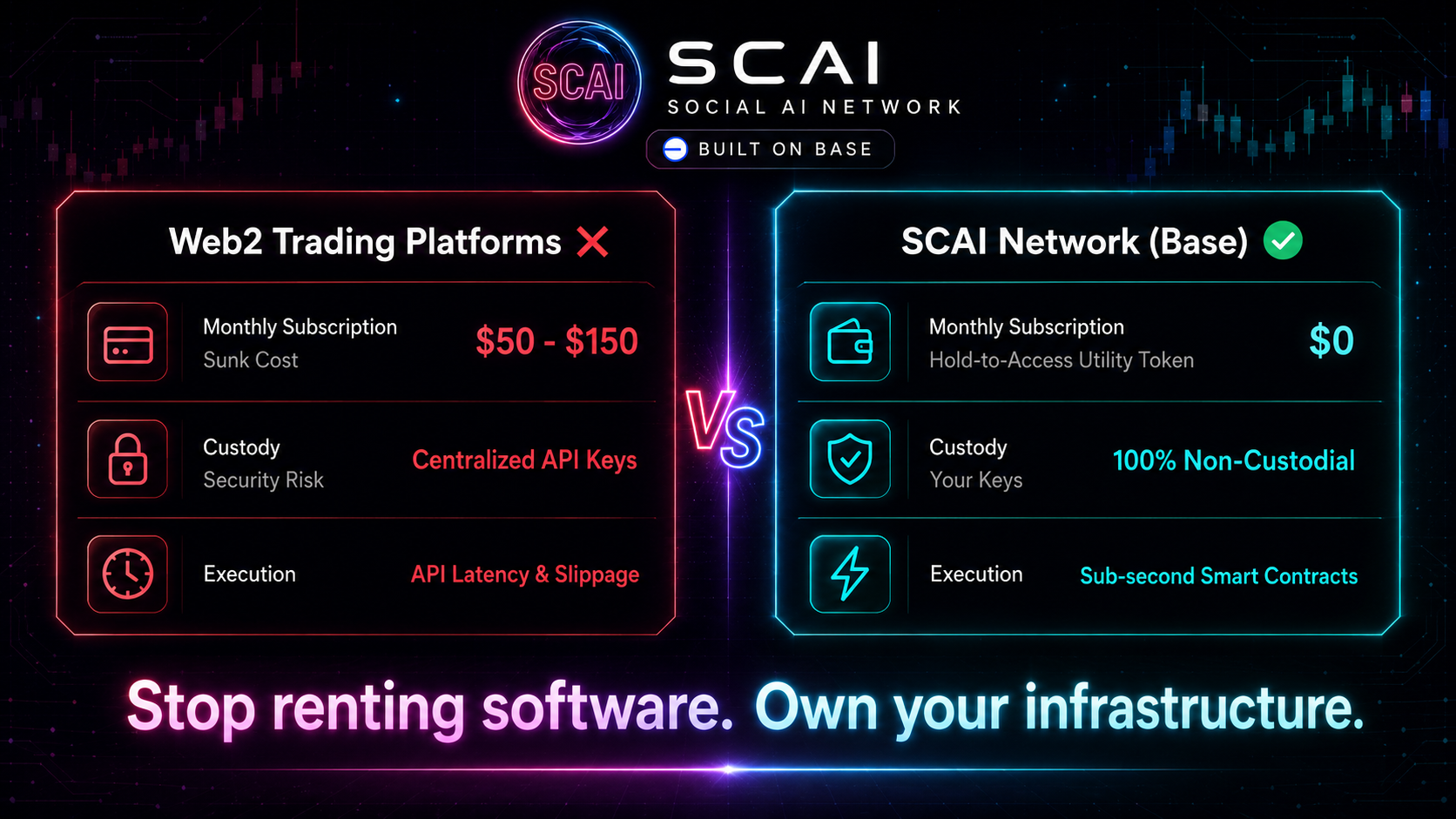
Most Web2 trading bot platforms run on the same model: pay a fixed monthly fee to access the software.
At first, that sounds normal. You pay for Netflix. You pay for Notion. You pay for cloud storage. Why not pay for a trading bot?
Because trading is not entertainment, documentation, or file storage.
Trading is capital allocation.
And every fixed cost becomes a tax on performance.
Let’s use simple math.
A trader with a $2,000 portfolio pays $50 per month for a bot subscription. That trader now needs to generate 2.5% monthly returns just to break even on the software cost.
If the subscription is $100 per month, the hurdle jumps to 5% monthly.
That is before exchange fees, gas fees, slippage, failed trades, bad market conditions, and losses.
In other words, the trader begins every month in a hole.
The platform gets paid regardless of performance. The trader assumes 100% of the market risk, but the SaaS provider collects revenue whether the strategy works or not.
This destroys the compounding curve.
For small and medium accounts, the damage is even worse. A $100 monthly fee may look harmless to a large fund, but for a retail trader it can silently consume alpha. The bot does not just need to be profitable. It needs to outperform the subscription drag every single month.
That is not automation.
That is rent.
And in DeFi, rent is the first thing that should disappear.
APIs Were Not Built for On-Chain Speed
The second problem is technical.
Most legacy bots rely on centralized exchange APIs. The trader connects an exchange account, gives the platform permission to place orders, and hopes everything works when volatility spikes.
But markets do not wait.
When volatility is low, API-based systems can feel smooth. The interface looks clean. The bot seems responsive. The trader feels in control.
Then the market moves violently.
Suddenly, API lag matters. Orders can be delayed. Execution can arrive late. A trade designed to enter at one price may fill at another. A stop-loss can trigger after the damage is already done. A strategy that looks profitable in a calm backtest can bleed in live conditions because the infrastructure cannot keep up.
That gap is called slippage.
And in fast-moving crypto markets, slippage is not a small detail. It is often the difference between a profitable strategy and a losing one.
There is also the security problem.
API keys are powerful. Even when withdrawals are disabled, trading permissions can still be abused. A compromised key can create destructive trades, manipulate positions, or expose the trader to unwanted risk.
On top of that, many traders still keep funds inside centralized exchanges because that is where their bots operate. That means accepting exchange risk, custody risk, withdrawal risk, and platform dependency.
For an industry built around self-custody, this is backwards.
DeFi was not created so traders could hand control back to centralized software layers.
It was created so capital could move through open, transparent, programmable infrastructure.
From Subscription Access to Hold-to-Access
SCAI Network is built around a different idea.
Instead of asking traders to burn capital every month on subscriptions, access is unlocked through ownership.
This is the Hold-to-Access model.
A user acquires and holds $SCAI tokens in their own wallet. That holding unlocks access to the SCAI automation ecosystem: AI-powered trading tools, on-chain strategies, analytics, and execution infrastructure designed for Web3 markets.
The difference is fundamental.
In the SaaS model, access is rented.
In the Hold-to-Access model, access is owned.
A monthly subscription is a sunk cost. Once paid, it is gone forever. Whether the bot performs well or badly, the money has left the trader’s portfolio.
With Hold-to-Access, the user is not continuously paying rent to use the platform. The user holds an asset that grants access. If they stop using the ecosystem, they can decide what to do with that asset.
This does not mean there is no risk. Tokens can fluctuate in value. Markets are volatile. Gas costs, liquidity, and execution conditions still matter.
But the economic design changes the relationship between user and platform.
The trader is no longer just a customer paying a bill.
The trader becomes part of the network.
Why Base Changes the Equation
For this model to work, the infrastructure has to be fast, affordable, and scalable.
That is why SCAI Network is being built around Base.
Base, as a Layer 2 network, makes on-chain activity far more practical for trading automation than Ethereum mainnet alone. Lower transaction costs and faster settlement create the conditions for a new class of trading tools: bots that are not trapped behind centralized APIs, but connected directly to on-chain liquidity and smart contract logic.
This matters because DeFi trading is not only about placing an order.
It is about routing capital, reacting to liquidity, managing execution, and interacting with protocols in real time.
A true Web3 trading bot should not simply copy the Web2 experience and add a wallet login.
It should be native to the environment it operates in.
That means wallet-based access. On-chain execution. Transparent rules. Automated strategies that interact with decentralized liquidity. And a business model that does not punish smaller traders with fixed monthly costs.
SCAI Network’s thesis is simple:
The future of trading automation will not be rented.
It will be held.
Aligned Incentives Beat Extractive Fees
The most powerful part of Hold-to-Access is incentive alignment.
In the SaaS model, the platform’s priority is subscription retention. The user pays monthly. The business grows by collecting more recurring fees.
In a token-based access model, the network depends on utility, demand, and trust. If the tools are weak, users leave. If execution is poor, confidence drops. If the ecosystem does not improve, the token loses relevance.
That creates pressure in the right direction.
Developers must build better infrastructure. The platform must deliver real utility. The ecosystem must keep improving because the value of access depends on the strength of the network.
When users win, the network becomes more valuable.
When the network becomes more valuable, builders, users, and holders move in the same direction.
That is the Web3 upgrade.
Not just decentralized finance.
Decentralized incentives.
The End of Bot Rent
The old trading bot model made sense in the Web2 era.
But DeFi changed the rules.
A market that runs 24/7, settles on-chain, and rewards speed, transparency, and self-custody cannot be served forever by centralized dashboards, API keys, and monthly rent.
The next generation of traders will not ask, “Which subscription should I pay for?”
They will ask, “Which network do I want access to?”
SCAI Network is building for that future: an AI-powered Web3 trading automation ecosystem where access is unlocked through holding, not renting.
The death of Web2 trading bots will not happen because traders stop wanting automation.
It will happen because they stop accepting extractive business models.
SaaS was built for software users.
DeFi needs something different.
DeFi needs owners.
Join the SCAI Network Presale
The SCAI Network presale is the first opportunity to secure access before the infrastructure becomes public.
Hold $SCAI. Unlock the ecosystem. Trade Web3 with tools built for Web3.
Access the SCAI Network Interface — https://scainetwork.com/
Follow our Live Executions on X — https://x.com/SOCIALAINETWORK
This article is for informational purposes only and does not constitute financial advice. Crypto assets involve risk, including possible loss of capital.