THE DEAL THAT CLOSED BECAUSE NOBODY BLINKED
 VICTOR RAPHAEL3 min read·Just now
--
The Final 72 Hours Decide More Than the Previous Six Months. The Founder Who Holds Composure Walks Away With a Different Number Than the One Who Shows Urgency.
Both founders had the same deal.
Same buyer. Same protocol category. Same general valuation range. They were not in competing processes they had been in separate conversations with the same acquirer, six months apart, and the acquirer had made nearly identical offers to both.
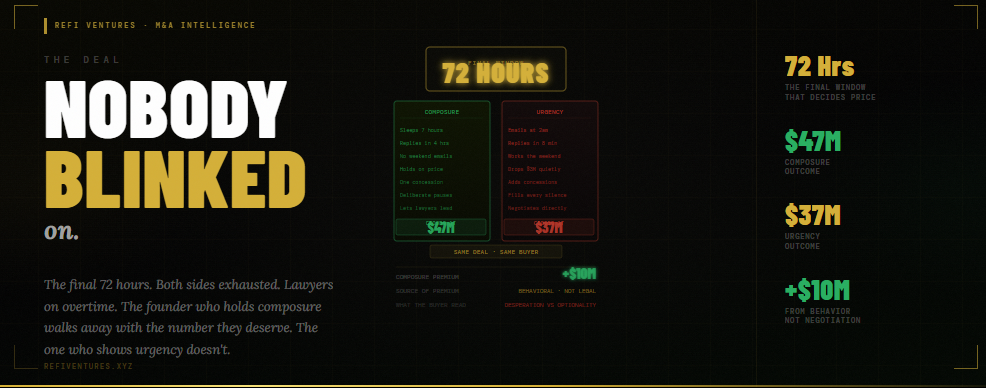
One closed at $47 million. One closed at $37 million. The difference was not legal skill, not leverage, not product quality. It was behavior in the final seventy-two hours.
The final stretch of any acquisition is a behavioral test that most founders do not know they are taking. By the time both sides reach the last round of terms, the financial parameters are largely set. The material issues have been resolved or accepted. What remains is a final negotiation over a handful of points where both sides have some flexibilit and the outcome of that negotiation is determined almost entirely by which party appears to have more optionality.
Optionality is not a legal concept. It is a feeling the acquirer forms by watching how the founder behaves in the moments when the deal is closest to closing.
The founder who closed at $47 million did not reply to weekend emails. Not because he was playing a game but because he had made a deliberate decision that his behavior in the final stretch would not signal urgency. He slept. He waited four hours before responding to time-sensitive messages. He made one significant concession on a term that mattered to the acquirer and held on everything else. When the acquirer’s lawyer sent a 2am markup, he reviewed it the following morning. His message was consistent and unspoken: he could walk. He was choosing not to.
The founder who closed at $37 million replied to everything within minutes. He worked through the weekend. He sent emails at 2am. He made three concessions in forty-eight hours when one would have been sufficient. He filled every silence in the negotiation with clarification or movement. His message was also consistent and unspoken: he needed this deal to close. The acquirer read it clearly.
Neither founder said anything explicit about their urgency or their alternatives. The signal was entirely behavioral. And the acquirer, who runs these processes regularly, extracted $10 million in value from reading it accurately.
The urgency signals that cost the most in final negotiations are the fastest to produce. Replying too quickly tells the counterparty you have been waiting. Working through weekends tells them you have nothing else competing for your attention. Making sequential unprompted concessions tells them you are afraid the deal will fall apart and are pre-emptively buying goodwill. Each of these signals individually is worth almost nothing. Cumulatively they communicate that the founder’s walk-away position is lower than their stated position which is the only information the acquirer needs to calibrate their final push.
The protection against this is not silence or strategy. It is genuine alternative development. The founder who replies in four hours because they are genuinely busy with other conversations is behaviorally indistinguishable from the founder who waits four hours as a tactic. The founder who does not work weekends because their pipeline has multiple active processes is indistinguishable from the one who has decided not to. Both signal optionality because both have it.
This is the real argument for running a proper process with multiple buyers rather than pursuing a single acquirer serially. The composure that closes deals at premium prices is not a posture. It is the natural consequence of having genuine alternatives. The founder who has two real offers moves differently in the final stretch than the one who has one. That movement is worth millions.
The deal closes. The price is set. And in the final seventy-two hours, almost none of it is about the protocol.
It is about who blinks first.
Build genuine optionality before your process begins at refiventures.xyz