The Day Stops Whispering
 Veyrain Paperrain7 min read·1 hour ago
--
London, and the Moment the Market Learns to Speak
Chapter III — The Stem
London: Where Growth Becomes Visible
There is a moment in the life of every plant that the farmer watches for more carefully than any other.
Not the planting — that is his own action, and he knows when it happened. Not the bloom — that is still weeks away, and he has learned not to count on it before it arrives. But the moment when the stem breaks the surface. When what has been happening entirely beneath the ground — the germination, the root’s long reach downward, the slow accumulation of structure — finally crosses the threshold into the visible world.
This is emergence. And in the experience of the farmer, it changes everything.
Before the stem appears, the field is a field of faith. You believe the seeds took. You believe the roots are holding. You tend the soil and adjust the water and watch the sky, but you are, in a fundamental sense, working on trust. The evidence is beneath your feet, inaccessible.
When the stem breaks through, the uncertainty does not disappear — a late frost can still kill a young plant, and drought can still reach the roots — but the nature of the uncertainty changes. You are no longer asking did anything happen. You are asking how far will it go.
The Roman agricultural writers were precise about this transition. Columella, writing in the first century AD from his estates in southern Spain, described the emergence of the stem as the moment when a plant entered into relationship with its environment. Before emergence, the plant was self-contained — drawing only on what was stored within the seed and what the soil immediately around it could provide. After emergence, it became part of a larger system. Sunlight reached it. Wind tested it. Rain fell on leaves that had not existed the day before. The plant was now, in Columella’s framing, in conversation with the world.
It could still fail. But it could no longer fail quietly.
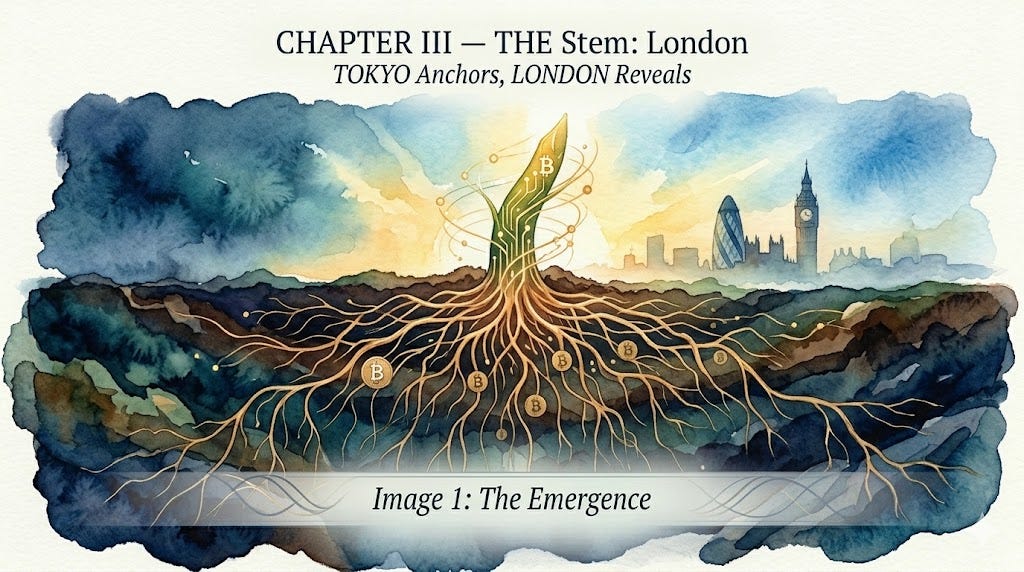
London opens into that same moment.
After Sydney’s tentative first hours and Tokyo’s patient structural work, the London session arrives with a quality that participants in every time zone recognize immediately, even if they have never tried to describe it: the market wakes up.
Liquidity deepens. The spread between buyers and sellers tightens. Volume that had been measured in the Asian sessions begins to multiply as European institutional desks open their books, review the overnight positioning, and make decisions that have been forming through the hours they were away. The price that Tokyo left at a particular level is suddenly subject to pressure from a much larger pool of participants — participants who bring with them not just capital, but information, conviction, and the kind of decisive energy that comes from fresh attention applied to a situation that has already been developing for hours.
This is the stem. Not the beginning of the plant’s life, but the moment its life becomes legible to the world.
What Sydney planted and Tokyo anchored is now, in London, being tested by the full environment. The early high from the Asian session — was it a ceiling that will hold, or a level the market is gathering itself to break? The structure that Tokyo built quietly through its middle hours — was it genuine accumulation, or distribution dressed as stability? London does not always answer these questions immediately, but it begins to answer them. The stem, as it rises, reveals by its direction what the roots beneath it were actually doing.
A market that uses the London open to extend cleanly through Asian resistance is telling you the foundation was real. A market that fades on London volume — that gives back the Asian session’s gains as European participation increases — is telling you the structure was not as secure as it appeared. Either way, the emergence into London is when the day’s story stops being subtext and starts being text.
There is a specific feeling to the London open that no other session produces — a sudden change in the weight of the market that arrives not gradually but at once.
In Sydney, price moves through empty space. In Tokyo, it moves with deliberate, measured intention. But London arrives like a door opening onto a crowded room. The spread that was two points is suddenly one. A level that held through the Asian session without being seriously tested is now being tested, repeatedly, by participants who did not watch it form and do not have the same attachment to it. The pace of the tape changes. Candles that took an hour to build in Tokyo take minutes to form. The market, which had been breathing slowly, begins to breathe faster.
This acceleration is not noise. It is information.
The trader who has learned to sit with London understands that the first thirty minutes of the session are not the time to reach — they are the time to read. The direction that asserts itself as European volume arrives and sustains, as the spread tightens and the pace increases, is a direction with weight behind it. The move that London initiates and then immediately questions, that pushes through a level and pulls back within the same candle, is telling a different story. The stem that rises confidently is not the same as the stem that rises and bends.
The farmer could see the difference. So can the trader who has learned to look.
Maia’s association with continuous, sustained development — with growth that does not arrive all at once but builds through each stage into something durable — finds in the stem perhaps its most recognizable expression.
The stem is not the most admired part of the plant. It does not carry the beauty of the bloom or the patient mystery of the root. It is the functional middle — the channel through which everything the root gathered is carried upward into expression. Columella described its role with characteristic Roman practicality: the stem exists to connect and to carry. Its strength determines not what the plant is now, but how far the plant can eventually reach.
London connects and carries in exactly the same way.
It receives the foundation that the earlier sessions built and becomes the channel through which that foundation’s quality is expressed as movement. A deep root system, established through Sydney and Tokyo, expresses itself in London as momentum that sustains — that finds buyers at each pullback, that treats resistance as a temporary obstacle rather than a permanent ceiling, that rises with the measured confidence of something that knows its own foundation.
A shallow root system expresses itself differently. The initial move looks similar. The chart, in the first hour, may be indistinguishable. But the stem that has no depth behind it bends under the first real pressure. The momentum that London generates without Tokyo’s structural backing tends to reverse by the time New York opens, leaving behind a day that looked like expansion and turned out to be exhaustion.
The farmer who understood his roots did not need to wait for the storm to know which of his plants would hold.
He could see it in how the stem rose.
London is not where the day reaches its peak.
London is where the day rises into view.
A Closing Verse, After the Old Manner
When root had found its depth at last and darkness held no more, The stem arose to meet the light it had not seen before — Not rushing toward the open sky, but rising, sure and slow, As Columella’s careful eye had watched the field below.
So London takes what Asia built and lifts it into sight, The structure formed in quiet hours now tested by the light — What Tokyo had anchored deep begins at last to move, And what the stem declares in rising, only roots can prove.
Then read the London open well — the pace, the spread, the weight — For here the day stops whispering and learns to speak its fate: The stem that rises clean and holds was rooted somewhere true, And what the bloom will be at last is what the stem rose through.