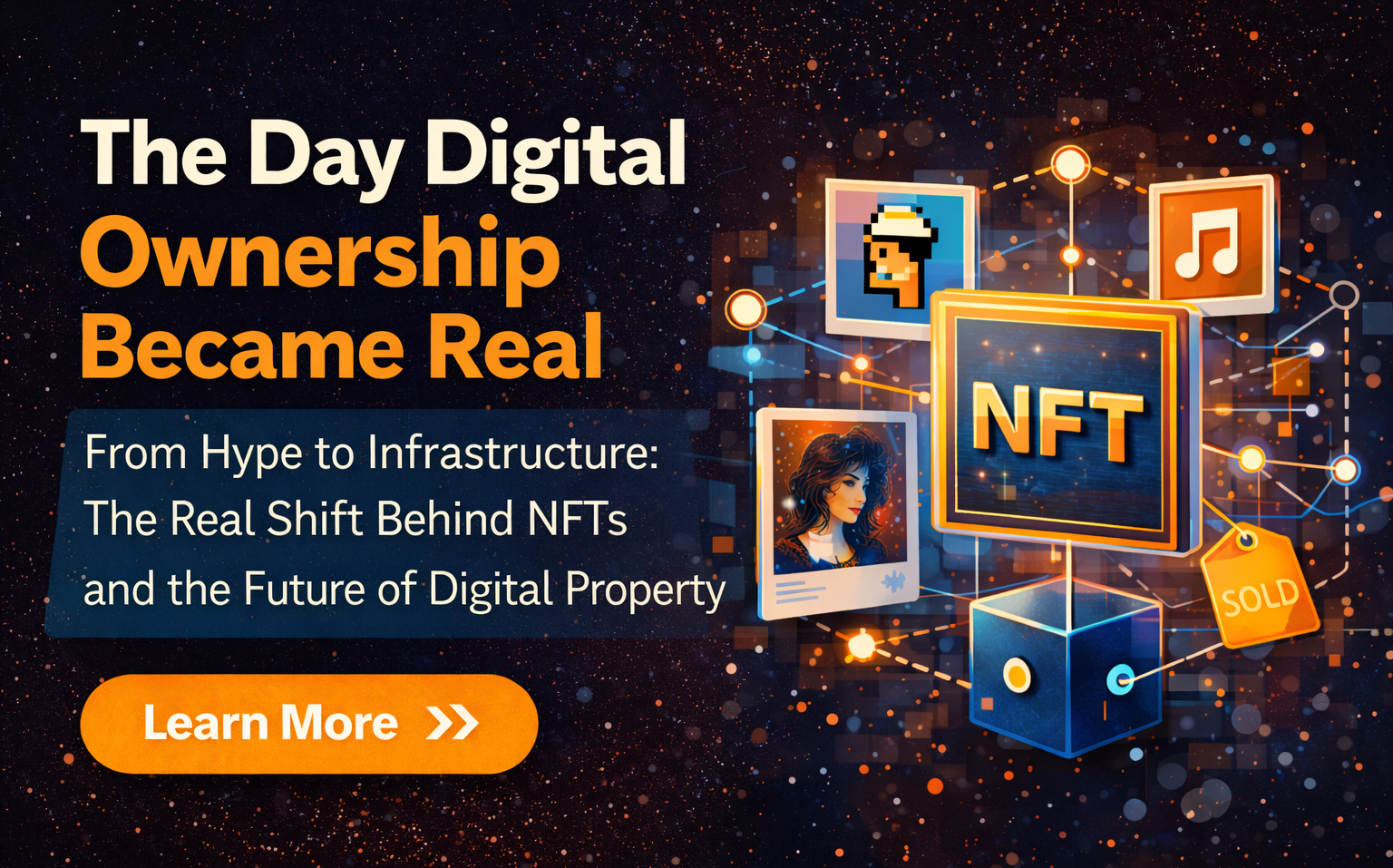
The Day Digital Ownership Became Real: Why NFTs Matter More Than You Think
How Non-Fungible Tokens Introduced Verifiable Ownership to the Internet and Redefined Digital Value
 AniketBuilds4 min read·Just now
--
In 2021, a digital artwork sold for $69 million.
It wasn’t framed.
It wasn’t hung in a gallery.
It wasn’t even physical.
It was a file.
And that moment triggered one of the loudest debates in internet history:
“How can a JPEG be worth millions?”
But that question misses the point.
Because NFTs were never about the image.
They were about ownership.
The Internet’s Missing Layer
For decades, the internet gave us the ability to copy everything.
Music.
Photos.
Videos.
Articles.
Art.
Digital content had one defining feature:
Infinite duplication.
You could download the same image as millions of others. There was no way to distinguish the “original” from a copy.
Ownership, in the digital world, was blurry.
You could own the device.
You could own the storage.
But you couldn’t truly own the file in a way that was verifiable and transferable without a central authority.
NFTs changed that.
They introduced a missing layer to the internet:
Verifiable digital ownership.
What an NFT Actually Is (Without the Hype)
NFT stands for Non-Fungible Token.
Let’s break that down.
- Non-fungible means unique.
- Token means a digital record stored on a blockchain.
Unlike Bitcoin or Ethereum which are interchangeable each NFT has a unique identity.
An NFT is:
- A token stored on a blockchain
- Linked to metadata (often pointing to digital art, music, or assets)
- Assigned to a specific wallet address
- Traceable and transferable
Important distinction:
An NFT is not the image.
It’s the proof of ownership recorded on a decentralized ledger.
That proof cannot be altered without consensus.
And that’s where the power lies.
Why Artists Were First to Adopt NFTs
Digital artists had a long-standing problem:
Their work was easy to copy and hard to monetize.
Before NFTs:
- Digital art could be screenshotted infinitely.
- There was no built-in resale royalty structure.
- Marketplaces controlled distribution.
NFTs allowed artists to:
- Sell directly to global buyers
- Encode royalties into smart contracts
- Track ownership history
- Build community-driven ecosystems
For the first time, digital art had programmable scarcity.
And scarcity creates value.
The Speculation Phase (And What It Taught Us)
Let’s be honest.
The NFT boom wasn’t purely about innovation.
It was also about speculation.
Collections sold out in minutes.
Prices skyrocketed.
Flipping became common.
Then markets cooled.
Volumes dropped.
Critics declared NFTs “dead.”
Projects disappeared.
But something important happened during the correction:
The noise faded.
And utility began to matter.
Every new technology follows a similar cycle:
Excitement → Overvaluation → Correction → Infrastructure growth.
NFTs are now in the infrastructure phase.
The serious builders stayed.
NFTs Beyond Art
While headlines focused on digital collectibles, deeper innovation emerged.
NFTs are now being used for:
Gaming Assets
Players can truly own in-game items, skins, or characters — and trade them freely.
Event Tickets
NFT tickets reduce fraud and allow programmable resale limits.
Music Rights
Artists can tokenize songs, grant ownership shares, or offer exclusive access.
Digital Identity
NFTs can represent credentials, certifications, or memberships.
Tokenized Real-World Assets
Physical property, luxury goods, or intellectual property can be represented on chain.
The concept isn’t limited to art.
It’s about tokenizing ownership.
Smart Contracts: The Hidden Engine
NFTs are powered by smart contracts — code that executes automatically when conditions are met.
That means NFTs can:
- Pay creators royalties on every resale
- Unlock content based on ownership
- Grant access to communities or platforms
- Trigger events automatically
Ownership becomes dynamic.
It’s not just “I own this.”
It’s “Because I own this, I can do this.”
That programmability opens new economic models.
The Real Question: Do NFTs Represent Copyright?
This is where confusion often arises.
Buying an NFT does not automatically mean you own the copyright.
In most cases, the creator retains intellectual property rights unless explicitly transferred.
An NFT represents:
Ownership of the token.
Proof of transaction.
On-chain authenticity.
Legal rights depend on contract terms.
Understanding this distinction is crucial for serious adoption.
NFTs and the Metaverse Economy
As digital environments expand, property rights become necessary.
In virtual worlds:
- Land can be owned.
- Avatars can wear digital fashion.
- Virtual spaces can host events.
NFTs provide a way to verify ownership of these digital assets.
Without ownership, there is no sustainable digital economy.
NFTs act as digital property deeds.
The Criticism (And Why It Matters)
NFTs have faced legitimate criticism:
- Environmental concerns (especially on early blockchains)
- Market manipulation
- Rug pulls and scams
- Overhyped valuations
- Limited mainstream understanding
These criticisms forced improvement.
Today, many NFT platforms operate on energy-efficient blockchains.
Security audits are more common.
Regulatory conversations are increasing.
Maturity takes time.
The Bigger Idea: Digital Property Rights
Step back from speculation.
Think about where the world is heading.
More of our lives are digital:
Work.
Identity.
Assets.
Entertainment.
Social interaction.
If society becomes increasingly digital, we need clear digital property frameworks.
NFTs are one attempt to build that layer.
They allow ownership to exist natively in online environments.
That concept is powerful even if early execution was imperfect.
Final Thought
That $69 million sale wasn’t about pixels.
It was about proof.
Proof that digital ownership could exist without a centralized authority.
NFTs represent a shift in how we think about:
Value.
Scarcity.
Creativity.
Property.
Identity.
Will every NFT project succeed?
No.
But the idea that digital ownership can be programmable, transferable, and verifiable is here to stay.
And once ownership becomes native to the internet, the economic possibilities expand dramatically.
The NFT era may evolve.
But the ownership layer it introduced isn’t disappearing.
It’s becoming infrastructure.