In Max Barry’s dark, hilarious, and disturbing novel Machine Man, the protagonist is a scientist named Charles Neumann.
Charles is a man who loves efficiency. He is an engineer who looks at the world and sees a series of sub-optimal systems. He creates lists. He tracks data. He minimizes waste.
One day, while working late in the lab, Charles accidentally drops a piece of heavy machinery on his leg. It crushes the limb. He is rushed to the hospital, where the doctors are forced to amputate.
Most people would view this as a tragedy. Charles views it as a data point.
While recovering, he designs his own prosthetic leg. He builds it with carbon fiber, servos, and hydraulics. And when he attaches it, he realizes something profound: The machine is better than the meat.
His new leg doesn’t get tired. It doesn’t get cramps. It is stronger, faster, and more durable than his biological leg. It is, in every measurable way, an upgrade.
So, Charles does the only logical thing an engineer obsessed with optimization would do: He cuts off his other leg.
He replaces it with a second machine. Then he looks at his hands. They are clumsy. They tremble. They are “legacy hardware.” So, he cuts them off.
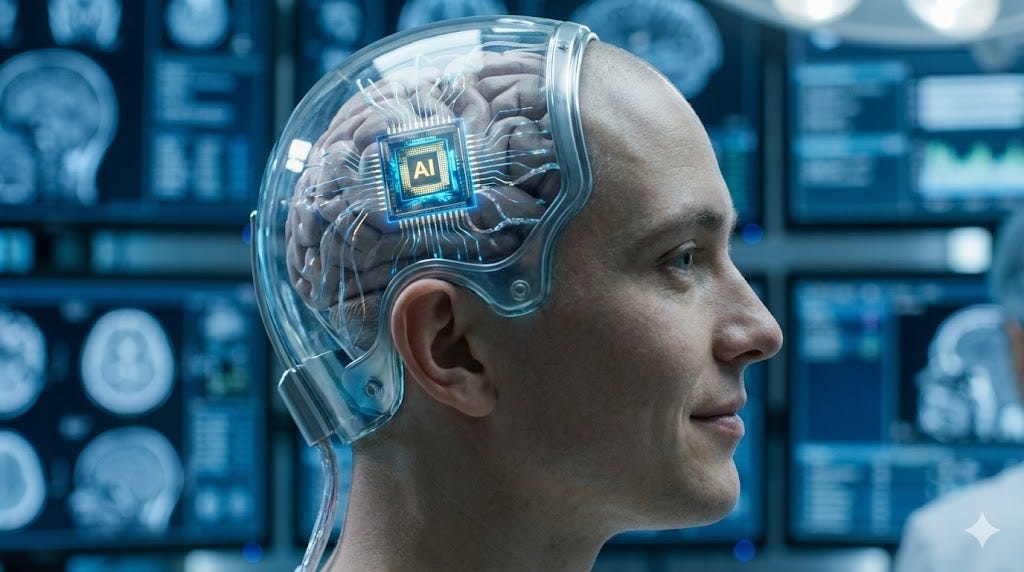
The novel follows Charles’s descent into madness as he systematically replaces every part of his body (his eyes, his internal organs, his blood) seeking the ultimate state of efficiency. He becomes a sleek, powerful, terrifying cyborg. He eliminates all the “friction” of being human.
But in the process, he loses the ability to touch. He loses the ability to feel warmth. He loses his connection to the woman he loves because he literally cannot hold her without crushing her. He becomes a perfect machine, and in doing so, he ceases to be a person.
I find Machine Man to be the perfect parable for the modern “High Performer.”
We are currently obsessed with Optimization.
· We track our sleep with Oura rings.
· We track our productivity with RescueTime.
· We use AI to write our emails, schedule our meetings, and summarize our reading.
We are hacking off our “slow” biological parts (our messy brainstorming, our wandering attention, our need for rest) and replacing them with algorithmic prosthetics. We are becoming Charles Neumann.
We think we are becoming “Better.” But we need to ask: What are we cutting off to get there?
Here is why the “Machine Man” mindset is a trap, and why the most inefficient parts of your day might actually be the most valuable.
1. The Upgrade Paradox (The Ship of Theseus)
The central philosophical question of the book is a version of the Ship of Theseus: If you replace every plank of a ship, is it still the same ship?
If Charles replaces every part of his body with a machine, is he still Charles?
At first, Charles argues “Yes.” He argues that “Charles” is the software (his mind), and the body is just hardware. But as the book progresses, his mind changes. The machine parts influence his thinking.
· Because he is strong, he becomes aggressive.
· Because he doesn’t feel pain, he loses empathy for others’ pain.
· Because he is “perfect,” he develops contempt for the “broken” humans around him.
The hardware rewrites the software.
The Corporate Reality: The AI-Optimized Culture
I see this happening in companies that aggressively adopt AI tools to “optimize” their workforce.
· The Scenario: A marketing team replaces their copywriters with ChatGPT (Optimization 1). Then they replace their graphic designers with Midjourney (Optimization 2). Then they replace their project managers with an AI Agent (Optimization 3).
· The Result: The output is faster. The costs are lower. The metrics look great.
· The Trap: The culture shifts. The company stops caring about craft and starts caring about volume. The “Voice” of the brand becomes generic because the “Hardware” (the AI) creates generic output.
By replacing the messy human parts with efficient machine parts, the company loses its identity. It becomes a Ship of Theseus that has forgotten where it is sailing.
The Strategic Lesson
You are your inefficiencies.
· Your unique writing style comes from your specific, inefficient way of thinking.
· Your company culture comes from the messy, inefficient conversations at the coffee machine.
The Fix: The “Do Not Optimize” List
You must identify the parts of your business (and your life) that are Sacred.
· The Rule: “We will use AI to schedule the meeting, but we will never use AI to run the meeting.”
· The Rule: “We will use AI to code the widget, but we will never use AI to design the widget.”
· Keep the heart meat. Optimize the rest.
2. The Feedback Loop of Dissatisfaction (Better is Never Enough)
One of the funniest and saddest parts of the book is Charles’s relationship with his own upgrades.
The moment he installs his new mechanical legs, he is ecstatic. He runs fast. He jumps high.
But 24 hours later, he notices a flaw. The servo whines a little bit. The battery life could be better. The firmware is buggy.
The ecstasy of the upgrade fades instantly, replaced by the itch for Version 2.0.
He spends the entire book in a state of perpetual dissatisfaction. He is never “finished.” He is always in “Beta.” He can never enjoy his life because he is too busy patching his existence.
The Corporate Reality: The Productivity Trap
We are living in the Era of the Stack.
I know leaders who spend more time optimizing their “Productivity Stack” (Notion, Obsidian, Zapier, Superhuman, ChatGPT) than they do actually working.
· They find a new AI tool that saves them 5 minutes.
· They spend 10 hours setting it up.
· They use it for a week.
· They find a better tool.
· Repeat.
They are Charles Neumann. They are cutting off their hands every week to install a slightly better clamp.
The Strategic Risk: Meta-Work
This is Meta-Work: Work about work.
It feels like progress because it is technical. It gives you a dopamine hit. “Look at my new workflow!”
But it is a distraction. While you are upgrading your legs, your competitor (who is walking on old, slow, biological legs) has already crossed the finish line because they just kept walking.
The Fix: The “Stack Freeze”
· The Protocol: Declare a “Tool Freeze” for Q1.
· The Rule: “We are not allowed to switch project management software. We are not allowed to try a new AI agent. We must use what we have.”
· The Insight: A mediocre tool used by an expert is better than a perfect tool used by a novice. Mastery comes from using the same tool for 10,000 hours, not trying 10,000 tools for an hour.
3. The Loss of Touch (The Haptic Disconnect)
The most heartbreaking scene in the book occurs when Charles tries to hold the hand of Lola, the woman he loves.
His mechanical hand is a marvel of engineering. It can crush a steel pipe. It can type 200 words per minute.
But it has no haptic feedback. He can’t feel the softness of her skin. He can’t feel the warmth. He has to rely on visual sensors to tell him if he is crushing her bones.
He has optimized for Output (Strength), but he has lost Input (Sensation).
He is powerful, but he is numb.
The Corporate Reality: The Data-Driven Numbness
In the corporate world, AI gives us infinite Output. We can generate unlimited emails, unlimited code, unlimited reports.
But AI has terrible Input. It cannot “feel” the room.
· The Scenario: A CEO sends an AI-generated email announcing layoffs.
· The Output: The email is clear, concise, and legally perfect. It is “Strong.”
· The Input: The email lacks the “haptic feedback” of human empathy. It feels cold. It enrages the workforce. The CEO is baffled. “But the email was logical!”
The CEO has become Charles. He has crushed the hand he meant to hold because his tool provided no sensation.
The Strategic Risk: The Empathy Deficit
When you mediate your relationships through algorithms, you go numb.
· If you look at your customers as “Data Points” on a dashboard, you stop feeling their frustration.
· If you look at your employees as “Utilization Rates,” you stop feeling their burnout.
The Fix: The “Analog” Meeting
To restore sensation, you must remove the glove.
· The Protocol: For high-stakes emotional conversations (hiring, firing, strategic pivots), ban the tech. No Zoom. No AI notes.
· The Act: Sit in a room. Look them in the eye. Shake their hand.
· The Logic: You need the “bandwidth” of biological connection (micro-expressions, tone, body heat) to make the right decision. Don’t trust the sensors. Trust your gut.
4. The Dependence on the Vendor (Proprietary Biology)
As Charles becomes more machine, he realizes a terrifying truth: He doesn’t own his own body.
His legs are manufactured by a corporation called Better Future.
His eyes rely on proprietary software.
He needs firmware updates to walk. He needs a charging station to survive.
He has traded his biological autonomy for corporate dependency. If Better Future goes bankrupt, or if they decide to “brick” his legs via a remote update, Charles is a statue. He is a subscription-based organism.
The Corporate Reality: The SaaS-ification of Skills
We are doing this to our workforce.
· We are hiring “Prompt Engineers” whose entire skillset is dependent on OpenAI’s current model.
· We are building companies that run entirely on rented APIs.
We are turning our employees into Subscription-Based Workers.
· The Risk: If GitHub Copilot goes down, your developers can’t code. They have forgotten how to write the syntax without the prosthetic.
· The Risk: If Salesforce raises its prices, your sales team is held hostage because they don’t know how to sell without the CRM data enrichment.
We are trading “Sovereignty” for “Convenience.”
The Strategic Lesson
Independence is inefficient, but it is resilient.
· A biological leg is slow, but it heals itself. It doesn’t need a Wi-Fi connection. It doesn’t have a Terms of Service agreement.
· The Fix: Skill Redundancy.
o Ensure your team can still do the math without the calculator.
o Once a quarter, run a “Blackout Day.” Turn off the AI tools. Can the team still function? If not, you don’t have a team; you have a dependency.
5. The End of the Man (The Singularity of Boring)
(Spoilers for the end of Machine Man).
By the end of the book, Charles has achieved his goal. He is almost entirely machine. He is interfaced directly with the computer.
And he finds that it is… boring.
The chaos of being human (the hunger, the desire, the fear) was what drove him. The “friction” was the fuel.
When he removes the friction, he removes the motivation. He becomes a super-computer with nothing to compute. He realizes that “Perfect” is a synonym for “Dead.”
The Corporate Reality: The AI Stagnation
This is the long-term danger of AI.
If we use AI to remove all the “boring” parts of work (the research, the drafting, the debugging) we might find that we have removed the parts that teach us how to think.
· The Junior Analyst: If the Junior Analyst never has to grind through the Excel sheets because the AI does it, they never develop the intuition for the numbers. When they become a Senior Analyst, they are useless.
· The Writer: If the writer never struggles with the bad first draft, they never find the surprise insight that comes from the struggle.
We are optimizing away the Learning Journey.
The Strategic Conclusion: Keep the Struggle
As a leader, you must protect the “Struggle.”
· The Mandate: Do not automate the learning process. Automate the execution process.
· The Example: Let the AI format the slide deck. Do not let the AI write the story of the slide deck. The struggle to write the story is where the strategy is born.
Conclusion: Don’t Cut Off Your Leg
Max Barry wrote Machine Man as a satire of gadget culture. But today, it reads like a documentary of the Silicon Valley mindset.
We are surrounded by Charles Neumanns.
· They tell us that sleep is a bug.
· They tell us that conversation is latency.
· They tell us that humanity is a legacy platform that needs to be deprecated.
They offer us a shiny, carbon-fiber alternative. They offer us the AI Agent that never sleeps. They offer us the productivity hack that eliminates all downtime.
It is tempting. It is so, so tempting to cut off the slow, tired, biological parts of ourselves and replace them with the machine.
But before you pick up the saw, remember Charles.
Remember that the machine is strong, but it cannot feel.
Remember that the machine is fast, but it cannot love.
Remember that the machine is efficient, but it is not you.
Efficiency is a metric. Humanity is the mission.
Keep your messy, slow, inefficient biological legs. They are the only things that can take you where you actually want to go.
The Cyborg Trap: What Machine Man by Max Barry Teaches Us About Self-Optimization was originally published in DataDrivenInvestor on Medium, where people are continuing the conversation by highlighting and responding to this story.