In Justin Cronin’s sprawling apocalyptic epic The Passage, the end of the world doesn’t begin with a nuclear bomb. It doesn’t begin with an alien invasion or a climate catastrophe.
It begins with a government experiment called Project Noah.
In a secret military facility in Colorado, a team of brilliant scientists believes they have discovered the key to the next stage of human evolution. They have found a rare virus in the jungles of Bolivia that boosts the immune system, enhances strength, and effectively grants immortality.
Their goal is to create the ultimate super-soldier: faster, stronger, and harder to kill than any human in history. They believe they can harness this chaotic biological force to make humanity “better.”
But the experiment fails.
The twelve test subjects do not become super-soldiers. They become “Virals.” They are stripped of their memories, their names, and their humanity. They are transformed into apex predators who are inextricably linked to a single, psychic Hive Mind. They stop thinking as individuals. They only hunger.
When the containment fails (as it always does), the Virals escape, and civilization falls. The lights go out, and humanity is plunged into a century of darkness, hunted by a collective intelligence that knows no fear, no doubt, and no mercy.
When I read The Passage, I was terrified by the monsters. Today, I am terrified by the scientists.
I see the same arrogance in the way modern organizations are deploying Artificial Intelligence.
Corporate leaders are looking at AI like the scientists looked at the virus: as a miracle drug. They believe that if they inject AI into every workflow, every email, and every line of code, they will create “Super-Employees.” They think they will build a workforce that is faster, smarter, and more efficient than ever before.
But they aren’t looking at the side effects.
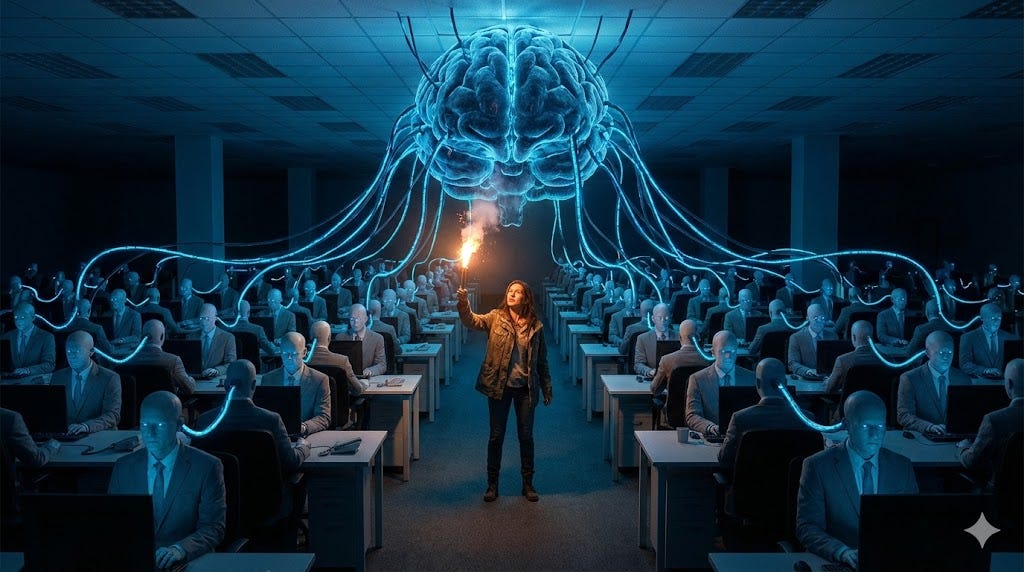
We aren’t creating super-soldiers. We are creating a Hive Mind. When every employee uses the same Large Language Model (LLM) to write their emails, design their strategies, and think their thoughts, individual creativity dies. The unique, jagged edges of human intellect are smoothed out into a bland, polite average.
We are assimilating our workforce into a sea of sameness. We are turning our thinkers into Virals.
Here is why the horror of The Passage is the perfect metaphor for the cognitive crisis facing your company, and how to keep the lights on in your organization.
1. The Death of the Individual Voice (The Hive Mind Effect)
The true tragedy of the Virals in Cronin’s book isn’t just that they are violent. It is that they are erased.
Before the experiment, the Twelve test subjects were distinct human beings. They were criminals, yes, but they had names. They had histories. They had unique voices. After the virus takes hold, those voices are drowned out by the roar of the collective. A Viral doesn’t make decisions; it receives instructions from the Hive. It is a node in a network, indistinguishable from the node next to it.
The Corporate Reality: The “Beige” Workforce
I see this “erasure” happening in real-time in the corporate world.
A few years ago, I could read a report from my team and know exactly who wrote it. I could hear Sarah’s cautious optimism in the executive summary. I could hear David’s sharp, analytical cynicism in the risk assessment. Their writing had Voice.
Today, I read reports that are grammatically perfect, structurally sound, and completely soulless.
The Scenario: A Marketing Director asks her team to draft a launch strategy.
The Process: Three different employees open ChatGPT. They all type in slightly different prompts, but they are all hitting the same central model (GPT-4).
The Output: The model gives them all the same “best practice” advice, written in the same helpful, neutral, corporate tone.
When those three employees submit their drafts, the Director can’t tell them apart. Sarah is gone. David is gone. There is only the AI.
The Strategic Risk: Algorithmic Monoculture
This is called Algorithmic Monoculture. Just as a farmer who plants only one type of corn is vulnerable to a single blight, a company that relies on a single model for its thinking is vulnerable to “cognitive blight.”
If everyone is using the same tool to do their thinking, you lose Cognitive Diversity. You stop getting the “weird” ideas, the risky ideas, and the counter-intuitive ideas that lead to breakthroughs. You get the “average” of the internet, replicated a thousand times.
The Fix: The “Turing Test” for Employees
As a leader, you must fight for the preservation of individual voice.
The Policy: Ban the use of AI for “First Drafts” on high-stakes strategy. Require your team to bullet-point their own original thoughts before they let the AI polish them.
The Test: If you cannot tell which of your employees wrote a memo, send it back. Tell them: “I don’t want the viral version. I want the human version. Put your name on this, not just on the header, but in the thinking.”
2. The Patient Zero Problem (The Lineage of Corruption)
In the lore of The Passage, the Virals function like a pyramid scheme of infection.
At the top is Zero (Professor Tim Fanning, the first subject). Below him are the Twelve. Below them are the millions of infected citizens.
The terrifying rule of this biology is that the lineage is absolute. Every Viral is psychically tethered to its creator. If the “Zero” is corrupt, the entire bloodline is corrupt. If the “Twelve” are hungry, the millions feed. The error at the top amplifies exponentially as it moves down the chain.
The Corporate Reality: Model Collapse and Bias
We are building this same fragility into our knowledge management systems.
In data science, there is a concept called Model Collapse. This happens when an AI model is trained on data generated by other AIs. Over time, the model loses touch with reality. The “signal” degrades. The output becomes stranger, more hallucinatory, and more homogenous.
The Scenario:
· Generation 1: You use an AI to write a rigorous policy document based on human inputs. It’s 95% accurate.
· Generation 2: Next year, a new manager uses AI to summarize that policy document for a slide deck. The nuance is lost.
· Generation 3: New hires use an AI chatbot to query the slide deck to learn the rules.
By Generation 3, the employees are following a hallucinated version of a summary of a draft. The “Zero” error (the 5% inaccuracy in the first draft) has become the law of the land.
The Strategic Risk: The Echo Chamber
If your organization creates a “closed loop” where AI is training on AI, you are building a viral lineage of bad data.
If your recruiting AI has a bias against women (the “Zero” error), and you use its output to train your performance review AI, you have infected the entire employee lifecycle with bias.
You cannot isolate the problem because the problem is in the blood of the system.
The Fix: Guard the Source Code
You must treat your “Ground Truth” data like the scientists should have treated the virus: with extreme containment protocols.
· Human-Generated Training Data: Ensure that the data you feed into your internal models is verified, human-created work. Do not let the AI eat its own tail.
· The “Zero” Audit: Regularly audit the core prompts and system instructions (the “Zero”) that govern your bots. A small tweak in the system prompt (“Be concise”) can lead to a massive loss of critical detail downstream.
3. The Arrogance of Containment (Project Noah)
The most frustrating part of The Passage is the hubris of the scientists.
They genuinely believe they are in control. They build a fortress in the Colorado mountains. They have layers of security, retinal scanners, and “fail-safe” protocols. They have containment cells lit by high-intensity UV lights because they know the Virals fear the light.
They believe they can “sandbox” the apocalypse.
But complex systems always fail. A storm knocks out the power. A janitor forgets to lock a door. An ego gets in the way. The containment breaks, and because the scientists relied entirely on the walls to keep them safe, they have no Plan B when the walls fall.
The Corporate Reality: “Sandboxing” and Shadow AI
I see this arrogance in every IT department across the industry.
“We have a secure, private instance of Azure OpenAI. Our data is safe.”
“We have a policy that employees cannot put proprietary code into ChatGPT.”
They believe they have contained the virus.
But they are ignoring the human element. Just like the janitor in the book, an employee will find a workaround.
· A developer will paste code into a personal Discord bot to debug it faster.
· A sales rep will upload the entire customer database to a shady “Lead Gen AI” tool they found on Twitter because they need to hit quota.
The containment will break.
The Strategic Risk: The Leaky Fortress
If your entire strategy relies on “Blocking” and “Containing” AI, you will fail. The pressure to use these tools is too high. The “Virals” (the shadow AI tools) are already inside the building.
The Fix: Resilience Over Containment
Instead of trying to build a perfect wall (which is impossible), build a resilient organization.
· Assume the Breach: Operate under the assumption that your data is already leaking. How do you mitigate the damage?
· Educate, Don’t Ban: Instead of blocking ChatGPT (which makes employees use it on their phones, where you have zero visibility), provide a sanctioned, monitored enterprise tool. Bring the Virals into the light where you can see them.
· Data Sanitization: Teach employees how to scrub PII (Personally Identifiable Information) before they prompt. The best defense is not a wall; it’s a smart workforce.
4. The Amy Option (The Human Constant)
In the bleak world of The Passage, there is one hope. Her name is Amy Harper Bellafonte.
Amy was also a test subject at Project Noah. She was injected with the virus. But unlike the Twelve, she didn’t turn into a monster. She didn’t lose her memory. She didn’t join the Hive Mind.
She retained her humanity. She became a bridge: someone who understood the power of the virus but was not consumed by it. She is described as “The Girl from Nowhere,” the one who walks between the worlds.
The Corporate Reality: The Hybrid Employee
As we navigate this AI revolution, we need to find and cultivate our “Amys.”
These are the employees who are AI-Fluent but Human-Anchored.
They know how to use the tools. They are power users of ChatGPT, Midjourney, and Copilot. They are faster and stronger because of the “virus.”
BUT, they have not lost their voice. They still check the facts. They still inject empathy into the email. They still question the output.
These are the most valuable people in the modern economy.
The Strategic Lesson: Hiring for Soul
In the past, we hired for “Skills.” We asked: Can you write code? Can you write copy?
Today, AI can do the skills. The skill floor has been raised to the ceiling.
Now, we must hire for “Soul.” We must hire for the things the virus cannot copy:
· Taste: Can you tell the difference between “good” output and “average” output?
· Curiosity: Do you ask questions the AI didn’t predict?
· Ethics: Do you care about the impact of the decision?
The Fix: The “Amy” Pipeline
Stop hiring people who are just good at following instructions (the AI does that). Start hiring people who are good at giving them. Look for the candidates who bring a unique, weird, undeniable humanity to the interview- the ones who resist the homogenization of the standard interview script.
Conclusion: Don’t Let the Lights Go Out
The metaphor of The Passage is terrifying, but it is also hopeful. The world ends, yes. But it begins again.
We are currently living through “The Passage” of our own industry. The old world (the world of manual knowledge work, of slow, deliberate individual drafting) is ending. The new world is faster, scarier, and connected by a digital nervous system that we barely understand.
As leaders, we are the scientists at Project Noah. We have the syringe in our hands. We have the power to inject our organizations with this new force.
We can choose to create a Hive Mind. We can choose to prioritize speed over thought, efficiency over identity, and metrics over humanity. We can turn our employees into Virals- mindless processors of data, linked to a central brain, creating a world of infinite noise and zero signal.
Or, we can choose the Amy Option.
We can use the power to enhance our humanity, not replace it. We can build organizations that are faster and kinder. Smarter and more creative.
The choice comes down to one simple principle, one that I learned in the hallways of my high school and that I see confirmed in the data of the Fortune 500:
Efficiency is a metric. Humanity is a mission.
Don’t let the lights go out on human thought. Because once they do, it is a very long, dark road back.
The Corporate Hive Mind: What The Passage by Justin Cronin Teaches Us About Homogenization was originally published in DataDrivenInvestor on Medium, where people are continuing the conversation by highlighting and responding to this story.