The Contract That Bills Itself: How Contract-on-Trigger™ Closes the Last 30% of the Last Mile
 Guillermo Rivero7 min read·Just now
--
I wrote recently about the last mile of collections — the two or three hours every morning that small businesses lose to matching bank deposits to open invoices. Invoice-on-Payment™ was our answer: don’t issue the invoice until the money arrives.
There’s a harder problem upstream. Before a payment ever arrives, someone has to agree on what’s being paid for, when, and in what sequence. And that agreement — the contract — is where most B2B service businesses bleed.
This is how Contract-on-Trigger™ fixes it.
The problem most AR software pretends doesn’t exist
Maria runs a small HVAC company in Orlando. She takes a job to install a commercial heating system — $15,000, three visits, three phases.
Here is what happens today in 94% of shops like hers:
She sends a quote by email. The customer replies “ok, let’s do it.” No signed contract. No defined milestones. No agreed billing schedule.
She does visit one: rough-in, pulls permits, runs ductwork. She texts the customer a photo and a number: “$5,000 due for phase one.”
Sometimes the customer pays. Sometimes they say they’ll pay next week. Sometimes they pay and dispute the amount two weeks later because they don’t remember agreeing to $5,000 for rough-in specifically — they thought it was $15,000 total, split however it lands.
Maria does visit two. Visit three. She sends one final invoice for the balance, trying to remember what was already paid and what wasn’t.
The customer pays. Or doesn’t. Or pays a different amount. Or disputes it.
Maria has no leverage. No contract. No court.
She absorbs the loss, or she spends forty hours on the phone, or she hires an attorney for a $15,000 receivable that costs $3,000 to pursue.
This is the last 30% of the last mile. Not reconciliation — authorization. Not payment matching — payment justification. And it’s a problem that platforms like Ironclad, DocuSign, and PandaDoc solve in a different silo from the one where AR automation platforms like Bill.com, Chaser, and RemindLedger™ operate.
The result: the contract sits in one tool, the billing sits in another, the payment sits in a third, and the exception — the dispute — falls through the gap between them.
The insight: a contract is a schedule of triggers
Most AR tools treat a contract as legal paperwork — something you sign, archive, and forget. At best, it’s a reference document you pull up when things go wrong.
But what if the contract were operational?
A B2B service contract is, fundamentally, a schedule of events that trigger payments:
“When signing occurs, Milestone 1 becomes billable for $5,000.” “When rough-in is complete and photo-documented, Milestone 2 becomes billable for $7,000.” “When inspection is passed, Milestone 3 becomes billable for $3,000.”
Each milestone is a trigger. Each trigger is a billing event. Each billing event, if we’re lucky, is eventually a payment.
Today, those triggers live in Maria’s head (or her assistant’s spreadsheet, or an email thread buried three months back). That’s where the system breaks.
Contract-on-Trigger™ puts the triggers into the system of record.
The contract — signed once, upfront, with milestones defined — becomes the engine that drives the billing. And the billing drives Invoice-on-Payment™, which drives reconciliation into the ERP.
One workflow. One system. One contract-to-cash path.
How it actually works
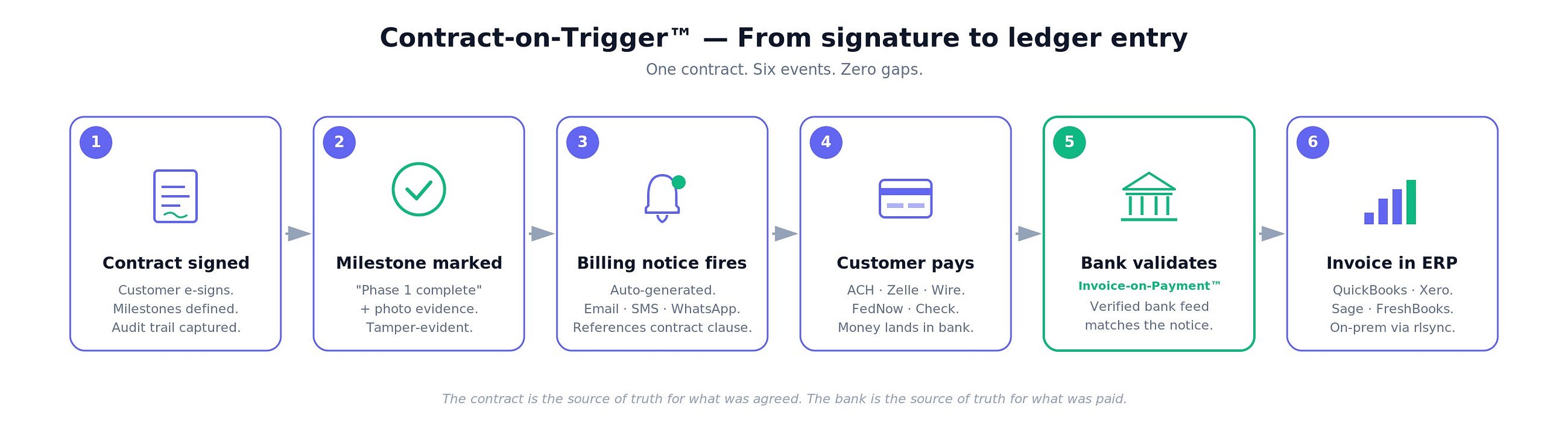
Step by step, from Maria’s perspective:
- She creates the contract in RemindLedger™. Customer name, project description, three milestones defined with amount and completion criteria. The contract is sent for e-signature — built-in for Tier 1 (ESIGN/UETA-compliant SES), or DocuSign integration for Tier 2 where higher-assurance signature is needed (real estate-adjacent, healthcare, or enterprise counterparties).
- The customer signs. Audit trail captures intent, IP, timestamp, device fingerprint, and the exact contract text at the moment of signature. The contract is tamper-evident from that moment forward.
- Maria does visit one. She uploads two photos to the milestone record and marks “Milestone 1: rough-in complete.”
- Contract-on-Trigger™ fires. A billing notice — not an invoice — is auto-generated for $5,000 and sent to the customer’s preferred channel: email, SMS, or WhatsApp. The notice references the exact contract clause and the evidence uploaded.
- The customer pays. Zelle, ACH, Wire, Check, FedNow — whatever rail they use. The money lands in Maria’s business account.
- Invoice-on-Payment™ validates. RemindLedger reads the verified bank feed, matches the incoming payment to the billing notice, and only then generates the official invoice — already paid, exact amount, correct taxes, the right line items. The invoice flows into Maria’s QuickBooks (or Xero, or Sage, or FreshBooks, or her on-prem ERP via rlsync).
- The next milestone moves to active. Milestone 2 is now visible, waiting for rough-in plus photo evidence plus a marked-complete action.
From contract to cash, one flow. From bank confirmation to ERP, automatic. From signed commitment to paid invoice, auditable at every step.
Why the contract matters more than the billing notice
If a customer disputes “I never agreed to $5,000 for rough-in” — Maria has:
- The signed contract with the exact milestone amount
- The date of signing and the IP/device fingerprint at signature
- The photo evidence of rough-in completion
- The billing notice referencing the specific contract clause
- The bank-confirmed payment trail
That’s not just better record-keeping. That’s the difference between eating a $5,000 loss and winning a small-claims case in forty minutes.
For B2B service businesses — contractors, consultants, HVAC, plumbers, IT services, agencies, wholesale distributors with milestone deliveries — this is the feature that makes the AR workflow defensible in court and in dispute mediation. Not sexier. Not faster. Just defensible.
And for the first time, it’s defensible inside the same system that handles reconciliation.
Two tiers, 95% and 5%
Contract-on-Trigger™ ships with two signature tiers.
Tier 1 — Built-in Simple Electronic Signature (SES). ESIGN Act and UETA-compliant out of the box. Full audit trail. No per-envelope fees. Works for the 90–95% of B2B service contracts below $50,000: HVAC installations, consultant retainers, maintenance agreements, wholesale supply contracts, services with defined milestones.
Tier 2 — DocuSign integration. For the 5–10% of contracts that need higher-assurance signature: real estate-adjacent work, healthcare counterparties (HIPAA-adjacent), enterprise vendors who require brand-recognized signature, cross-border contracts with EU counterparties (eIDAS QES), or high-value deals where dispute risk justifies the incremental cost.
The same contract can escalate from Tier 1 to Tier 2 per-envelope when needed — you don’t choose the tier by subscription plan, you choose by contract risk profile.
The workflow stops being “AR automation.” It becomes the system of record.
Here is the progression:
Before Invoice-on-Payment™: spreadsheets, WhatsApp threads, and hope.
With Invoice-on-Payment™: the bank becomes the source of truth for what got paid.
With Contract-on-Trigger™ + Invoice-on-Payment™: the contract becomes the source of truth for what was agreed, the milestone completion becomes the source of truth for what was delivered, and the bank becomes the source of truth for what was paid.
Three sources of truth, one workflow, zero places for a dispute to hide.
This is not two products. It’s one platform, one narrative, one family of methodologies we call the -On- family at Miurata: Contract-on-Trigger™ initiates the ledger, Invoice-on-Payment™ closes it, and eventually — when the regulatory build-out supports it — Money-on-Payment™ extends the same architecture to cash delivery networks.
What this means for small businesses
If you run a B2B service business that bills on milestones:
- Stop treating your contracts as paperwork you file away.
- Stop letting your billing schedule live in your assistant’s head or a shared Google doc.
- Stop absorbing milestone disputes because “the contract wasn’t clear.”
The contract is the system.
The milestone is the trigger.
The bank confirmation is the closure.
That’s Contract-on-Trigger™ plus Invoice-on-Payment™, working as one.
What’s next
RemindLedger™ launches in the United States in May 2026 with Invoice-on-Payment™ live from day one. Contract-on-Trigger™ enters general availability in Q1 2027 as a tier upgrade — built on the same integrated flow, using the same bank-validated reconciliation, tamper-evident by design.
The first US pilot of the combined flow begins next month with a services business we’ll profile once the case study is signed off.
If you’re a B2B service business tired of losing milestone disputes and manually tracking what was billed versus what was paid — reach out. Invoice-on-Payment™ solves the last mile of collections. Contract-on-Trigger™ solves the last mile of authorization. Together, they’re the last mile.
Guillermo Rivero is the founder of Miurata Solutions LLC, which operates RemindLedger™ (US, launching May 2026) and CentroPago (Latin America, live since 2023). Invoice-on-Payment™, Contract-on-Trigger™, and Money-on-Payment™ are trademarks of Miurata Solutions LLC. Money-on-Payment™ is a forward-looking architectural concept currently in the USPTO trademark filing stage; commercial deployment is planned for 2029 subject to regulatory build-out.