
THE COIN ISN’T THE BET
 Derek Wayne Bailey10 min read·Just now
--
The rails are
In my opinion, people still trying to decide which coin to buy are playing a lesser game. The real game will be played one layer down, and almost no one understands how one layer rules the other.
There are now more than five thousand coins in circulation, with new ones launching faster than the market can name them. Every quarter, the financial press devotes another round of speculation to which three will survive — which protocol will displace Ethereum, which Layer-2 will swallow the throughput problem, which memecoin will defy gravity one more time. The question is treated as if it matters. It matters far less than the question almost no one is asking: is it possible to own the rails underneath all of them?
- • •
Here is what you need to grasp.
Every coin is really an electricity trade
Strip away the price charts and the protocol arguments and the same transaction sits at the bottom of every cryptocurrency: electricity in, coin out. A chain is just a lot of computations; a computation is electricity moving through logic gates; the coin is the receipt for the work done. This is not interpretation. It is the physics of the asset class. The miner who finds cheaper electricity — which is the reason power cost is the industry’s central preoccupation — or who needs less electricity to produce the same coin wins on margin. The miner who is also faster wins twice over, because speed compounds — more attempts in the same window, more blocks won, more validations confirmed, more fees captured. Whoever lowers the electricity cost of the computation and raises the speed of it simultaneously holds a structural advantage that no decades-long power contract, no migration to a colder grid, and no protocol redesign can overcome.
That makes the substrate that performs the computation, not the coin produced by it, the highest value asset under the asset class. The owner of the substrate sits in the same economic position as the utility company. The electric company does not place a bet on coins. The phone company does not select the call most likely to result in a sale. Each is paid because the work flows across what they own, and the work flows because there is no other way for it to flow. The substrate that converts electricity into coin most efficiently will be paid regardless of which coin is being produced, and is exposed to none of the speculative risk of the coins themselves. Every reduction in the electricity required to produce the same coin is another arbitrage in the substrate owner’s favor — the spread between what it costs to mint and what the market still pays.
It is the cleanest form of economic rent in the industry, and almost no one has identified it as the actual prize.
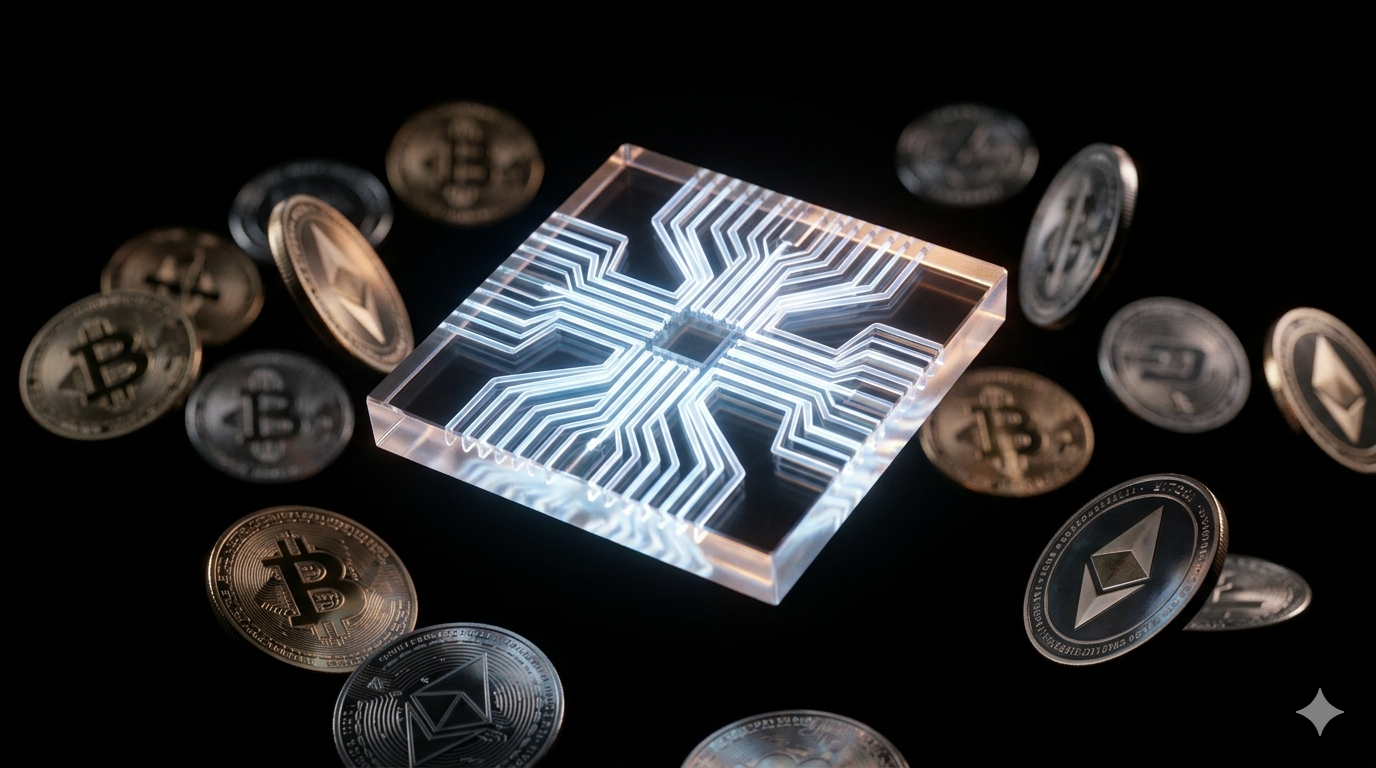
This is the structural position True Photonic is moving toward, and the asset the crypto market has not yet priced. Five thousand coins compete for attention and capital and developer mindshare. The compute beneath them does not. The compute is a single category, governed by a single equation — joules per hash, joules per validation, joules per settlement — and the substrate that performs that work on fewer joules and in less time takes a share of every transaction on every chain. Coin selection is a guess. Substrate ownership is a position.
- • •
Cost basis decides the race
Mining, in the literal Bitcoin sense and in the broader sense of consensus computation across proof-of-work and proof-of-stake systems, is a margin business with the margins set by electricity. The miner with the lowest cost per joule wins the block, regardless of which coin’s algorithm is running. Everyone in the industry knows this. It is the reason for what you are watching firms do — relocating to Iceland, signing twenty-year hydro contracts, parking containers next to flare gas in West Texas — all variations on the same desperate optimization of a curve that seeks cheaper energy to feed hungry transistors.
Our new photonic substrate is not on that curve. It is on a new one. Logic-in-Light™ architecture is designed to perform computation in the optical domain rather than the electronic. Validated switching at the gate level puts projected system-level throughput on the order of five to ten thousand times current electron-logic standards, with power draw designed at roughly a tenth. The implications, measured against the legacy industry’s published numbers, are difficult to overstate. Cooling water — the externality that has turned three continents of public opinion against mining and data center expansion — is absent by design, and the potential exists to operate an entire blockchain on solar input alone. Long story short, we are leaving the entire economic model of the legacy mining facility behind — the desperate hunt for stranded power, the capex on cooling towers, the negotiation with municipal water authorities.
We are not bending the curve. We are moving away from it.
- • •
One substrate unbounded
The comparison to legacy mining infrastructure breaks down further at the manufacturing layer. The Bitmains and MicroBTs of the industry exist because transistor-silicon can only perform the SHA-256 hash function efficiently if SHA-256 is etched into the silicon. That is what an ASIC is — a single-algorithm chip, manufactured at fab scale, locked to one coin’s hash function, depreciating from the moment it leaves the loading dock. The eighteen-month obsolescence curve is not a flaw in the business model; it is the business model. The customer pays for a machine that will be worth forty cents on the dollar when the next generation ships, and the manufacturer ships the next generation in eighteen months whether the customer has met its financial targets or not.
The photonic compute substrate is not built that way. It is designed as programmable optical logic, which means the configuration is what changes when the workload changes and the physical fabric does not. The same substrate is designed to hash SHA-256 in one instance, validate a different proof-of-stake chain in the next, run an artificial intelligence inference workload in the third, settle a micropayment in the fourth. One fabric, every workload. No fab cycle when a new coin launches with a new hash function. No write-down when an algorithm shifts. And because the substrate is hosted, none of those costs land on the customer either — no ASIC box, no hardware to own, no depreciation cycle to manage.
The substrate was going to be built because the underlying compute market — across artificial intelligence, scientific simulation, financial settlement, national defense, and the rest of the workloads that demand general-purpose high-throughput computation — was always going to demand it. Artificial intelligence alone is already pushing the legacy electron-logic infrastructure past its thermal, power, and water limits, and the public opposition to data center expansion that has surfaced across three continents is the visible signal that the industry has run out of room on the current substrate. The next decade of compute will not happen on more transistor silicon — it cannot, and the people building tomorrow’s infrastructure already know it. Crypto mining is one application of the substrate that comes next, not its reason for being.
You do understand that collapses an industry? The operator of photonic rails does not need to manufacture mining hardware.
- • •
The high-net-worth tier is where the shift will surface first
The turnkey mining market that serves high-net-worth investors today is built on the assumption that the customer needs to own a machine. Compass, MiningStore, Sazmining, EZ Blockchain, and the rest sell the same product in four variations — buy and host, fully managed, hashrate-as-a-service, colocation — and every variation eventually places a depreciating ASIC on the customer’s balance sheet. The math the principal works through over dinner, with a folder of investment alternatives open in front of him, has worked for the last several years because the alternative was not mining. The alternative now is mining on a substrate whose cost per hash is designed orders of magnitude below the floor any transistor-based facility can reach, with no hardware on the customer’s books to depreciate, no power contract to strand, no cooling water to source, no inventory cycle to manage.
Our entry into the HNW mining market is likely to be brutal. The current market leaders are stuck — they cannot pivot fast. The institutional miner has capital plans, signed power contracts, analyst guidance, and a board that approved a big Antminer purchase last quarter. Pivoting requires writing down the assets that justified the last raise, restating projections to the street, and explaining to shareholders why the substrate purchased eighteen months ago is being replaced by a substrate that was filed in a patent application last quarter. The institutional miner will be the last to move.
The high-net-worth principal has no such constraints. The principal is making a return calculation, not an institutional continuity calculation, and the moment the math changes, the folder closes on the old product and opens on whatever the new product turns out to be. That is why this segment will surface the shift first, and why the publicly traded mining companies — whose share prices are tied to the asset value of the ASICs they have already booked — will be the cruelest acknowledgement that the shift has happened.
- • •
The chains themselves will become customers — or eventually fold
The argument up to this point has treated the chain as the network being served and the miner as the customer of the substrate. The deeper move is that the chain itself will have to become a customer. A blockchain’s gas fees, throughput, and capacity are downstream of the cost and speed of the compute that maintains it. Ethereum’s gas, to take the most-cited example, ultimately reflects the cost basis of the validators and execution clients that run the network — and that cost basis, like the miner’s, is electricity at bottom. A chain whose consensus and execution layers are designed to run on a substrate engineered to perform the same work on a fraction of the joules can pass the savings directly into the protocol — lower fees, higher throughput, applications that were not viable at the old cost basis. The chain that does this competes from a superior position for developers, for capital, and for the next decade of useful adoption.
That promotes the substrate from one role to a larger one. It is the utility for the miners who write blocks. It is also the utility for the chains themselves. Our commercial conversation will not be with only high-net-worth principals and family offices. It will also be with foundations, with governance committees, with the long-time architects of public networks who have spent five years apologizing for transaction fees they did not design and cannot fix at the protocol layer. The fix is upstream of the protocol. The fix is the photonic substrate.
- • •
Every other service rides the same line
The argument so far has concerned mining and the chains the miners support. The substrate’s economic significance is not confined to either. The same fabric designed to perform hash computation is designed to perform every other workload the digital economy has been waiting on — storage in light, micropayment settlement, content distribution, identity attestation, secure routing. The line is paid for the line, then for the long-distance, then for the data, then for the streaming. Once the customer is on the substrate for one workload, the marginal cost of adding the next workload approaches zero, and the additional revenue is captured on a customer base already in place.
In the crypto context this matters because the next decade of the industry’s growth is not in mining alone. It is in the application layer — in publishers who want to charge fractions of a cent for an article without surrendering forty percent to a card network, in artists who want their work paid for at the point of consumption, in micropayment-settled commerce that the current electron-logic substrate cannot perform at scale. The infrastructure that wins mining is positioned to carry those workloads too, because they all share the same gating cost and the same gating physics.
- • •
Bet like the house.
The question of which coin will lead the next cycle is genuinely unanswerable. The question of which substrate will carry whichever coin leads is not. The answer is determined by physics and economics, both of which are being settled in our laboratory. Markets always lag the physics. They have not yet adjusted, and that lag is the window in which substrate ownership remains acquirable. When the lag closes — and it always closes — the position is no longer available.
Ten years from now, the names that mattered in this industry will not be the names of the coins that won. They will be the names of the people who recognized that picking the coin was the side bet. The shift between those two worlds will surface within the depreciation window of the ASICs being shipped today, and it will happen whether the rest of the market is ready for it or not.
Five thousand coins, one photonic substrate. Don’t just pick the coin. The opportunity to own the rails opens soon.
More follows on what owning the substrate looks like in practice, who is positioned to take that ownership, and why the first commercial moves are likely to surface in months rather than years.
Derek out.
Derek W. Bailey is the Founder of True Photonic, Inc. and author of Keep Computing: How Light Solves Computing’s Impossible Problem (2026). TPI is developing the Logic-in-Light™ architecture centered on the Poovey Switch, validated at 150–200 femtoseconds at the Technion Israel Institute of Technology.
Contact: [email protected]
Disclosure. The author has a financial interest in photonic computing through True Photonic, Inc. Projections in this article are based on preliminary research, laboratory testing, and engineering simulations. Actual results may vary materially.
Forward-Looking Statements. This article contains forward-looking statements regarding future technology development, market position, and commercial outcomes. Such statements involve risks and uncertainties, and actual results may differ materially from those expressed or implied. Readers should not place undue reliance on any statement beyond the date of publication.
