The Body as the Password: Why Behavioral Biometrics are the Final Stand Against Deepfake Fraud
 Chloe Johnson4 min read·Just now
--
The digital fortress is crumbling. For decades, we relied on passwords — those strings of characters we constantly forgot — and then migrated to “something you have,” like a physical token or a smartphone. But as generative AI enters its golden age, the traditional methods of proving who we are have become alarmingly easy to replicate. We are entering an era where seeing is no longer believing, and hearing is no longer proof of identity. In this landscape of synthetic media, the focus of cybersecurity is shifting from what you know or what you possess to how you behave. Behavioral biometrics represents the new frontier in the war against deepfake fraud.
The Death of the Static Identity
Traditional biometrics, such as fingerprints and facial recognition, were once hailed as the “unhackable” solution to identity theft. However, the rise of sophisticated deepfake technology has exposed a critical flaw: these are static data points. A high-resolution photo can be reconstructed into a 3D mask; a voice sample can be cloned with less than three seconds of audio. When an identity is based on a fixed image or a singular sound, it becomes a file that can be stolen, manipulated, and replayed by a malicious actor. This “synthetic identity” crisis has left banks, corporations, and individuals vulnerable to “Business Email Compromise” (BEC) and sophisticated phishing attacks where the attacker looks and sounds exactly like a trusted CEO or family member.
What is Behavioral Biometrics?
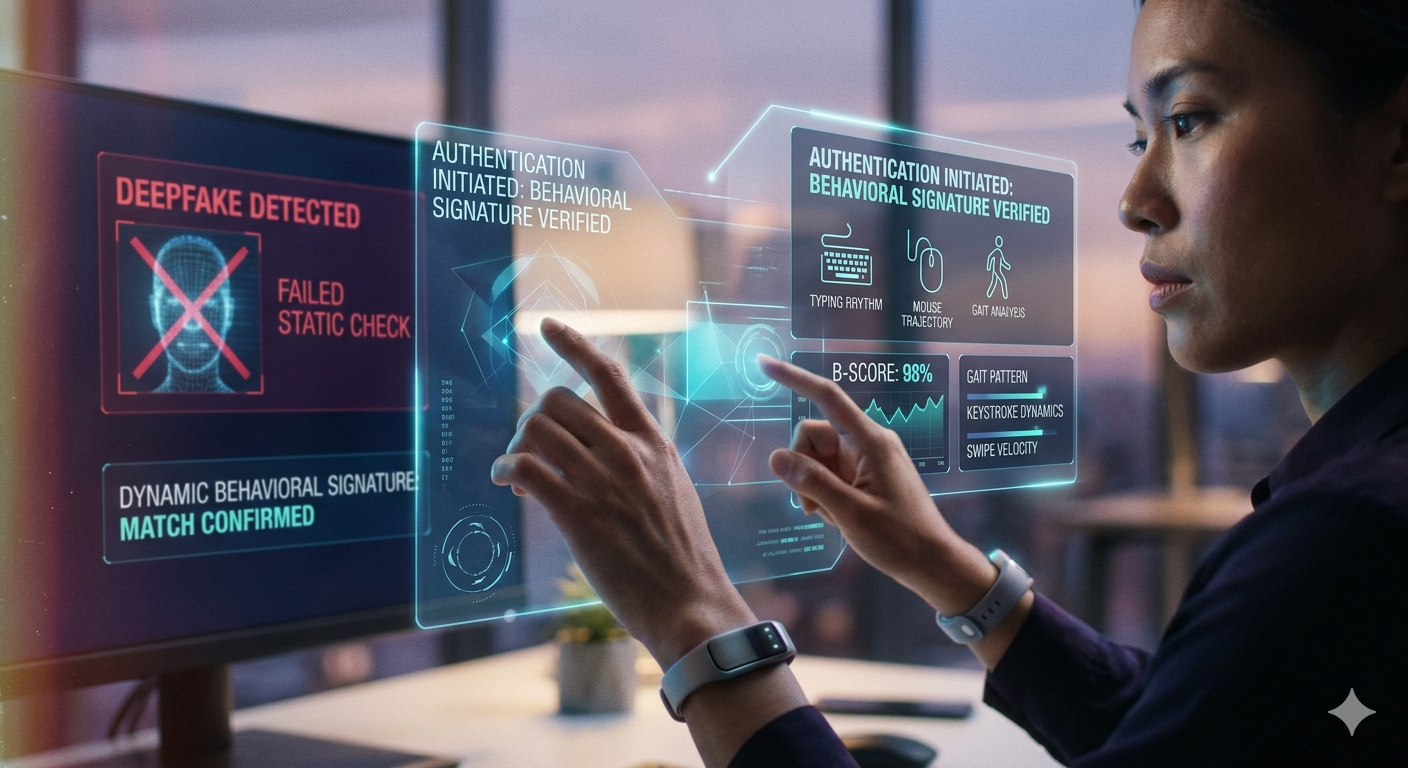
Unlike physical biometrics, which measure who you are (your face, your iris, your thumbprint), behavioral biometrics measure how you interact with the world. It is the study of unique patterns in human activity. This includes the way you hold your smartphone, the angle at which you swipe, the rhythm of your typing (keystroke dynamics), and even the way your mouse moves across a screen. These patterns are subconsciously ingrained and nearly impossible for an AI to mimic in real-time. While a deepfake can replicate your face perfectly on a Zoom call, it cannot replicate the specific micro-fluctuations in your hand tremors or the idiosyncratic pauses between your keystrokes.
The Invisible Layer of Security
One of the most significant advantages of behavioral biometrics is that it provides continuous authentication. Standard security measures are “point-in-time” checks; you log in, and the gate is open. If a session is hijacked after the initial login, the system remains blind to the intruder. Behavioral biometrics, however, works silently in the background. It creates a “B-Score” (Behavioral Score) that constantly monitors the user’s interaction throughout the entire session. If a user suddenly switches from being right-handed to left-handed, or if the typing speed increases to a superhuman rate indicative of a bot, the system can automatically flag the activity, require a step-up authentication, or terminate the session instantly.
Defeating the Deepfake: The “Liveness” Factor
Deepfakes thrive in the gap between a digital representation and a physical reality. They are essentially puppets controlled by algorithms. However, deepfakes struggle with the “liveness” of human nuance. In a video call, behavioral analysis can detect if the facial movements are slightly out of sync with the physiological micro-expressions that occur during natural speech. More importantly, if an attacker uses a deepfake to bypass a visual check, they still have to navigate the interface. The way a fraudster moves a mouse to transfer funds is fundamentally different from the way the legitimate account holder — who knows the interface by heart — would do it. Behavioral biometrics looks for these “non-human” or “atypical” navigation paths to spot the fraudster behind the mask.
Privacy by Design
A common concern with any biometric shift is the “Big Brother” effect. However, behavioral biometrics is inherently more privacy-friendly than its physical counterparts. While a stolen database of fingerprints is a lifelong security disaster (you can’t change your fingers), behavioral data is often processed as abstract mathematical patterns rather than raw personal data. It doesn’t require a high-resolution map of your face or a recording of your private conversations. It simply tracks the “how,” not the “what,” making it a powerful tool for organizations that need to balance high-level security with increasingly stringent data privacy regulations like GDPR and CCPA.
The Future: A Multi-Modal Approach
As we look toward 2026 and beyond, the “Final Stand” won’t rely on a single silver bullet. Instead, it will be a multi-modal defense system where behavioral biometrics acts as the glue. We are moving toward a “Zero Trust” architecture where identity is never assumed and always verified through a combination of environmental signals (IP address, location), physical biometrics, and behavioral patterns. In this ecosystem, the body — specifically the way the body moves and interacts with technology — becomes the ultimate, rotating password that no AI can guess and no deepfake can mirror.
The Takeaway
The deepfake revolution has turned our own likenesses against us. To fight back, we must move beyond the surface. By embracing the subtle, invisible rhythms of human behavior, we can build a digital world where identity is not just something we claim, but something we naturally inhabit. The shift is here: your behavior is your best defense.
#BehavioralBiometrics #CyberSecurity #DeepfakeDefense #FinTech #IdentityAccessManagement #AIRevolution #DigitalTrust #BiometricShift #TechTrends2026 #ZeroTrust