The Beginner’s Roadmap to Reading Price Charts Like a Professional Trader
 a5 min read·Just now
--
Introduction
Every financial market tells a story. Whether it is stocks, forex, commodities, cryptocurrencies, or indices, price movement reflects the ongoing battle between buyers and sellers. For beginners, these movements may appear random at first. However, with proper training in technical analysis, price charts begin to reveal structure, patterns, and meaningful signals.
Learning how to read price charts is one of the most important skills in trading. It allows traders to move beyond guesswork and develop a structured understanding of market behavior. Instead of relying on news headlines or emotional reactions, traders can analyze historical price action to anticipate possible future movement.
Technical analysis for beginners focuses on simplifying this process. It introduces key concepts such as trend direction, support and resistance, candlestick behavior, momentum, and volume analysis. When combined, these elements form the foundation of professional trading decisions.
Many new traders assume that chart reading is complex. In reality, it becomes intuitive with practice. Once the basic principles are understood, price charts begin to show repeating behaviors driven by human psychology — fear, greed, hesitation, and confidence.
This comprehensive guide explains how to read price charts like a trader, starting from basic concepts and gradually progressing toward advanced interpretation techniques. It is designed to help beginners build a strong foundation in technical analysis and develop confidence in market analysis.
What Is a Price Chart?
A price chart is a visual representation of how an asset moves over time.
It displays:
- Price changes
- Time intervals
- Market behavior
Charts help traders understand how buyers and sellers interact in real time.
The most commonly used chart types include:
- Line charts
- Bar charts
- Candlestick charts
Among these, candlestick charts are the most widely used in modern technical analysis.
Why Price Charts Matter in Trading
Price charts are the core tool of technical analysis.
They help traders:
- Identify trends
- Detect reversals
- Find entry and exit points
- Understand market psychology
Unlike fundamental analysis, which focuses on financial data, technical analysis focuses on price behavior.
Price charts reflect real-time market sentiment.
The Evolution of Chart Analysis
The study of price charts dates back centuries.
Early traders observed price movements manually, long before digital platforms existed. Over time, structured methods of analysis emerged.
A key contributor to modern chart analysis principles was Charles Dow, whose ideas formed the foundation of trend analysis and market behavior interpretation.
With the rise of technology, charting tools evolved significantly.
Today, traders use advanced platforms that display real-time data, indicators, and automated analysis tools.
Despite technological progress, the core principles remain unchanged.
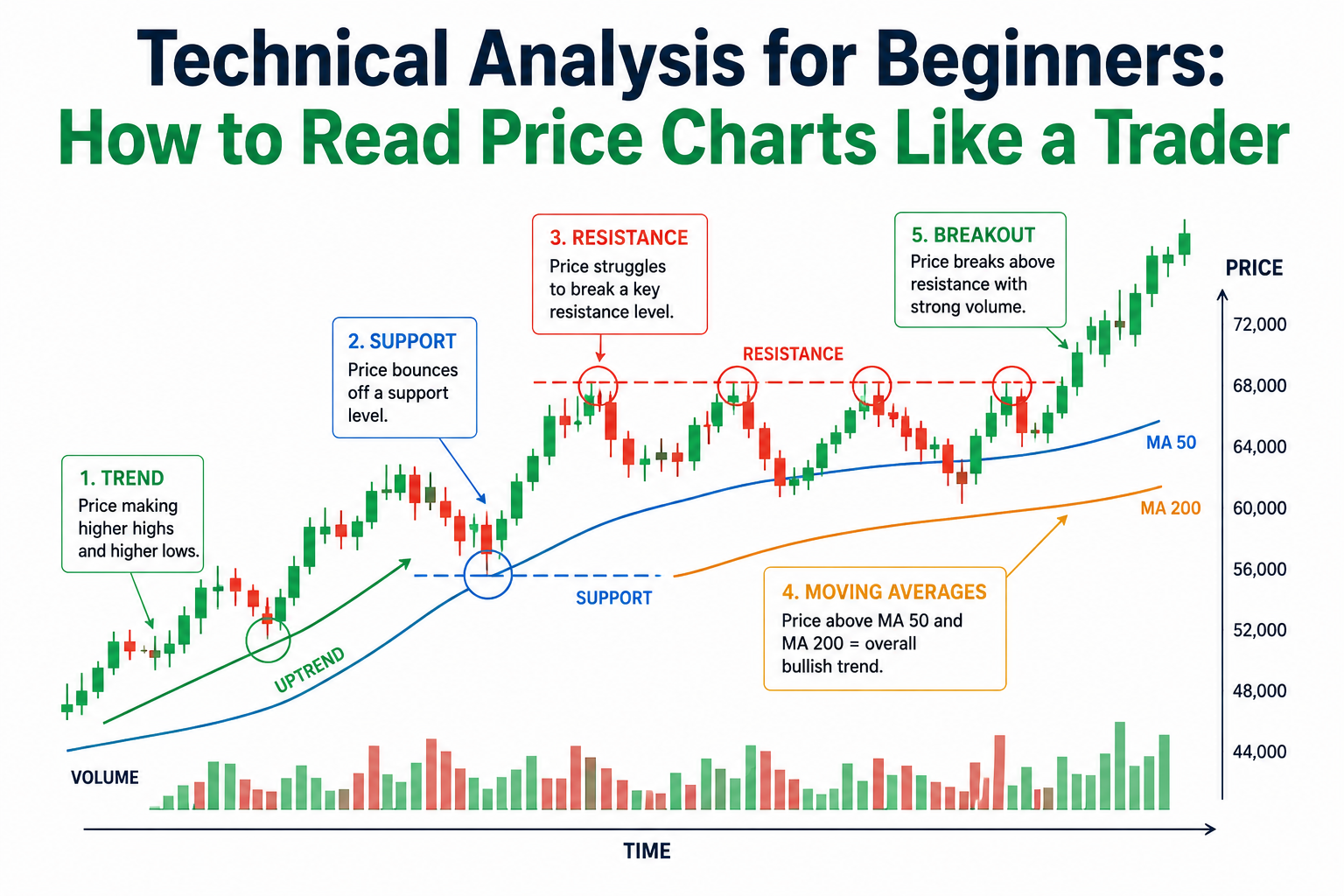
Understanding Market Trends
Trend identification is the first step in reading price charts.
Markets typically move in three directions:
Uptrend
Price forms higher highs and higher lows.
Downtrend
Price forms lower highs and lower lows.
Sideways Trend
Price moves within a range.
Understanding trend direction helps traders align with market momentum.
Trading with the trend is often more effective than trading against it.
Support and Resistance Explained
Support and resistance are key concepts in technical analysis.
Support
A price level where buying interest is strong enough to prevent further decline.
Resistance
A price level where selling pressure prevents further rise.
These levels act as psychological barriers in the market.
Traders use them to:
- Identify entry points
- Set stop-loss levels
- Plan profit targets
Support and resistance are essential for reading price charts effectively.
Candlestick Basics
Candlesticks provide detailed information about price movement.
Each candlestick shows:
- Opening price
- Closing price
- High
- Low
Candlestick patterns help traders understand market sentiment.
Bullish Candles
Indicate buying pressure.
Bearish Candles
Indicate selling pressure.
Candlestick analysis helps traders interpret short-term market behavior.
Common Candlestick Patterns
Several patterns are widely used in technical analysis:
Doji
Indicates market indecision.
Hammer
Suggests potential bullish reversal.
Shooting Star
Suggests potential bearish reversal.
Engulfing Pattern
Shows strong momentum shift.
These patterns help traders anticipate possible market direction.
Volume and Its Importance
Volume measures market participation.
High volume indicates strong interest.
Low volume suggests weak participation.
Volume confirms price movement.
For example:
- A breakout with high volume is more reliable
- A breakout with low volume may fail
Volume strengthens chart interpretation.
Understanding Market Structure
Market structure refers to the arrangement of highs and lows.
Traders analyze:
- Swing highs
- Swing lows
- Breaks of structure
- Trend shifts
Market structure helps identify whether buyers or sellers are in control.
It is one of the most important aspects of reading price charts.
Identifying Breakouts
A breakout occurs when price moves beyond a key level.
Breakouts can signal:
- Trend continuation
- Trend reversal
- Increased volatility
However, not all breakouts succeed.
Confirmation is important.
Traders often wait for:
- Retests
- Volume confirmation
- Candlestick confirmation
Retracements and Pullbacks
Markets rarely move in a straight line.
Retracements are temporary reversals within a trend.
Pullbacks offer opportunities to enter trades at better prices.
Understanding retracements helps traders avoid chasing the market.
Timeframes in Chart Analysis
Different timeframes provide different perspectives.
Common timeframes include:
- 1-minute and 5-minute (scalping)
- 15-minute and 1-hour (intraday trading)
- Daily and weekly (swing trading)
Higher timeframes show broader trends.
Lower timeframes show detailed entry points.
Combining multiple timeframes improves analysis.
Indicators and Their Role
Indicators help simplify price interpretation.
Common indicators include:
- Moving averages
- RSI (Relative Strength Index)
- MACD
- Bollinger Bands
Indicators are derived from price data.
They help confirm trends and momentum.
However, beginners should avoid overloading charts with too many indicators.
Price Action vs Indicators
Price action focuses on raw price movement.
Indicators provide calculated insights.
Many professional traders prefer combining both.
Price action shows real behavior.
Indicators help confirm decisions.
Balance is key.
Common Beginner Mistakes
Many beginners struggle due to avoidable errors.
These include:
Overtrading
Entering too many trades without analysis.
Ignoring Trends
Trading against strong market direction.
Relying on One Signal
Using a single indicator without confirmation.
Emotional Trading
Making decisions based on fear or greed.
Avoiding these mistakes improves consistency.
Building a Simple Chart Reading Strategy
Beginners should start with a simple framework:
- Identify trend
- Mark support and resistance
- Observe candlestick patterns
- Confirm with volume
- Plan entry and exit
Simplicity leads to clarity.
Complex strategies often create confusion.
Risk Management in Chart Trading
Risk management is essential in technical analysis.
Traders should always define:
- Stop-loss levels
- Position size
- Risk-reward ratio
Even strong setups can fail.
Protecting capital is more important than predicting direction.
The Psychology Behind Price Charts
Price charts reflect human behavior.
Markets are driven by:
- Fear
- Greed
- Uncertainty
- Confidence
These emotions create repeating patterns.
Understanding psychology helps traders interpret charts more effectively.
Modern Tools for Chart Analysis
Technology has transformed technical analysis.
Modern platforms offer:
- Real-time charting
- Automated indicators
- Pattern recognition
- AI-based insights
Artificial intelligence can now detect trends and patterns faster than ever.
However, human understanding remains essential for interpretation.
Why Learning Price Charts Is a Long-Term Skill
Chart reading is not learned overnight.
It requires:
- Practice
- Observation
- Experience
- Discipline
Over time, traders develop intuition.
This intuition becomes one of the most valuable trading skills.
Conclusion
Learning how to read price charts like a trader is one of the most important steps in mastering technical analysis. Price charts reveal market structure, trends, momentum, and trader psychology in a visual format that helps simplify complex financial movements. By understanding trends, support and resistance, candlestick patterns, volume behavior, and market structure, beginners can build a strong foundation for making informed trading decisions.
While indicators and modern tools can enhance analysis, the core of trading success lies in understanding price behavior itself. The most effective traders combine simplicity, discipline, and structured analysis rather than relying on random signals or emotional decisions.