The AI Rally Meets Its First Real Shock, While Oil Rises | April 28, 2026
 Jadid Herrera6 min read·Just now
--
The S&P 500 Index (SPX) and Nasdaq 100 Index (NDX) are selling off after both reached important chart levels. S&P futures are down about 36 points, or roughly 0.5%, after reaching the upper end of a major parallel channel. After a strong rally, the market is now pulling back from that area.
The Nasdaq 100 Index is still the more important chart because it includes many of the biggest AI and semiconductor names. It came within 115 points of the major 25,000 level. That level also lines up with a trend line that has marked key highs and lows in the market. The last pullback reached the 50% retrace of the parallel channel before the market surged again toward a potential 2026 high.
The Nasdaq 100 Index could still push through 25,000. When markets get this close to a major round number, they often pierce it. That move may depend on mega-cap earnings this week. Microsoft Corporation (MSFT), Amazon.com Inc. (AMZN), Apple Inc. (AAPL), and Meta Platforms Inc. (META) report later this week. Nvidia Corporation (NVDA) reports in a couple of weeks from now. Strong numbers from Microsoft Corporation (MSFT), which has been somewhat beaten down, could help push the Nasdaq 100 Index (NDX) through 25,000.
The bigger concern is that the market may be getting close to a major cycle top. The comparison to the dot-com era is hard to ignore. In 2000, the top 20 technology stocks had a combined market value of $3.81 trillion. The total market value of all stocks was $17.6 trillion. That put the top technology concentration at 21.65%.
In the current semiconductor era, April 2026, the top 20 semiconductor stocks account for $15.36 trillion, with a concentration at 21.44%. That is almost the same as the dot-com era. The Nasdaq 100 Index (NDX), compared with the M2 money supply, has also reached a level similar to that period.
This does not mean the market cannot rise another 10%. Markets can overshoot. But the warning signs are building: heavy concentration, aggressive risk-taking, leverage, and the belief that this cycle is different.
Federal Reserve policy is also important this week. Jerome Powell’s last Fed chair meeting and decision is tomorrow, Wednesday, at 2 PM, followed by a press conference. The market will be watching whether he stays on the board of governors or leaves.
West Texas Intermediate crude oil (WTI) is spiking as the UAE pulls out of OPEC. The move appears tied to a lack of unity among Middle Eastern countries against Iran, which has closed the Strait of Hormuz. The Strait remains closed, keeping oil relatively scarce compared with where supply had been.
From a technical view, West Texas Intermediate crude oil (WTI) is moving back toward the area where it previously broke down. The setup is simple: a level gets tested over and over, breaks, then price rallies back toward that area before the next move lower. The key shortable area is around $105.
Natural gas (NG) is still quiet. That is unusual because natural gas is often called the widow maker because of its volatility. Recently, compared with silver, gold, and oil, natural gas (NG) has been the calmest market in the group.
Gold is weakening, and the midterm view on metals remains bearish. The next move lower appears to be starting while stocks are also declining. Gold does not look attractive until it either reaches $3,500 or starts trading opposite the stock market. A swing trade level sits at $3,900, while the longer-term buyable level remains $3,500. First support is in the $4,300 to $4,400 area. If that breaks, $3,900 becomes the next major level.
Silver has rolled over from 82 resistance. It tagged that level and has already pulled back to 72, down $10 per ounce. First support is between 60 and 64. If that breaks, the longer-term target remains the 49 to 54 area.
The AI trade is starting to show real weakness. Semiconductors are falling hard as the OpenAI slowdown narrative gets more attention, and earnings from related infrastructure names add pressure. Several names are down 10% to 15%, which is breaking the idea that these stocks could only move higher.
Celestica Inc. (CLS) is falling hard after a major run that looks similar to many AI-linked stocks. The key day trade level is $350, based on prior pivot highs. This is not a swing trade setup. If a stock is seen as part of a bubble, a 10% or 15% pullback is not enough for a midterm or long-term entry. A much deeper pullback would be needed. If Celestica Inc. (CLS) keeps falling, support sits around $327 to $328, where there is a key gap fill.
Corning Incorporated (GLW), another major data center infrastructure name, is also dropping sharply. The company is tied more to fiber optics than chips, but the chart is showing the same pressure hitting the broader AI buildout trade. The key level to watch is the gap fill at $148.40, only as a day trade.
Rambus Inc. (RMBS) is another pick-and-shovel name tied to the data center backbone. After a strong run, the stock is getting hit hard in premarket trading. The key area to watch is around $106, where a gap fill sits. A piece of $106 would be an interesting setup.
Micron Technology Inc. (MU) is falling with the broader semiconductor group. Yesterday, it reached a parallel channel level almost to the penny. Today, the stock is down $30 from yesterday’s high. Based on the chart structure, the expectation is for a move back toward about $350 per share.
SanDisk Corporation (SNDK) is holding up better than many related names, but it also ran into a major trend line yesterday and is now pulling back. It had been one of the stronger names in recent weeks, reaching new all-time highs as recently as yesterday.
Spotify Technology S.A. (SPOT) is selling off sharply even though many would expect the stock to hold up better. The day trade levels to watch are $431, which is higher risk, and $415, which is the stronger level. If Spotify Technology S.A. (SPOT) drops into that area, there is also a double bottom in the same range.
United Parcel Service Inc. (UPS) is dropping sharply, which should pressure transports after a strong move higher. The key support levels are $99 and change, a piece of the $100 even number, and the gap fill at $97.50.
General Motors Company (GM) first popped on earnings, then reversed sharply and is now getting a small bounce. The company had very strong numbers and is one of the few earnings names not down significantly today. A longer-term trend line sits lower on the chart. It probably does not get reached on a day trade, but if it does, it could become a swing trade setup.
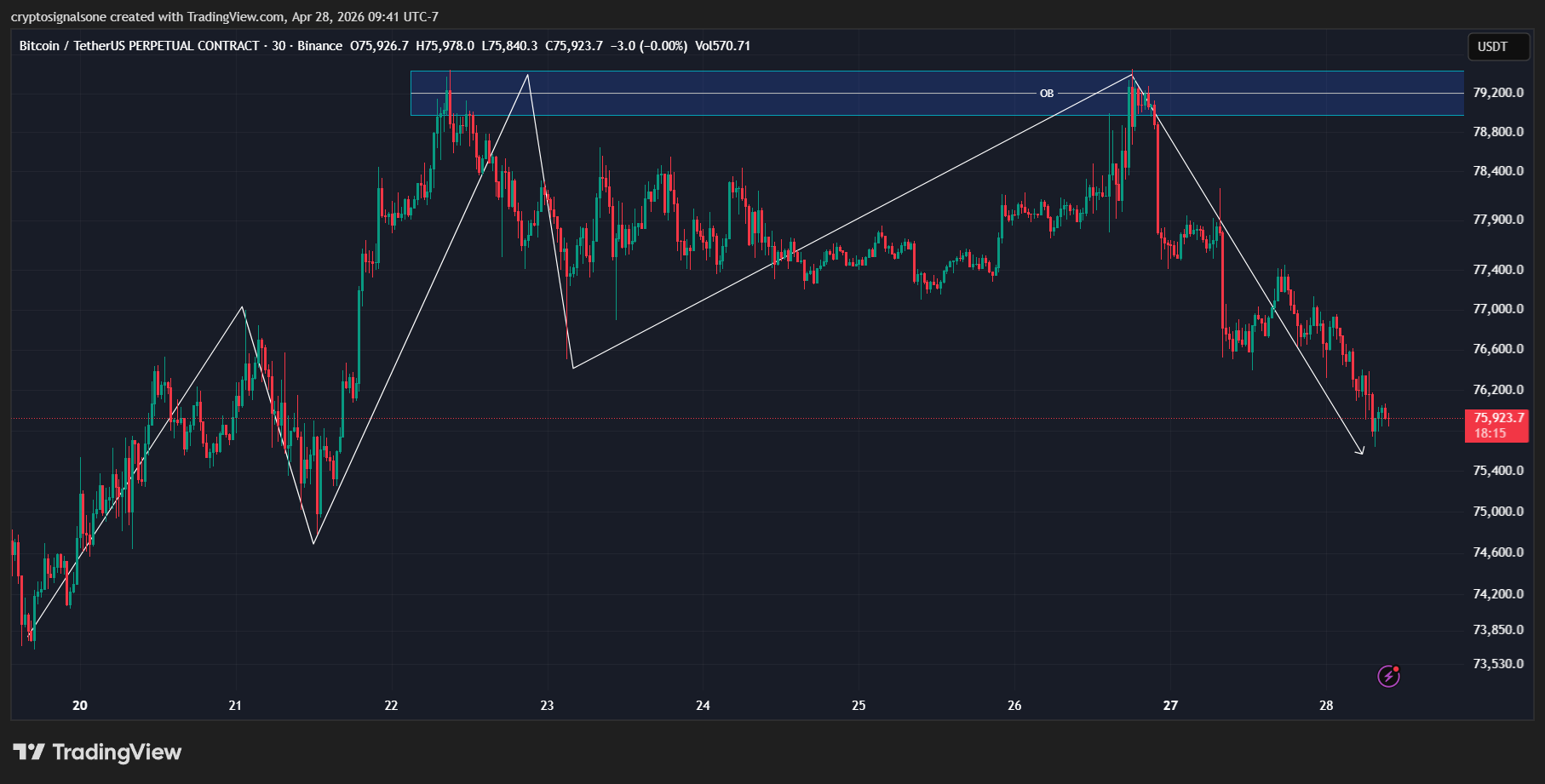
Bitcoin (BTC) kissed the underside of the $80K target last week and is now starting to pull back. A retest of $80K is still possible, but after two straight days of weakness, Bitcoin is back near $76K. If Bitcoin keeps falling, the first major support is $68K. If that level breaks, the next move points back toward $60K, with a possible break as low as $50K.
Volatility is starting to rise. Over the past month or so, oil had been moving higher, but the AI trade helped keep markets near all-time highs once things settled down. Now oil is rising again, while the AI trade is starting to crack.
Outlook
The broader market is looking more fragile. Oil is spiking, AI-linked earnings reactions are getting weaker, and major indices are pulling back from important technical levels. The Nasdaq 100 Index (NDX) is still close enough to 25,000 that a breakout attempt is possible, especially with mega-cap earnings ahead.
At the same time, concentration, risk appetite, semiconductor exposure, and the Nasdaq 100 Index (NDX) compared with M2 money supply are showing conditions that look more and more like past cycle extremes. The market can still overshoot, but the warning signs are becoming harder to ignore.