The Agent Economy Stack, in Five Layers
 leon melamud5 min read·Just now
--
Agents will not become useful because models get smarter.
They become useful when they can access context, prove permission, pay for resources, and settle transactions safely.
Everyone is talking about AI agents.
Most of the conversation still starts and ends with the model: GPT, Claude, Gemini, Llama, or whatever comes next.
But the agent economy will not be built by LLMs alone.
An agent that can only reason is still mostly a chatbot.
The real economy starts when agents can access tools, understand authority, spend money, pay other machines, and settle transactions without leaking user trust all over the internet.
That requires a stack.
Here is the short version.
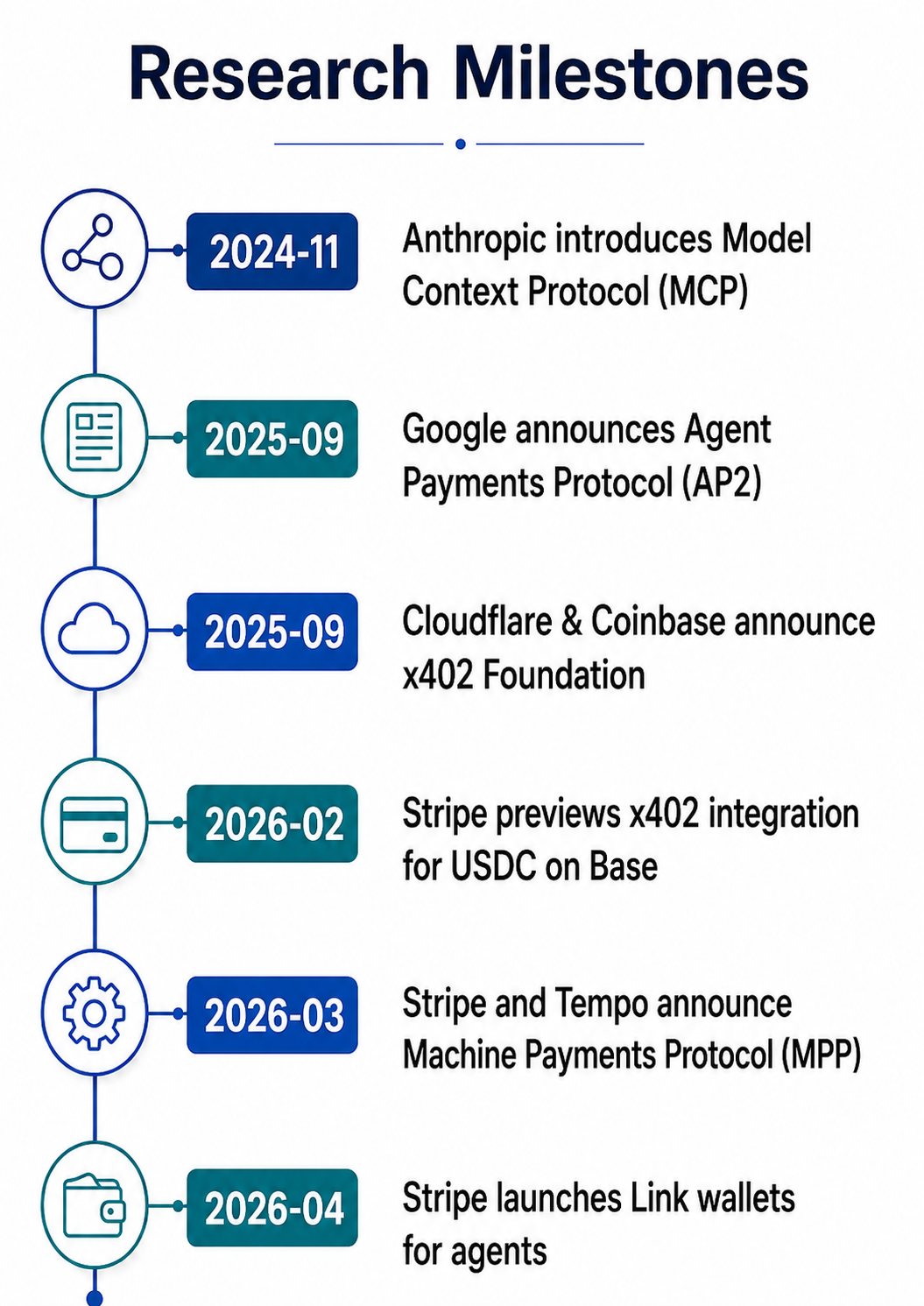
TIMELINE
1. Agent Core: the brain
The innermost layer is the LLM.
This is the reasoning engine that interprets the user’s goal, breaks it into steps, and decides what to do next.
There is no special “Agent Core Protocol” here. It is usually an LLM API or runtime: OpenAI, Anthropic, Google, Meta, or an open model.
The model is necessary, but it is not the product. A model can think. An agent needs to act.
2. MCP: context and tools
The next layer is the Model Context Protocol, or MCP.
MCP gives agents a standard way to connect to external systems: files, databases, apps, APIs, code execution, and internal services.
Without MCP-style interfaces, every model-to-tool integration becomes a custom one-off adapter. That does not scale.
With MCP, an agent can discover available tools, request context, and call functions through a shared interface.
This is the layer that turns a model from “smart text generator” into “software operator.”
The hard part is security: scoped access, OAuth, audit logs, least privilege, and preventing the agent from touching systems it should not touch.
In production, every external skill also needs validation. Teams need observability into the execution trace: what the agent saw, which tool it called, why it made that decision, and what changed afterward. They also need to scan tools and MCP servers for unsafe inputs, permission leaks, prompt-injection risks, and vulnerable connectors.
3. AP2: permission to buy
Once agents can act, the obvious question appears:
Who authorized this?
That is the problem that Google’s Agent Payments Protocol (AP2) is trying to solve.
AP2 is about user intent and accountability. It uses signed mandates to show what the user asked for, what the final transaction includes, and whether the agent is authorized to proceed.
This matters because “my agent bought this” is not good enough for commerce. Merchants, banks, users, and platforms need a verifiable trail.
AP2 is not the payment rail itself. It is the trust-and-authorization layer for agent-led purchases.
Think of it as the agent economy’s permission receipt.
4. x402 and MPP: machines paying machines
The fourth layer is machine payments.
This is where protocols like x402 and MPP come in.
Both revive HTTP 402 “Payment Required” for an internet where agents may pay per API call, dataset, inference, action, or unit of compute.
The flow is simple:
1. Agent requests a paid resource.
2. Server responds with payment requirements.
3. Agent pays or proves payment.
4. Server returns the resource.
x402 is closely associated with crypto and stablecoin payments. MPP, from Stripe and Tempo, points toward a broader machine-payment layer that can include both stablecoin and fiat rails.
The category matters more than the acronym.
Agents need native ways to pay other software instantly and programmatically. Subscriptions and API keys are too heavy for every tiny transaction.
5. Wallet and settlement: the money actually moves
The outer layer is the user wallet and settlement rail.
This is where Stripe Link, cards, bank rails, stablecoins, and payment networks come into play.
The agent should not hold your raw card number or get unlimited spending power.
A wallet layer lets the user approve spend, issue scoped tokens, use one-time credentials, and settle through existing rails.
In plain English: this is where the human says yes, the agent gets limited authority, and the payment actually clears.
This layer is boring only until it breaks. Then it becomes the whole story.
A day in the life of the stack
Imagine an autonomous research agent running out of server capacity. The LLM realizes it needs more compute, then uses MCP to check the cloud provider’s API. AP2 verifies the engineering team authorized this spend, x402 or MPP handles the machine payment, and funds settle from the company’s approved wallet.
The agent keeps working without waking up a human.
The missing layer: orchestration
This stack does not exist in a vacuum.
The real enterprise value appears when specialized agents work together: research, finance, security, support, sales.
That is where orchestration matters. Companies need workflow automation that coordinates handoffs, passes the right context, enforces approvals, and keeps the full execution trace visible.
That is the path from “AI assistant” to synthetic workforce.
The takeaway
The agent economy is not one technology.
It is a stack:
- LLMs reason.
- MCP connects tools and context.
- AP2 proves authorization.
- x402 and MPP enable machine payments.
- Wallets and settlement rails move money safely.
Each layer answers a different question:
- What should the agent do?
- What can it access?
- Who gave permission?
- How does it pay?
- How does the transaction settle?
That is the architecture shift.
The winners will not just build better chatbots. They will build reliable systems where agents can understand, act, transact, and be audited.
The future is not about agents talking more.
It is agents that can safely do more.
If you are building agent-native software, start with one painful workflow, one clear user, and one action worth trusting an agent to complete.
About the Author
Leon is a recognized leader in enterprise AI adoption and operationalization. He serves as the Head of AI Transformation and GenAI Lead at ThetaRay, specializing in deploying complex AI systems to fight financial crime.
As an AWS Superstar and n8n Ambassador, he bridges the gap between scalable cloud architecture and agentic workflow automation.
Dedicated to shaping the future of autonomous systems, Leon is also the Co-Founder of AI Transformation leads, Israel N8N, and MCP Israel.
🔗 Connect with me on LinkedIn: www.linkedin.com/in/leon-melamud