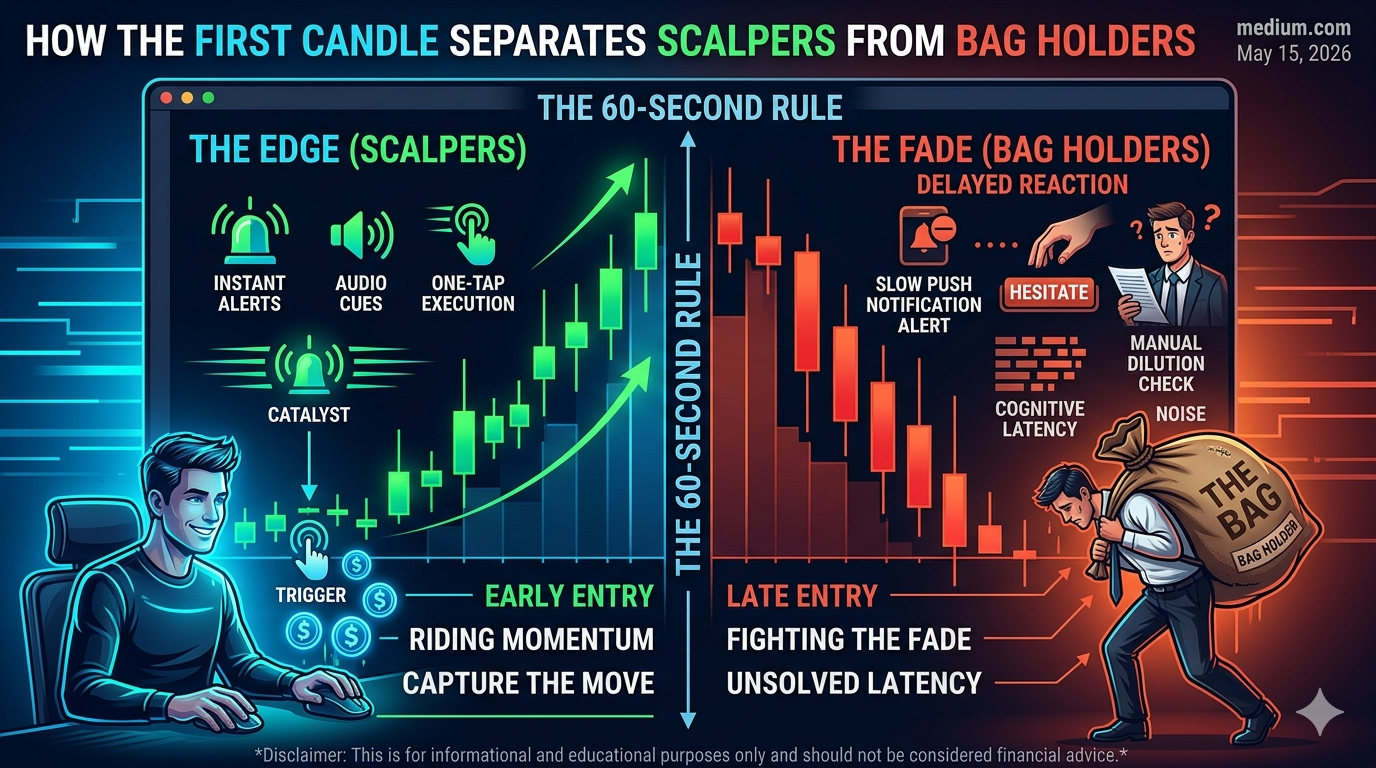
The 60-Second Rule: How the First Candle Separates Scalpers from Bag Holders
--
The alert fires.
You see it. You read it. You pull up the chart. Volume is spiking. Float is tiny. The pre-market candles are stacking green.
By the time you’ve processed all of that and your finger is on the trigger — the first 60-second candle has already closed.
You didn’t miss the news. You missed the trade.
Why the First Candle Is Everything
Gap and Go is a momentum strategy. That’s the whole game: catch the move while it’s moving, exit before the fade.
But momentum has a window. For small-cap, low-float Nasdaq gappers, that window is brutally short. The first 60 seconds after a catalyst fires is when the real edge lives. It’s when informed traders enter. When algos position. When the setup prints its intent.
If you’re not in during the first candle — or at minimum making your Trade/No-Trade call before it closes — you’re not early. You’re the second wave. And the second wave is usually the one holding the bag.
This isn’t a philosophy. It’s mechanics. The average Gap and Go on a low-float name moves 15–40% in the first three minutes. After that, you’re either riding momentum or fighting the fade. The difference between those two outcomes is measured in seconds, not minutes.
The Latency Stack Nobody Maps Out
Most traders think of latency as a single problem: the news is slow.
It’s not one problem. It’s a stack of problems, and they compound.
Layer 1: Wire latency. The time between a catalyst hitting the wire and your alert service receiving it. This varies by provider but is rarely zero. Most retail news services add 5–30 seconds of pipeline delay by the time the signal is processed, filtered, and sent.
Layer 2: Alert delivery latency. Push notification, audio alert, email — each delivery method has its own overhead. A push notification that has to pass through Apple’s APNs, your lock screen, and your attention takes real time. An audio alert that fires instantly in your ear is a different category.
Layer 3: Cognitive latency. This is the one nobody talks about. The time between you receiving an alert and you understanding what it means. Reading a headline, processing the catalyst, mapping it to a setup you know — that takes 5–15 seconds for a trained scalper and 30–60 seconds for someone still building their pattern recognition.
Layer 4: Decision latency. Trade or no-trade. Is this Tier 1 or Tier 3? Is the float right? Does the chart setup look clean? Each of these checks is time. Time you spend not in the trade.
Layer 5: Execution latency. Order entry. Broker routing. Fill confirmation. Fast brokers with hotkeys eat 1–2 seconds here. Slower setups can add 5–10.
Add it up. Even in an optimized setup, a retail trader is running 20–40 seconds of latency from catalyst to fill. In a setup where the edge lives in the first 60 seconds, that’s not a delay. That’s the edge, gone.
It’s Not Just Algos
The instinct is to blame institutional algorithms. And they’re real — high-frequency algos are parsing news feeds in microseconds and positioning before most retail traders have finished reading the headline.
But the algo problem is not your biggest problem.
Algos move fast on macro signals — earnings, Fed announcements, large-cap catalysts. For small-cap, low-float momentum setups in micro-cap names, the institutional algo presence is lower. The HFT crowd isn’t fighting over a stock with a $50M float. The edge isn’t gone because of algos.
The edge is gone because of your own latency stack.
Most retail Gap and Go traders are losing to themselves: fragmented alert setups, slow signal pipelines, manual dilution checks, decision hesitation. These are solvable problems. They don’t require beating Goldman Sachs at their own game. They require removing the friction you’ve built into your own workflow.
The Cognitive Load Bottleneck
There’s a specific moment in every pre-market setup where everything is happening at once.
You’re watching two or three charts. Level 2 is moving. You’re tracking halt status. Pre-market volume is printing. And somewhere in that chaos, a new alert fires.
Your brain now has to do something very expensive: context switch.
You have to pull attention away from the charts you’re managing, process the new information, evaluate whether it’s actionable, and make a decision — all while the setup is live and moving.
For most traders, that context switch takes too long. And the response is usually one of two things:
Hesitate. You wait until you feel confident. By then, you’ve missed the entry.
Rush. You act before you’ve processed. You enter without knowing whether the setup is clean or armed with a dilution shelf sitting behind it.
The dilution problem deserves its own breakdown — I covered it in depth here.
The fix isn’t better discipline. It’s fewer decisions at the moment of truth. The pre-work — catalyst classification, dilution status check, setup scoring — has to happen before you’re asked for a Trade/No-Trade call. Not during it.
What a 60-Second-Ready Workflow Actually Looks Like
Speed alone isn’t the answer. Plenty of traders get alerts fast and still lose. Speed without context is just faster mistakes.
What a 60-second-ready workflow actually requires:
1. The alert has to arrive pre-classified. Not just a headline — a categorized signal. Tier 1 (high alpha catalyst) or Tier 3 (noise). That classification has to be machine-done, not human-done, and it has to be attached to the alert itself.
2. Dilution status has to be baked in. Not a tab you open. Not an EDGAR search you run. The dilution context — whether this company has an active shelf registration, and how aggressive it is — has to arrive with the alert. CLEAN, ARMED, ACTIVE, or DESPERATE. One word. Eyes stay on the chart.
3. The setup score has to be calculated, not estimated. Float, volume, catalyst grade, dilution status — these combine into a single number that tells you whether this is worth your attention. That number needs to be visible before you make any decision.
4. Audio alerts, not visual alerts. If you’re looking at the alert, you’re not looking at the chart. Eyes on the chart, ears on the alert. That’s the pre-market workflow of a scalper who’s actually early.
When all four of those are in place, your cognitive load at the moment of decision drops to near zero. You’re not evaluating. You’re executing a plan you already made.
The Window Is Getting Smaller. The Standards Are Getting Higher.
The Gap and Go edge still exists. The setups are real. The alpha is real.
But the tolerance for inefficiency in your own workflow is shrinking. Every second of unnecessary latency — in your alert pipeline, in your decision process, in your execution — is a second that belongs to someone who built their setup better than you did.
The 60-second rule isn’t a target to hit. It’s a standard to exceed. The traders who are consistently early aren’t faster humans. They’re traders who engineered the friction out of their workflow so the only thing left is the trade.
Related: Why Small-Cap Momentum Traders Keep Getting Wrecked — And What’s Actually Causing It →
Teardown: StocksToTrade Review: Built for Screeners, Not Pre-Market Alerts →
Built for this workflow: Day Trader Sniper — Free Trial →
https://www.daytradersniper.com
Day Trader Sniper provides algorithmic signal filtering tools. Setup Score and HCS Grade are not buy or sell recommendations. Day Trader Sniper is not a registered investment advisor. Past signal performance does not guarantee future results. Trade at your own risk.