Everyone wants a bigger ring, but no one wants a “cheapened” symbol.
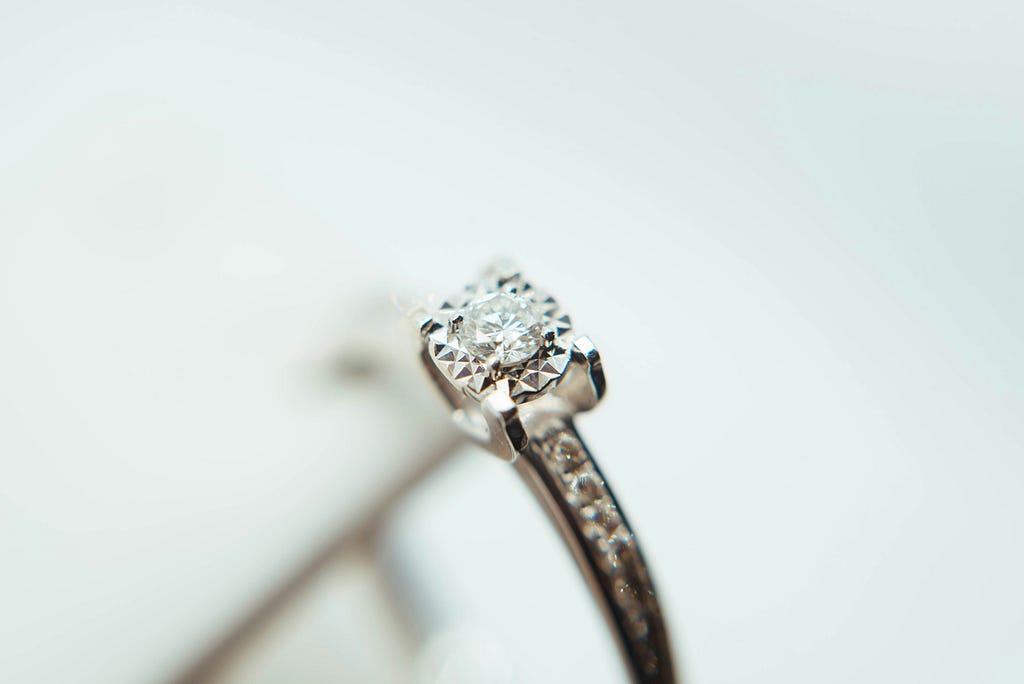
For over a century, the diamond industry leaned on a single, powerful myth: a diamond is a finite, billion-year-old miracle. We didn’t just buy a stone; we bought its ‘manufactured scarcity’.
In economics, diamonds were the ultimate Veblen Good — a luxury item where demand actually increases as the price rises because the high cost itself signals status. But now, we are witnessing this paradox in its death throes. High-tech labs have fundamentally disrupted the narrative, and in doing so, turned a “miracle” into a commodity.
The 85% Price Crash
To the human eye, a jeweler’s loupe, and even standard thermal testers, lab-grown diamonds (LGDs) are 100% real. They possess the exact same carbon structure and optical brilliance as earth-mined stones. But while they are physically identical, their price tags are living in two different universes.
As of early 2026, the price gap has reached a breaking point:
- The Global Price Gap: A 1-carat natural diamond of high quality still commands roughly $4,200 USD.
- The Lab Reality: An identical lab-grown stone has plummeted to under $800 USD (with some direct-to-consumer brands hitting the $450 mark).
We are no longer paying for the stone; we are paying for the “story” of the dirt it came from. But the math is becoming impossible to ignore.
The “Size Inflation”
This price crash has triggered a fascinating shift in how we display wealth, particularly in the United States — the world’s largest retail diamond market.
In 2020, the average US engagement ring center stone was roughly 1.2 carats. By 2026, that “standard” has ballooned to 2.45 carats. Because lab-grown stones now account for over 60% of all engagement rings sold in the US, consumers aren’t necessarily pocketing the savings; they are simply buying massive “rocks” that would have been financially impossible a decade ago.
For the same $5,000 budget, a US consumer is no longer choosing between a “good” or “bad” diamond. They are choosing between a modest natural stone and a lab-grown “iceberg.”
A Tale of Two Markets: The US vs. India
While the stones are the same, how we value them depends entirely on where you are standing.
In the United States: The Consumption Model
In the West, diamonds are treated as a “sunk cost” luxury. US jewelers typically offer a standard 30-day return window, but beyond that, the resale market for lab-grown stones is effectively zero. If you try to sell a lab diamond back to a US jeweler in 2026, they likely won’t take it. To the American market, the diamond is like a new car — it loses its “value” the moment you drive it off the lot.
In India: The Asset Model
In India, the landscape is radically different. Jewelry isn’t just fashion; it’s a liquid family asset. To combat the fear that lab diamonds are a “melting” investment, Indian brands have pioneered aggressive buyback schemes.
- Many premium Indian LGD brands now offer contractual guarantees of an 80% cash buyback or a 100% exchange credit.
- This allows the Indian consumer to treat a lab diamond with the same financial confidence they have historically reserved for gold.
The Sunk Cost
If you’re looking at this analytically, the “investment” argument for natural diamonds is failing the math test.
Consider the “Realized Loss” for a 2026 buyer:
- Natural: You spend $10,000. If you sell it later at a 40% resale value, you have “lost” $6,000.
- Lab: You spend $1,500. Even if the resale value is $0, you have only “lost” $1,500.
Ultimately, the Veblen Paradox is breaking because the “status” of a diamond was built on the assumption that you couldn’t fake rarity. But when the “fake” is identical to the “real,” rarity becomes a choice rather than a fact. For a new generation of buyers, the geological miracle is no longer worth the $8,500 premium.
The 2.4-Carat Illusion: How Technology Killed the Prestige of the Diamond was originally published in DataDrivenInvestor on Medium, where people are continuing the conversation by highlighting and responding to this story.




![One Link = €100 Per Person (Here’s How It Works) [EU Only]](https://cdn-images-1.medium.com/max/1536/1*mdN1W8EjYAk-JnYsbIbDDw.png)