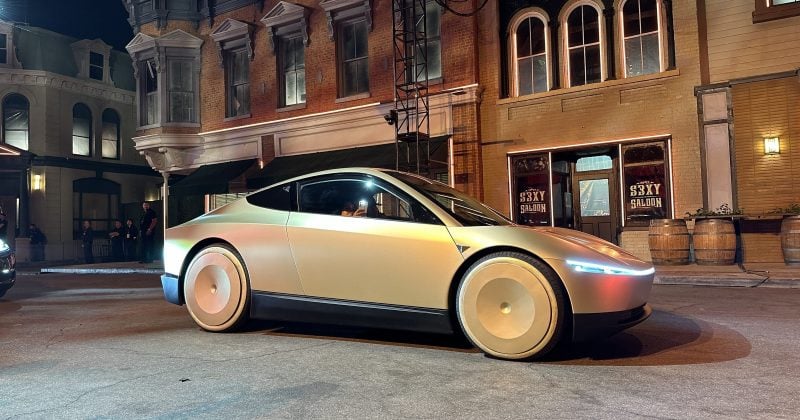
Tesla’s Cybercab starts production with record-breaking efficiency numbers
The steering wheel-free robotaxi achieves 165 Wh/mi, making it the most efficient production EV ever certified.
Share
Add us on Google by Editorial Team May. 30, 2026Tesla’s Cybercab just set a new benchmark for electric vehicle efficiency, and it did so without a steering wheel or pedals. The autonomous two-seater, now rolling off the line at Giga Texas, has been certified at 165 Wh/mi, a figure that makes every other production EV on the road look like it’s wasting electricity.
That translates to roughly 6 miles per kWh. Previous efficiency leaders like the Lucid Air and Tesla’s own Model 3 consume approximately 28-40% more energy per mile.
What the numbers actually mean
Lars Moravy, Tesla’s VP of Vehicle Engineering, called the Cybercab “the most efficient EV that has ever been certified and built.” The 165 Wh/mi rating is a certified figure, not a lab estimate.
Moravy also referred to that number as “the starting point.” Tesla’s engineering teams are apparently still chasing further gains, which suggests the production version shipping to fleet operators could eventually get even stingier with its energy consumption.
AdvertisementThe Cybercab’s two-seater design, stripped of traditional driver controls, contributes significantly to that efficiency figure. No steering column, no pedal assembly, no dashboard designed for human operation.
Production ramp and manufacturing strategy
Production officially commenced at Giga Texas in April 2026, though early units had already started rolling off the line by February. The initial ramp-up is expected to be gradual, which is standard Tesla practice.
Tesla plans to leverage what it calls an “unboxed” manufacturing process for future high-volume production. Rather than building a car from a single body-in-white frame and adding parts sequentially, the unboxed method assembles separate modules simultaneously before joining them.
The vehicle is designed exclusively for unsupervised autonomous operation. There is no option for a human to take over driving because there is literally nothing for a human to grab.
What this means for investors
Some minor tokens with tangential Tesla branding exist in the wild, but they have zero connection to the company’s actual strategy.
For the EV market specifically, Tesla just raised the bar in a way that competitors will struggle to match quickly. Achieving 165 Wh/mi requires optimization across aerodynamics, drivetrain efficiency, battery chemistry, and vehicle weight.
The ride-hailing sector faces the most immediate disruption. Companies operating human-driven fleets are looking at a future competitor that doesn’t pay drivers, doesn’t take breaks, and uses roughly 28-40% less energy per mile than the most efficient alternatives currently available.
Autonomous driving regulatory approvals vary wildly by jurisdiction. And the gap between a certified efficiency number and real-world performance across diverse conditions can be meaningful. Investors should watch fleet deployment numbers and real-world efficiency data as they become available, not just factory output figures.
Disclosure: This article was edited by Editorial Team. For more information on how we create and review content, see our Editorial Policy.