System Design: How to Build a Tax Calculation Engine (TurboTax-Style)
--
Designing a scalable, rule-driven tax engine with high accuracy, auditability, and seasonal scaling
Modern fintech systems demand absolute accuracy.
Modern fintech systems demand absolute accuracy.
Unlike typical backend systems, a tax engine is not optimized for speed alone — it must handle complex rules, versioning, and auditability.
In this blog, we will design a scalable tax calculation engine step by step.
## 1. Functional & Non-Functional Requirements
### Functional Requirements
- Accept complex financial data (W-2, 1099, deductions)
- Calculate taxes using predefined rules
- Generate official tax documents (PDFs)### Non-Functional Requirements
- Absolute Accuracy (no floating-point errors)
- Auditability & Versioning
- Extreme Seasonal Scalability*Key Insight:** This is a rule-driven system, not a CRUD system.
## 2. Capacity Estimation
- 50 million users
- 40 million users active within 14 days
- Peak load: 10,000+ QPSData size:
Each tax return ~100KB → ~5TB storage*Takeaway:** The system must handle massive compute spikes during tax season.
## 3. Database Design
### NoSQL (Application State)
{
  "user_id": "u_9988",
  "tax_year": 2025,
  "income": {
    "w2": [{"employer": "Tech Corp", "wages": 120000}]
  },
  "deductions": {
    "standard": true
  }
}
Stores complete tax data as a single JSON document.
### Relational Database (SQL)
Used for:
- User accounts
- Payments
- Filing status*Why Hybrid?**
NoSQL handles flexible structures, while SQL ensures strong consistency.## 4. API Design
POST /api/v1/taxes/calculate
Request:
{
  "user_id": "u_9988",
  "tax_year": 2025,
  "income": {...}
}
Response:
{
  "total_tax": 22080,
  "refund": 1920,
  "audit_trail": [
    {"rule": "TAX_BRACKET_2", "amount": 8500}
  ]
}
*Never use floating-point numbers. Always use integer cents or decimal libraries.**
## 5. High-Level System Design
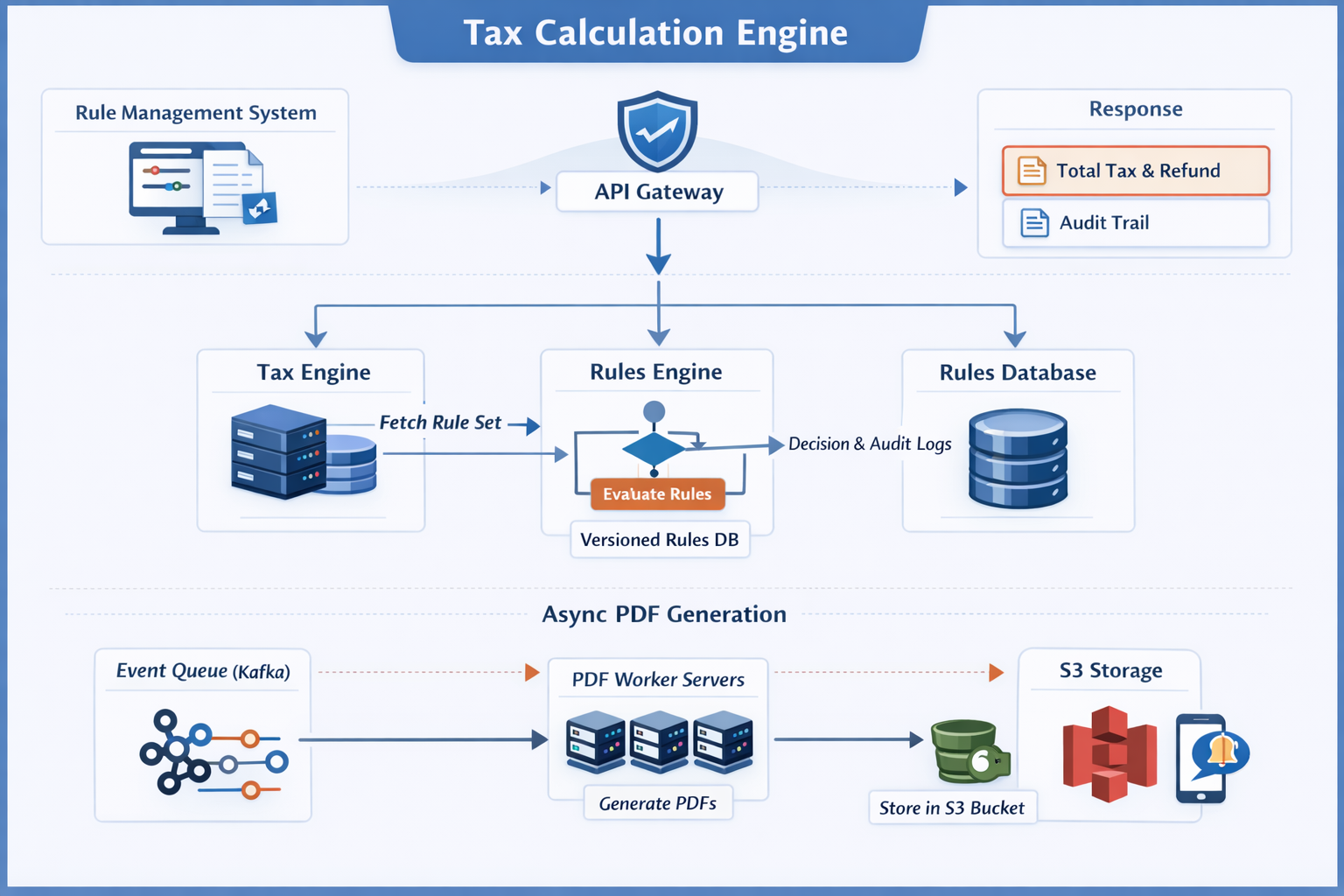
The core idea is to separate tax logic from application code.
Bad Approach:
if (income > 100000) → tax = ...

Correct Approach:
Rules stored as data
### System Flow
1. User submits tax data
2. API Gateway receives request
3. Tax Engine fetches rules based on tax year
4. Rules Engine evaluates conditions
5. Tax is calculated
6. Audit trail is generated
7. Response is returned*Code does not contain tax logic. Rules database does.**
The above diagram shows how requests flow through the rules engine and execution system.
## 6. Scaling for Millions of Users
### Elastic Scaling (Kubernetes)
The system auto-scales based on traffic spikes during tax season.
### Frontend Validation
Input validation is handled in the frontend to reduce backend load.
### Asynchronous PDF Generation
User → Request → Kafka → Worker → S3 → Notify UserHeavy tasks like PDF generation are handled asynchronously.
Rule Versioning:
Each tax year has a separate rule set (2024, 2025, etc.)
## Conclusion
A tax engine must balance accuracy, scalability, and flexibility.
By separating rules from execution and using scalable infrastructure, we can build a reliable system.
This architecture ensures correctness while handling massive seasonal traffic.
If you found this helpful, give a clap and follow for more system design content.