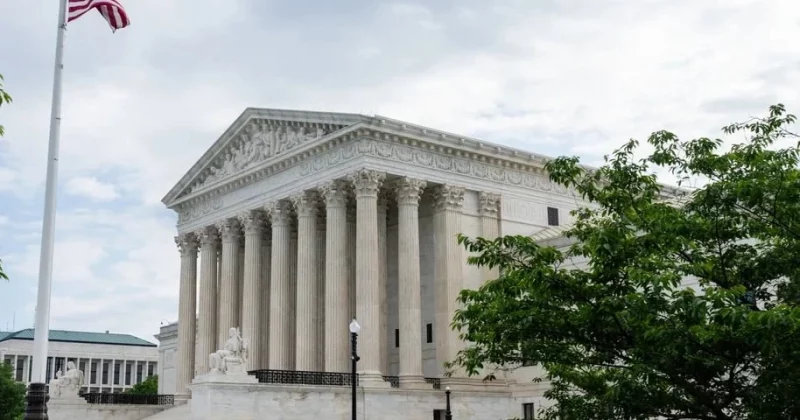
Supreme Court bolsters SEC’s power to recoup illegal gains in unanimous ruling
The 9-0 decision in Sripetch v. SEC removes a key hurdle for the agency's enforcement actions, with potential ripple effects across the crypto industry.
Share
Add us on Google by Editorial Team Jun. 5, 2026The US Supreme Court just handed the SEC its clearest win in years. In a unanimous decision issued on June 4, the Court ruled that the agency can force defendants to surrender illegal profits without first proving that specific investors suffered financial losses.
The decision in Sripetch v. SEC resolves a long-running disagreement among federal appeals courts and gives the SEC a streamlined path to one of its most powerful enforcement tools: disgorgement.
What the Court actually decided
Justice Neil Gorsuch, writing for all nine justices, laid out a straightforward principle. The SEC doesn’t need to show that a specific person lost money. It only needs to show that the defendant profited from breaking the law.
AdvertisementThe ruling does come with a guardrail. Disgorgement must be limited to the defendant’s net profits from the illegal conduct, not gross revenue or some inflated estimate.
The case centered on Ongkaruck Sripetch, who participated in multiple penny-stock pump-and-dump schemes between 2013 and 2019. A lower court had ordered him to hand over approximately $2.25 million in profits, plus more than $1 million in prejudgment interest.
Sripetch’s defense hinged on the argument that the SEC hadn’t identified specific investors who were harmed by his schemes. Several federal circuits had split on whether that kind of proof was necessary. The Supreme Court granted certiorari on January 9, heard oral arguments on April 20, and settled the question definitively: it isn’t.
Why disgorgement matters more than you think
In fiscal year 2025, the SEC secured more than $2.7 billion in total monetary remedies. Disgorgement accounted for over half of that figure.
Before this ruling, defendants in certain circuits could challenge disgorgement orders by arguing the SEC hadn’t sufficiently demonstrated harm to identifiable victims. That argument is now dead across all federal courts. The circuit split had created an uneven enforcement landscape where the SEC’s power varied depending on geography. The unanimous ruling eliminates that inconsistency.
The crypto angle
The SEC has historically wielded disgorgement as a central tool in its crypto enforcement actions. Cases against firms like Ripple and Terraform Labs both involved the agency seeking to reclaim profits from what it characterized as unregistered securities offerings. In those contexts, identifying specific harmed investors can be extraordinarily difficult, given that tokens trade on global, often pseudonymous markets.
By removing the requirement to prove pecuniary harm to individual investors, the Court has effectively lowered the bar for the SEC to pursue disgorgement in exactly the kind of cases that define crypto enforcement. A token issuer who profits from selling what the SEC deems an unregistered security can now face disgorgement without the agency needing to track down and document losses for each buyer.
Disclosure: This article was edited by Editorial Team. For more information on how we create and review content, see our Editorial Policy.