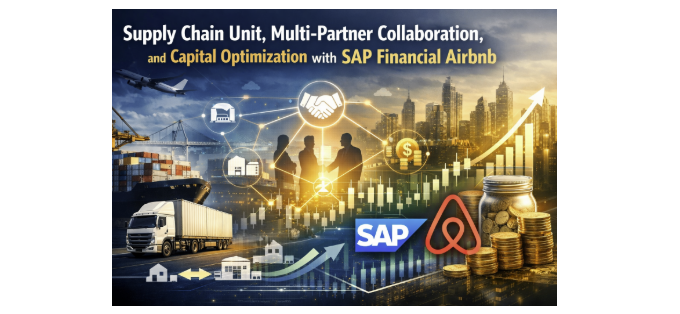
Supply Chain Unit, Multi-Partner Collaboration, and Capital Optimization with SAP Financial Airbnb
 Ferran Frances-Gil8 min read·Just now
--
Introduction: The Convergence of Value and Motion
The traditional boundaries separating logistics, supply chain planning, and financial services are dissolving into a unified, nodal architecture. Historically, supply chain management was viewed as a siloed efficiency problem, focused on the internal movement of goods within the rigid walls of a single ERP instance. This “Monolithic Era” treated warehouses and factories as static cost centers rather than dynamic value-generating nodes. However, the rise of the cloud and the globalization of trade have transformed the product’s journey into a high-stakes relay race involving multiple legal entities, diverse IT landscapes, and a complex web of third-party logistics providers (3PLs). As we transition into the SAP S/4HANA Cloud era, the true challenge is not merely moving data to a new server, but architecting a “Digital Twin” that can breathe across boundaries, providing a robust image of logistical evidence that serves as the bedrock for financial contracts.
“The digital transformation of the supply chain is shifting the focus from internal process optimization to ecosystem-wide value orchestration.”
The Supply Chain Unit (SCU) as the Catalyst for Transparency
At the heart of this architectural evolution lies the Supply Chain Unit (SCU). In modern SAP S/4HANA systems, the SCU acts as the invisible bridge that decouples the geographical and functional identity of a location from its accounting and inventory identity. This is a revolutionary shift; it allows an organization to model a Transhipment Location that is physically managed by a partner — perhaps in a different SAP instance or a non-SAP system — as a native node in its own planning engine. This decoupling is essential for the “Financial Airbnb” model, where physical assets owned by various partners are utilized dynamically as collateral. By defining a node via an SCU, the system creates a verifiable record of “logistical evidence” — a digital proof of the asset’s existence, location, and status. This evidence is the primary requirement for deploying financial services contracts where the physical goods serve as guarantees.
“In a decentralized network, the ability to identify a functional node independently of ownership is the prerequisite for trust and liquidity.”
Multi-Partner Collaboration and the Logistics Evidence Loop
The SCU enables a multi-partner collaboration framework that moves beyond simple EDI messages. When a partner’s warehouse is modeled as an SCU-based location in a lead firm’s S/4HANA instance, it creates a digital “hook” for real-time visibility. This collaborative horizon ensures that every participant in the value flow — shippers, carriers, and financial institutions — shares a single version of the truth. This is not just about knowing where a pallet is; it is about building a robust image of the value flow. As goods move through these SCU-defined nodes, the “logistical evidence” is captured and timestamped, creating a high-fidelity audit trail. This trail is what financial markets require to treat inventory in motion as a liquid asset. By validating the flow of value through these nodes, the network provides the certainty needed to trigger payment or release credit, effectively turning the supply chain into a programmable financial instrument.
“Collaboration in the digital age is measured by the fidelity and transparency of the shared data loop between independent actors.”
The Financial Airbnb: Dynamic Asset Utilization
The “Financial Airbnb” concept applies the principles of the sharing economy to industrial assets and capital optimization. Just as Airbnb allows homeowners to monetize underutilized space, the SCU-driven architecture allows logistics partners to monetize their “nodal capacity” and the underlying value of the goods they handle. By using assets as collateral within service contracts, companies can optimize capital by reducing the need for traditional credit lines. The robust logistical evidence provided by the IBP-TM-BN4L triangulation ensures that the collateral — the goods in the transhipment hub — is real and reachable. This allows for the deployment of financial service contracts directly onto the logistical flow. If an SCU node reports a successful receipt and verification of goods, the financial contract can automatically adjust the risk profile of the transaction, lowering the cost of capital for all involved.
“Dynamic asset-backing represents the next frontier in capital optimization, where the physical flow of goods dictates the availability of credit.”
From IBP to TM: The Governance of Value Certainty
Modeling the node is the first step, but ensuring that the “Brain” (IBP) and the “Muscles” (TM) stay in sync is where the financial value is secured. In many failed projects, IBP plans a route that TM cannot execute, leading to a break in the logistical evidence chain. To maintain the integrity of the value flow, three pillars of governance must be applied. First, the Real-Time Integration (RTI) must be the single source of truth for master data, ensuring that lead times in IBP match the physical reality in TM. Second, hierarchical constraint propagation ensures that strategic goals flow down to execution. Third, the “Integration Gap” is closed by passing the Means of Transport (MoT) as a hard constraint. This level of governance is what gives financial partners the confidence to write contracts against the supply chain. If the planning and execution are misaligned, the “collateral” is at risk; if they are aligned, the collateral is a certain asset.
“True governance in supply chain management is the elimination of the gap between a promise and its physical fulfillment.”
SAP Business Network for Logistics (BN4L) and the Global Grid
Everything we have discussed — the SCU modeling, the OBP-to-TM governance, and the financialization of assets — reaches its zenith within the SAP Business Network for Logistics (BN4L). BN4L acts as the social and technical grid where shippers, carriers, and financial hub operators interact. How does the SCU design power this network? It provides the “DNA” of the node. When a ship enters a port modeled as an SCU location, the event is captured in BN4L and instantly reflected in the IBP Digital Twin. This real-time feedback loop is what sustains the “Financial Airbnb” model. The network doesn’t just track location; it validates the “logistical evidence” across the entire multimodal journey. This automated, nodal network model triggers workflows — from freight tendering to automated gate arrivals — that are inherently linked to the underlying financial contracts, optimizing capital at every milestone.
“A network is only as strong as its nodes, and the cloud provides the infrastructure to make those nodes universally accessible.”
Capital Optimization through Collateralized Logistics
The ultimate goal of this integrated architecture is capital optimization. By creating a robust image of the value flow, companies can move away from “dead capital” trapped in inventory. When assets are used as collateral in financial service contracts, the supply chain becomes a source of liquidity. The SCU-based design facilitates this by providing the specific, verifiable data points required for risk assessment. Financial institutions no longer have to guess the status of the collateral; the “logistical evidence” is presented in real-time through the integration of TM and BN4L. This enables “just-in-time financing,” where the cost and availability of capital are dynamically adjusted based on the movement of goods. This reduces the overall risk in the system, allowing for lower interest rates and more efficient use of working capital across the entire partner ecosystem.
“The fusion of logistics and finance allows for a more granular and responsive approach to managing global risk.”
Technical Execution: Implementing the SCU for Multi-Partner Success
To execute this vision, organizations must adopt a specific technical posture regarding their SAP landscape. First, all transhipment points, regardless of ownership, must be modeled as Locations tied to a Supply Chain Unit (SCU) in the S/4HANA core. This ensures that RTI can propagate these nodes into IBP for both Time-Series and Order-Based Planning. Second, the transportation lanes must be built as multi-stage entities that mirror the physical reality of the multimodal journey. This allows IBP to calculate the “nodal capacity” at each transhipment point. Finally, the connection to BN4L must be configured to utilize these specific SCU identifiers. This technical rigue is what enables the “logistical evidence” to be generated automatically. Without this level of detail, the collaboration remains superficial, and the ability to leverage assets as financial collateral is lost in a sea of data noise.
“Technical excellence in master data management is the bedrock upon which the entire financialization of the supply chain is built.”
The Cloud Evolution: From Migration to Architectural Transformation
Transitioning to the cloud is not a mere technical migration; it is an architectural evolution toward a more open and collaborative future. By leveraging the SCU to model a complex, multimodal world, organizations achieve a degree of scalability that was impossible in the on-premise era. You can add or remove partners and nodes without re-configuring your entire ERP core, because the SCU provides a standardized “plug-and-play” interface for nodal identification. This agility is the primary driver for cloud adoption in the supply chain space. As more partners join the network, the “image of logistical evidence” becomes richer and more robust, attracting more financial service providers and further optimizing the capital requirements of the network. The cloud becomes the ecosystem where the physical and financial worlds finally merge.
“The cloud is not just a place to store data; it is the laboratory where we are reinventing the mechanics of global trade.”
Conclusion: Orchestrating the Future of Value Flow
The integration of SAP IBP, S/4HANA TM, and BN4L, underpinned by the SCU model, represents the pinnacle of modern supply chain architecture. This design does more than just move boxes; it orchestrates value. By facilitating multi-partner collaboration and providing a robust, verifiable image of logistical evidence, this framework enables the “Financial Airbnb” model of asset utilization. The resulting optimization of capital through the use of assets as guarantees in financial contracts is the competitive advantage of the next decade. The companies that succeed will be those that view their supply chain not as a series of costs, but as a synchronous network of value-generating nodes. The SCU is the key to unlocking this potential, providing the certainty and transparency needed to lead in the cloud era.
“The future of logistics belongs to those who can translate physical movement into financial certainty.”
Glossary of Terms and Architectural Concepts
For the professional reader, it is essential to distinguish between the various components of this architecture. SAP IBP provides the cross-functional planning capabilities, while S/4HANA TM handles the granular execution of transportation. The SCU is the object that allows these two worlds to share a common understanding of a location. BN4L is the network layer that extends this understanding to external partners. The “AirBnB of Finance” is the business model enabled by this stack, where the efficiency of the physical flow is directly converted into financial liquidity. This document serves as a blueprint for implementing these concepts in a way that maximizes both logistical performance and financial return. “In the nomenclature of the modern supply chain, every term must reflect a dual reality of physical motion and financial value.”
“Efficiency is the foundation, but agility is the architecture of modern global survival.”
Connect and Stay Informed:
Join the Conversation: Connect with fellow professionals in the SAP Banking Group on LinkedIn. https://www.linkedin.com/groups/92860/
Stay Updated: Subscribe to the SAP Banking Newsletter for the latest insights. https://www.linkedin.com/newsletters/sap-banking-6893665983048081409/
Join my readers on Medium where I explore Capital Optimization in depth. Follow for actionable insights and fresh perspectives https://medium.com/@ferran.frances
Explore More: Visit the SAP Banking Blog for in-depth articles and analyses. https://sapbank.blogspot.com/
Connect Personally: Feel free to send a LinkedIn invitation; I’m always open to connecting with like-minded individuals. [email protected]
I look forward to hearing your perspectives.
Kindest Regards,
Ferran Frances-Gil.
#CapitalOptimization #GenAI #RiskManagement #BaselIV #RWA #FinancialTechnology #BankingInnovation #TreasuryManagement #AssetLiabilityManagement #SAPBankAnalyzer #DigitalTransformation #CreditRisk #CapitalEfficiency #FerranFrances