Stop Guessing: Why I Spent Years Building a Probabilistic Engine for Market Chaos
--
From the secret projects of the Manhattan Project to modern XGBoost: Why the future of trading is a “Multiverse” of probabilities, not a single line on a chart.
The “Aha!” Moment
I remember the exact trade that broke me. Everything was “perfect”. The RSI was oversold, the price hit a major support level, and my favorite Twitter guru was screaming “Long!”. I entered the market, and within minutes, a sudden spike in volatility wiped me out.
That was the day I stopped believing in “crystal balls” and started believing in math. If you’ve ever felt that the market is personally hunting your stop-losses, you’re not alone. The problem isn’t your intuition; it’s your tools.
The Manhattan Project Secret: Why Monte Carlo?
To build a better tool, I had to look back at history — specifically to the 1940s. While working on the atomic bomb, Stanislaw Ulam was playing solitaire while recovering from an illness. He wondered: “What are the chances of this game coming out successfully?”
Instead of trying to calculate the infinite permutations of cards (which is what most failed trading bots do), he realized he could just play the game 100 times and count the wins. This became the Monte Carlo Method.
In trading, we face the same problem. You cannot calculate every possible reaction to a Fed announcement. But you can simulate the market’s reaction 30 times with slight variations in “noise”. If the price goes up in 25 out of 30 “parallel universes”, you don’t have a prophecy — you have an Edge.
The Engine: Teaching XGBoost to Handle the Noise
Most people think AI is a magic box. You put in data, and it spits out money. In reality, a raw Neural Network is often too “fragile” for the stock market; it overfits to the past.
At AEMMtrader, we chose XGBoost (Extreme Gradient Boosting). Why? Because it’s built for tabular data and handles non-linear relationships better than almost anything else. We didn’t just feed it $Close$ prices. We fed it:
- Volatility Clusters: Because volatility is “sticky” — it tends to follow itself.
- Order Flow Proxies: Using tick volume to see if a move is backed by real money or just a “wash”.
- Fractal Ratios: How the price moves on H1 compared to the D1 trend.
But even the best XGBoost model can hallucinate. That’s why we run it through the Monte Carlo filter.
The “Multiverse” Forecast: How to Read the Score
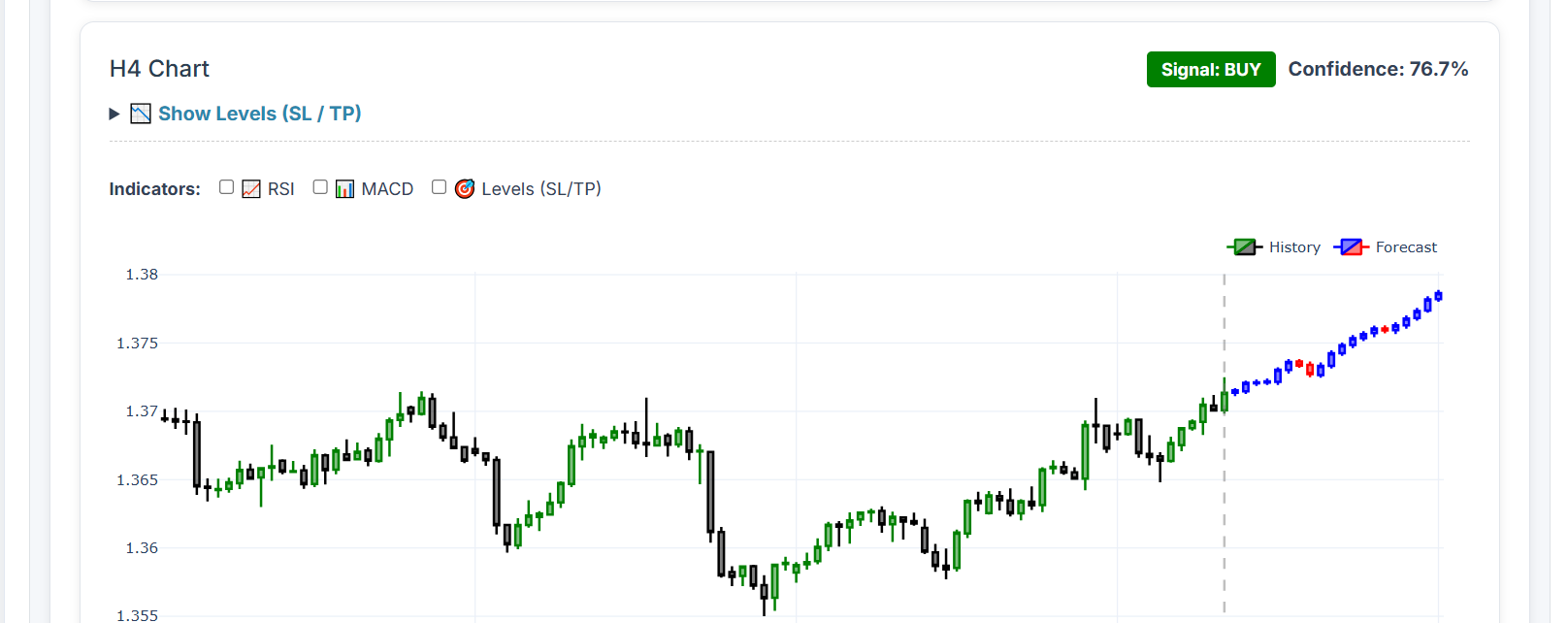
When you look at our Forex AI Forecasts, you see a Confidence Score. This is the heart of our system.
- High Conviction (70%+): This means that out of 30 simulations where we artificially “shook” the market with random noise, the majority still arrived at the same destination. The trend is robust.
- The Neutral Trap: If 15 simulations go up and 15 go down, the system stays Neutral.
- Pro tip: The “Neutral” signal is your best friend. It’s the algorithm telling you: “The signal-to-noise ratio is too low. Go play with your kids; don’t touch the terminal.”
The Fractal Conflict: Why H1 and H4 Disagree
I often get emails saying: “Your H4 chart shows a SELL, but H1 shows a BUY. Which one is lying?”
The answer is: Neither.
The market is fractal. Imagine a mountain. From a plane (H4), you see a clear downward slope. But if you are a hiker on the ground (H1), you might be walking up a small hill to get around a boulder.
By running independent models for H1, H4, and D1, we avoid the “Butterfly Effect” where a small error on a 5-minute chart ruins a weekly forecast. When the timeframes conflict, we see a setup. A BUY on H1 inside a SELL on H4 is a “Shorting Opportunity” — a chance to sell the peak of a corrective wave. This is how pros build a statistical edge.
Why I Don’t Believe in “100% Accuracy”
If you are looking for a “Holy Grail” that never loses, close this tab. You won’t find it here. In fact, anyone promising 90% accuracy is likely selling you a martingale system that will eventually blow up your account.
Professional quantitative trading is a game of 55–60% probabilities. If you have a 60% win rate and a 1:2 risk-to-reward ratio, you are effectively a casino. My goal with aemmtrader.com is to give you the data to be the casino, not the gambler.
Final Thoughts: Trading in 2026
We are long past the era of drawing triangles on a screen. To survive today, you need to be a “Centaur” — a human trader with an AI exoskeleton.
My team and I built aemmtrader.com to give retail traders the same probabilistic edge that hedge funds have been using for a decade. Don’t ask what the price will be; ask what the probability of success is.
See the math in action at aemmtrader.com. Trade smarter, not harder.