Stop Chasing 500% APY: Why “Boring” DeFi Is Actually Winning
 0xyooga3 min read·Just now
--
We’ve all seen the cycle.
A new protocol launches with a headline-grabbing APY. 200%. 500%. Maybe more. Capital floods in, Twitter starts shaming you for being “early,” and TVL explodes.
Then, three weeks later? Quiet. The liquidity rotates to the next shiny thing, the emissions dry up, and the project slowly fades into obscurity.
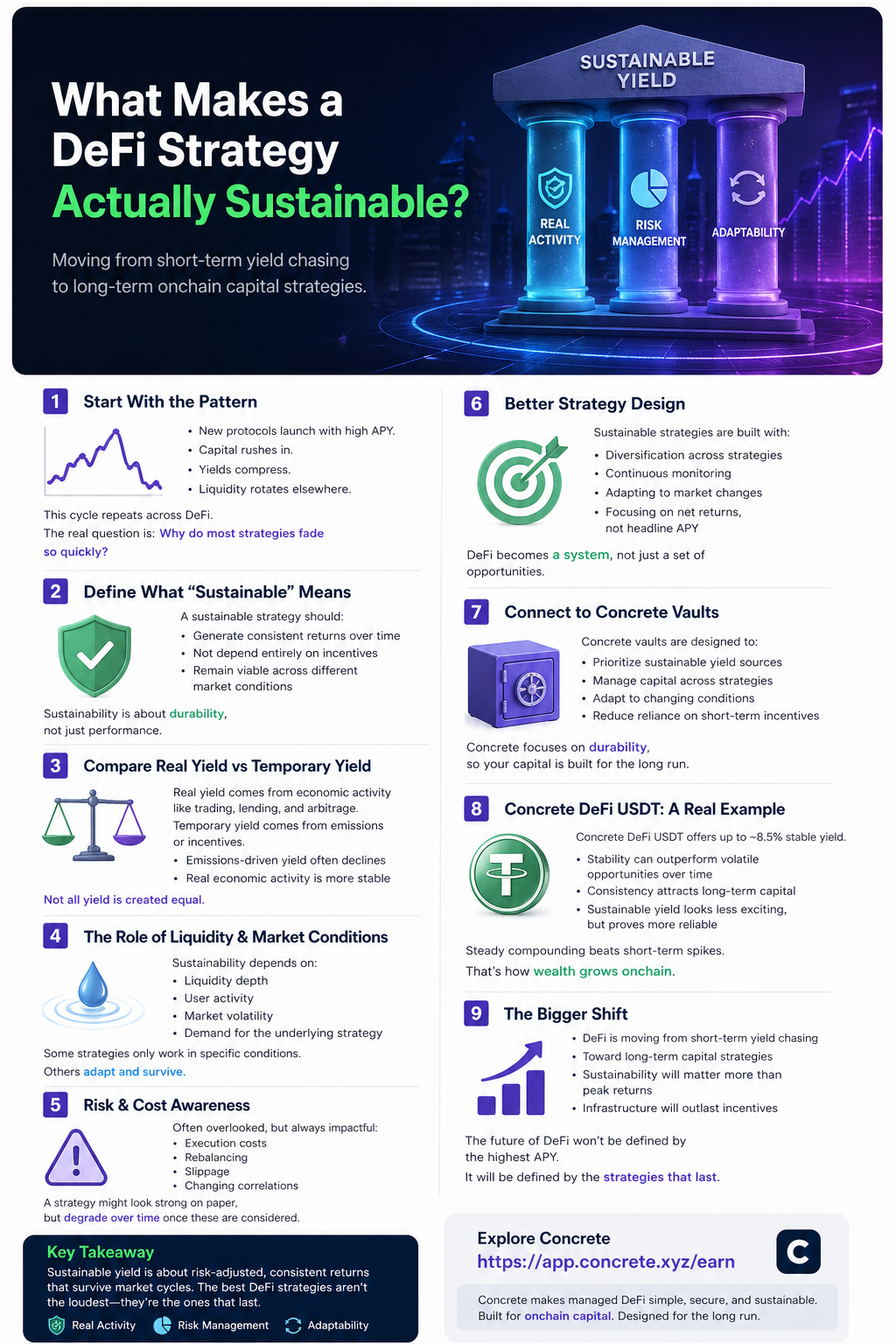
This isn’t a bug in DeFi; it’s the design. It’s the cycle of incentive farming. And if you’ve been in the trenches long enough, you eventually stop asking, “What’s the highest yield right now?” and start asking the only question that matters: What actually lasts?
The Test: If the Token Printer Stops, Do You Still Make Money?
There is a fundamental difference between yield and durable yield.
Most of what we see today is just a subsidy disguised as a return. It’s the protocol paying you to show up. The moment that token emission schedule runs out, the math breaks. The capital that came for the yield leaves with the yield.
If you want to know if a strategy is sustainable, ask this: If all token incentives disappeared tomorrow, would this strategy still make sense?
If the answer is no, you aren’t investing; you’re just timing a rotation.
Real yield comes from boring, structural stuff: trading fees, lending spreads, and arbitrage. These aren’t exciting, but they exist because the market actually needs them to function.
The Costs You Aren’t Calculating
Even when you find “real yield,” the math is often lying to you.
We look at a headline APY and assume that’s what we keep. We forget the friction. Rebalancing costs money. Slippage eats your margin. Gas fees erode your principal.
Scaling is the silent killer, too. When a position gets too big, it starts moving the market against itself, compressing the very spread you were trying to capture. A 15% APY backtest often translates to an 8% reality check once you factor in the operational drag.
That 8% might be lower, but it’s real. And in this market, real — and consistent — is better than 40% for 30 days.
DeFi Is Growing Up
The “degen era” isn’t going away, but it is maturing. We’re seeing a shift from finding the right trade to building the right system.
Sustainable DeFi looks more like traditional capital management. It requires diversification across multiple yield sources, active monitoring to handle market shifts, and a preference for “boring” durability over fragile, high-octane plays.
This is exactly what we’re building at Concrete.
Instead of chasing the highest yield on a single protocol, our vaults manage capital across multiple sources. We adjust as conditions change, prioritizing sustainability over the “wow” factor.
We target around 8.5% stable yield. It’s not the kind of number that makes headlines, but it is the kind of number that attracts institutional capital — the kind of capital that doesn’t need to exit in 30 days.
The Bottom Line
Peak returns are easy to find. Durability is hard.
The protocols that will define the next five years of DeFi aren’t the ones with the flashiest APY today. They’re the ones still operating — and still generating returns — when the next wave of incentive farming has come and gone.
Sustainable yield is often unexciting. That’s not a flaw. That’s the feature.
*** If you’re ready to stop rotating and start compounding, check out what we’re doing at Concrete.