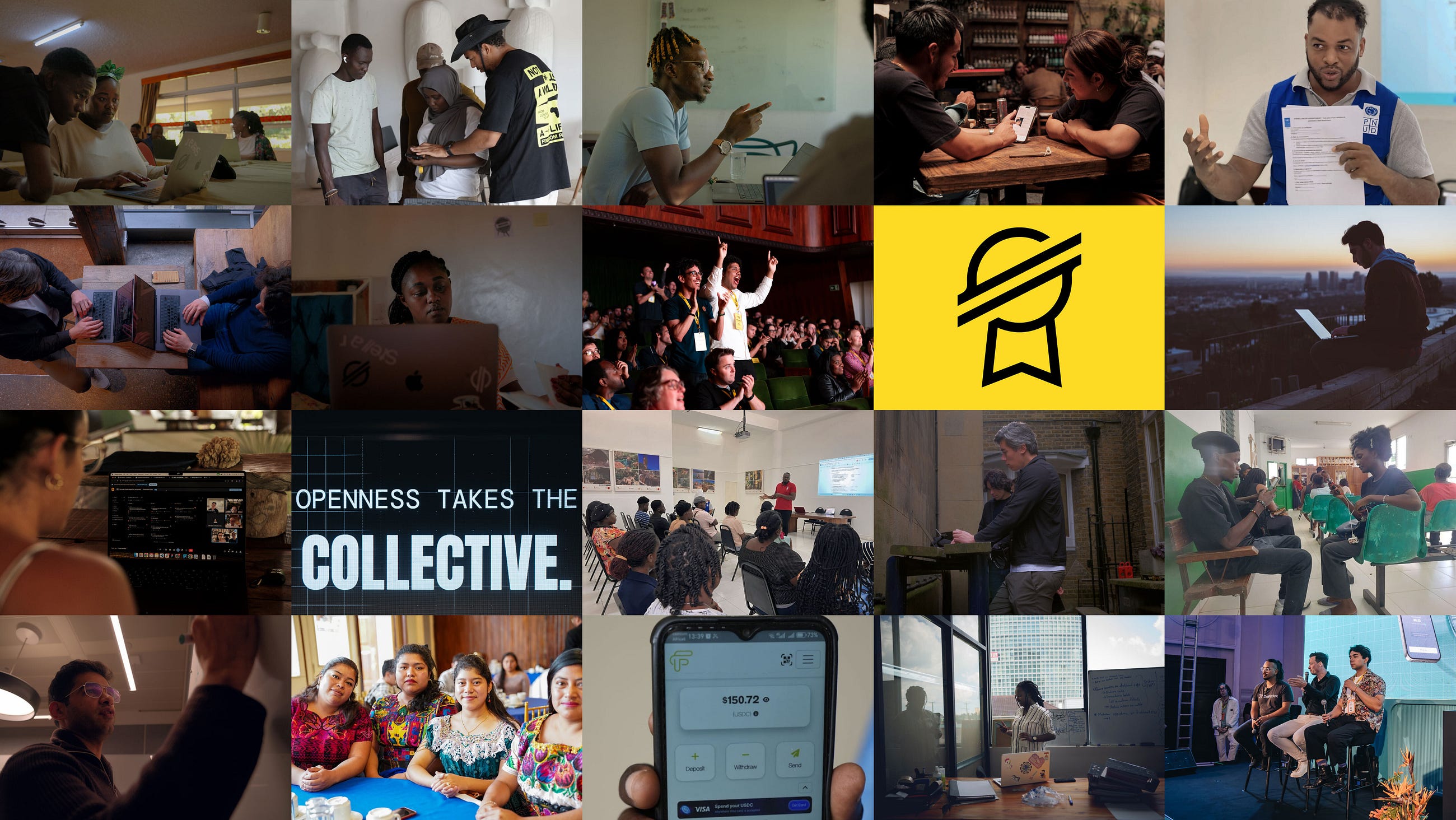
Stellar Community Fund — 2025 Impact Report
 Anke Liu14 min read·Just now
--
The Stellar Community Fund (SCF) is an award program operated by the Stellar Development Foundation (SDF), and leverages community input to fund and support companies and teams building on Stellar. With over $42M awarded to over 650 projects since 2019, SCF is one of the largest and longest-running award programs in web3. Learn more at communityfund.stellar.org.
This report synthesizes 2025 award data, community feedback and discussion, as well as survey responses from 333 SCF alumni teams, highlighting key milestones, trends, challenges, and actionable recommendations for 2026.*
Executive Summary
In 2025, the Stellar Community Fund moved from scaling the number of funded projects to scaling their impact. More teams launched on mainnet than any prior year, and more of them reported acquiring real users and generating revenue, and the programs around them (security, growth support, governance) matured to match. The year also made clear where the gaps are, and those lessons shaped SCF 7.0, which launched in January 2026.
Key Program Updates
SCF changes every year based on community feedback (see full history), and 2025 was no different. Key updates were introduced to the program to keep up with evolving ecosystem needs for growth and security, including:
- SCF 6.1 (Abstract Review Process)
- Audit Bank V2
- The introduction of the Public Goods Award
- The introduction of Growth Hack
- Quarterly Process Update
- Preparation for SCF 7.0 (launched in January of 2026)
Some hyperlinks above link to the #scf-governance channel in the Stellar Dev Discord and are only accessible for SCF verified members (anyone can join, the verification process is automatic and quick).
Program Output At a Glance
Build Award:
- 8 SCF Build rounds
- 1,163 submissions
- 154 awards
- $14.4M in XLM funding
- 82 teams completed their Mainnet Tranche
Audit Bank:
- 10 top auditors
- 23 protocols
- $1.3M worth of security audit weeks
Public Goods Award:
- 2 quarters
- 10 unique public good projects
- $419K in XLM funding
Growth Hack Pilot:
- 10 companies
- $300K in XLM funding (both base and performance-based awards).
Liquidity Award:
- 4 protocols awarded
- $200K in XLM funding
Kickstart (now replaced by Instawards):
- 2 cohorts
- 45 teams engaged
- 41 teams awarded
- $570K in XLM funding
Note: Above 2025 metrics only cover programs associated with the Stellar Community Fund, and do not encompass all funding and support programs by the Stellar Development Foundation (learn more about other SDF support programs).
Impact on Supported Teams
Based on the responses from 333 SCF-awarded teams.
External Funding & Revenue
120 awarded teams reported raising external funding after their SCF engagement, totalling nearly $70M in funding. Highlights include infrastructure platform DFNS with their $16M Series A raise, Latam-focused wallet AlfredPay with a $15M Series A funding round, and Kenya-based Honeycoin with a near $5M Seed funding round.
Out of ~230 active for-profit companies, over half were actively generating revenue at the time of the survey with an average of $57K per month. Over 60% of companies had an expected runway exceeding 6 months.
SCF Impact on Team Success
48% of survey respondents (161 teams) indicated SCF had an immense impact on their success to date, and over 40% mentioned SCF had a considerable impact on their success. SCF funding allowed teams to launch core new products on Stellar or develop on existing ones, hire developers and other employees, and build strong partnerships with the ecosystem.
Category and Audience
Out of all active responding teams, 136 built applications, 54 financial protocols, 54 infrastructure & services, and 61 dev tooling. 40% of teams indicated that they have a fast growing user base. 45% of teams were looking to get product-market-fit with their first real users on their Stellar product. Most teams catered to end-users, businesses, or developers.
Geographic Reach and Impact on End-User
SCF-funded teams indicated that they have active users in 86 countries, with top countries being Nigeria, Argentina, Brazil, and the United States. Over 33% of companies were purposefully built to deepen financial access in underserved markets.
Team
SCF funds global teams from nearly 70 countries, with a large number of team members living in the United States, Nigeria, United Kingdom, France, and India. Team size ranges from single-developer projects to companies with 50–100 employees, with an average team size of 6.
Open-Source
Over 40% of teams participating in SCF Build are fully open-source, ~15% are partially open-source, and ~12% indicated they would be open-source in the near future. Most non-open-source products were applications, on-off ramps, or specific infrastructure, but all DeFi protocols and most developer tooling were open-source.
Ecosystem Trends and Insights
DeFi-Powered User Growth
2025 showed growing adoption of an emerging trend of real-world wallets implementing decentralized finance (“DeFi”) protocols, abstracting away complex blockchain lingo for user-facing financial products based on stablecoins. For example, after integrating with Blend, Meru processed over $770M in transaction volume with over 145K yearly active users, with over 20% MoM growth in asset value held by accounts. Lobstr scaled to an average of 120K MAU, boosted by Aquarius AMM liquidity in swaps. Beans app saw a 2.5x Volume increase with over $600K in stablecoin inflows within three months of integration with DeFindex’s streamlined DeFi infrastructure.
Cross-Border and Stablecoin Payments
Stablecoin rails became the backbone for remittances, payroll, and merchant payments, with integrations into local banking, mobile money, and card networks. ScopeX scaled to over 40K users and €100M in volume for their EU-India corridor; Peer (Honeycoin’s P2P wallet) scaled to over 160K monthly users; Decaf reached $48M in monthly volume; AlfredPay reached 40% MoM user growth in Q4 in Latam; COCA.XYZ grew their user base with ~80% QoQ; and card infrastructure Kulipa grew to support $8M in monthly transaction volume.
DeFi Acceleration and RWA Tokenization
With new RWAs launched on Stellar (PYUSD, USDY, and more) the ecosystem expanded with the launch of DeFi strategy vaults, tokenized portfolio products and RWA-backed credit protocols. DeFi protocols like Blend and Aquarius saw an increase in TVL of approximately 284% (from $44.82M to $172.04M). After launching in June, DeFindex’s strategy vaults were integrated by 10+ partners. Normal Finance launched its synthetic asset and tokenized portfolio protocol, and with 7 live integrations, StellarBroker processed over $20M in trade volumes since its launch in May. Reflector saw its Total Value Secured increased +640%, reaching nearly 100M USD by the end of 2025.
Social Good and Real-World Utility
SCF-funded teams participated in the second cohort of the UNDP SDG Blockchain Accelerator and ran pilots testing blockchain-based digital payment flows under real operational constraints, not ideal conditions. Notable highlights include Bousol and Kura connecting digital wallets to point-of-sale infrastructure designed for low connectivity in Haiti using the Stellar Disbursement Platform, FreedomPay Wallet microfinance product for businesses in The Gambia using MoneyGram cash-out, and Amero Exchange collaborating with UNDP Guatemala to pilot a community investment feature tied to remittances.
Security-First Mindset
As DeFi grew on Stellar, security tooling became essential. AI-powered Almanax offered complimentary scans to all SCF-funded teams, open-source Scout (by CoinFabrik) offered bug-detection, Komet (by Runtime Verification) offered fuzzing and formal verification tool, and Extractor (by Hacken) offered an on-chain risk monitoring and incident response layer. Compliance and risk management platforms like Hypernative partnered with protocols and key ecosystem participants to support more informed decision-making in fund movements.
Infrastructure Efficiency
As more traditional finance companies came onchain, teams leveraged plug-and-play infrastructure to quickly integrate Stellar into their applications within days. Wallet-as-a-service platform DFNS scaled to $3B monthly transaction volume, and Mercuryo and Bitwave each significantly scaled partnerships with Stellar ecosystem companies. Many open-source SDKs were built with support of SCF; they, along with essential tooling like Scaffold Stellar, are maintained by the SCF Public Goods Award.
Program Insights
SCF Build Award
Across 8 SCF Build rounds in 2025 (SCF #33 through SCF #40), the Build Award processed 1,163 project abstracts and 644 Build submissions, and awarded 154 projects with a combined $14.4M in funding. The average award was approximately $93K, and about 25% of submissions were awarded.
Program Evolution: SCF 6.0 to 7.0
2025 saw the Build Award evolve significantly. SCF 6.1 introduced an abstract review process to decrease the total number of projects reaching community vote in order to help voters focus on higher-quality submissions. The program also prepared for the major SCF 7.0 overhaul (activated in January 2026), which introduces a referral-based intake system, three separate Build Tracks, a new quarterly governance process, and a restructured 10–20–30–40% payout model designed to incentivize faster mainnet launches. Additional SCF funding is now available for top projects to reach feature-complete status, up to a $300K total cap for each project inclusive of all prior SCF funding.
Community Vote & Neural Quorum Governance
Since October 2023, SCF’s Community Vote phase has been powered by Neural Quorum Governance (NQG), a reputation-based voting mechanism co-designed with BlockScience that computes individualized voting power through layered neurons and a group delegation system inspired by the Stellar Consensus Protocol.
The mechanism underwent significant evolution during 2025. SCF #39 introduced the Retro Vote Quality neuron (rewarding voters whose past picks reached mainnet) and expanded Discord Tier recognition, adding new dimensions to the voting power model. Most critically, we identified that high delegation abstain rates (routinely 45–57%) were a measurement methodology issue rather than an issue of voter apathy. A redesigned quorum algorithm reduced the abstain rate to 0%.
Voting power distribution improved significantly: the top 5 voters’ share of total NQG dropped from 43.6% in #37 to 21.5% in #40, driven by logistic weighting functions, broadened Trust Graph bonuses, and new neuron inputs. The Theil index (a standard measure of voting power inequality) declined from 0.60 to 0.32 over the same period. Across all 2025 rounds, an average of 88% of panel-awarded projects were also in NQG’s top-N ranking, demonstrating consistent convergence between community signal and expert review.
Tranche Progression & Category
Of the 154 awarded projects, 52 (34%) completed all tranches through mainnet launch, significantly more than 2024. 48 projects are at the MVP stage, 22 at testnet, and 31 at the initial awarded stage. This reflects the natural pipeline funnel where projects from later rounds are still progressing through deliverables. Most awarded projects were categorized as Applications, followed by Infrastructure & Services and Financial Protocols.
Big Wins
90+ SCF-funded mainnet projects were showcased at Meridian 2025, and 72 mainnet-launched projects were highlighted through demo days on @StellarOrg. Clear examples of ecosystem coordination emerged across SCF, the Ambassador Program, and external partners. Of the 154 awarded submissions, 87 (57%) are building with Soroban smart contracts, signaling strong alignment with the Stellar ecosystem roadmap.
Key Learnings
The most significant program learning was the need to focus on quality over quantity. With the rapid increase in AI capability, it became harder to tell which teams were genuinely capable of delivering. SCF 7.0 addresses this through trusted referrer intake. Additionally, the 7.0 shift to a 10–20–30–40% structure should motivate faster mainnet launches. Teams also responded well to additional check-ins on tranche progression, leading to faster tranche completion.
Due to the increasing large number of submissions in Community Vote (especially towards the rounds later in the year), not all submissions were reviewed adequately, and final award allocation required some calibration, something you can see in the NQG-Panel Alignment % dropping in SCF #39 and #40. Reducing voter apathy was one of the key drivers leading up to SCF 7.0’s restructure, and the effects are already visible in SCF #41, which had 100% NQG-Panel Alignment.
SCF Growth Hack
Launched in Q4 of 2025, the SCF Growth Hack Program builds on the successful User Acquisition Pilot (April–July 2025) to run quarterly cohorts that help 10–15 mainnet-launched companies accelerate their path to product-market fit. Each company receives $20K in XLM to test acquisition strategies over a 4-week campaign plus 4-week retention period. Top performers share up to $200K in XLM in performance-based awards. The program bridges the gap between development (SCF Build) and scaling (GTM audits, Marketing Grant, and investment readiness).
The first cohort (to be completed in early 2026) included 10 companies spanning cross-border payments, DeFi, stablecoin infrastructure, and financial inclusion across Latin America, Africa, Asia, and Europe: Abroad (stablecoin payments for travelers), Allbridge (cross-chain bridge), CashAbroad (cross-border importer payments), DeFindex (DeFi strategy infrastructure), Myaza (African cross-border payments), Mykobo (regulated Euro stablecoin), Normal (tokenized portfolio products), ROZO (intent-based interoperability), Seevcash (African diaspora remittances), and Untangled OctoVault (DeFi strategy management).
Audit Bank
The Soroban Security Audit Bank enhances the safety and security of Soroban projects by coordinating audits from leading security firms and allocating them to strategically important projects, most of them SCF-funded.
Audits in 2025
Across 2025, the Audit Bank coordinated 23 audits for 21 unique DeFi and essential (cross-chain) infrastructure protocols, engaging 10 audit firms at an estimated total program cost of approximately $1.3M (including competitive audits and formal verification engagements covered under separate agreements). See all available audit reports here.
Key V2 Improvements
In 2025, the program was restructured with an expanded roster of whitelisted audit firms and several improvements, including a sliding co-payment structure to align incentives with security outcomes. Every incoming request now undergoes a mandatory readiness assessment including STRIDE threat modeling and self-serve tooling scans (via tools like Almanax, Scout, and Komet). The program also shifted from pre-purchased credits to a whitelisting model with multiple quotes per project, and introduced complementary follow-up audits at key TVL milestones including formal verification and competitive audits for high-impact protocols.
Public Goods Award
Launched in May 2025 , the Public Goods Award supports community-maintained public goods such as key infrastructure and tools for ecosystem visibility, data, and governance that directly strengthen the Stellar ecosystem. This award replaced expiring grants from SDF’s Infrastructure Grant Program, bringing these essential projects under the SCF umbrella with greater community accountability.
A key milestone was the program’s first use of Community Vote with Soroban Governor which was a significant step toward progressive decentralization of Stellar ecosystem governance. The program also drove more public communication about open-source projects and increased accountability for maintainers to publish traction and achievements.
Liquidity Award
The SCF Liquidity Award was relaunched in early 2025 to provide initial liquidity support for protocols meeting business, technical, and legal criteria. 4 protocols (OrbitCDP, FxDAO, Untangled, and Normal) were awarded Liquidity Awards totalling $200K. To qualify, they had to attract and maintain consecutive 7-day TVL of recognized assets greater than $250K. While the program served its purpose for early-stage liquidity needs, the award structure provided limited value given the larger liquidity requirements of maturing protocols. The program’s structure and incentives will be reviewed in 2026 to better serve the ecosystem.
Kickstart
The SCF Kickstart program supported early-stage teams with small awards and structured mentorship across two cohorts in H1 2025. 45 teams participated, of which 41 received awards totalling $570K. The program was discontinued after H1 2025 due to insufficient ROI: teams often did not achieve sufficient traction post-cohort to meet Build Award criteria. The learnings directly informed the design of Instawards in SCF 7.0, which embeds early-stage incubation directly within Ambassador chapters for more hands-on regional support and a clearer pathway into the Build Award pipeline.
Looking Ahead: 2026
2025 demonstrated that the highest-impact ecosystem growth comes not from maximizing volume, but from deepening quality: of applications, of security, of governance, and of the support infrastructure around builders. SCF 7.0 is built around that lesson.
Better signal, less noise
With AI lowering the cost of producing submissions, surfacing genuine signals from noise became the defining challenge of 2025. The referral system in SCF 7.0 helps, but it’s just the start. We’re looking at what else can improve inflow and selection quality over time: tighter feedback loops between referrers and reviewers, better ways to identify skilled and impactful teams from the pipeline, and enhanced analysis of what’s actually working across rounds.
Helping teams grow, not just build
SCF has historically been strong at incubation, but in 2026 the emphasis shifts to what comes after mainnet launch. With its debut in 2025 the Growth Hack program will increase in frequency and scale, and initial steps have been made towards providing awarded teams with UX feedback and user testing as part of their Build Award process. Coordinated support across the ecosystem, especially through regional Ambassador chapters, will help more teams make the transition from a funded idea to a scaling business.
Security as a practice, not a checkbox
As activity in Stellar-based DeFi protocols grows and institutional interest increases, security must evolve from a one-time checkpoint into a continuous capability. The Audit Bank is shifting from reactive audit allocation toward a security maturity model — scaling milestone-based follow-up audits as TVL grows, sharing education resources, and incentivizing projects to invest in their own security practices between audits.
Governance that’s actually decentralizing
The Public Goods Award is moving toward community-led governance, with administration shifting from SDF to community members on community-built platforms. NQG will keep being refined. The voting power improvements in 2025 were meaningful, but as the voter base grows and diversifies, the calibration work doesn’t stop. We need to make sure the mechanism keeps reflecting what the community actually thinks, not just what early participants think. Longer term, we’re exploring what it looks like for the ecosystem to govern its own resource allocation.
Building in the age of AI
AI makes it cheaper and faster to build, which is mostly good news. More people from more places can participate. But shipping a product is not the same as finding users, and that gap is only getting wider. SCF is actively exploring how to adapt: developing guidelines around responsible AI usage in submissions, calibrating evaluation criteria to reflect AI-assisted timelines, and when and where appropriate, encouraging teams to leverage AI tools throughout the build and growth process. All while ensuring funded work meets the same standards of originality and depth SCF has always required.
Learn more about the Stellar Community Fund at communityfund.stellar.org. Join the Stellar Dev Discord to participate in governance and community discussions.
*Disclaimer: This report is provided for informational and ecosystem transparency purposes only. Project descriptions, including links, are based on information provided by award recipients or publicly available sources. Stellar Development Foundation and Stellar Community Fund make no representations or warranties regarding the accuracy, completeness, regulatory status, or legal compliance of any project or link described or included herein. Inclusion in this report does not constitute an endorsement, recommendation, or investment advice by SDF or SCF with respect to any project, token, protocol, or digital asset. Recipients of SCF awards are independent entities solely responsible for their own regulatory compliance. Readers should conduct their own independent due diligence before engaging with any project or protocol referenced in this report.
SDF will never ask for your private keys or ask you to deposit funds to any wallet address. Please review our Security Guide for more information.