
State of Crypto Marketing 2026. Built from the public record.
 Jukka Blomberg4 min read·1 hour ago
--
On the agency side of crypto marketing, every quarter now produces a measurement framework — OMI, the awards stacks, the citation indices, the AEO leaderboards — and most of them cite themselves. There is no equivalent operator-side synthesis, built only on primary sources, that anyone can independently verify. We are writing it.
The premise is simple. In a regulated category, what is publicly visible about a firm’s marketing function is what the regulator can see about that firm’s marketing function. The gap between the public signal and the private practice is where regulator risk lives. A synthesis built only on public sources is therefore the regulator’s view of the function — which is the only view that matters after July 1.
What the report is
A 40-page report synthesising eighteen months of public signal across thirty-plus crypto marketing organisations — exchanges, L1 and L2 foundations, wallets, and CASP-licensed firms. Every claim is anchored to a primary source the reader can open in a new tab. No anonymous quotes. No off-the-record reads. If a thing is not publicly visible, it does not go in the report; the visibility itself is the data.
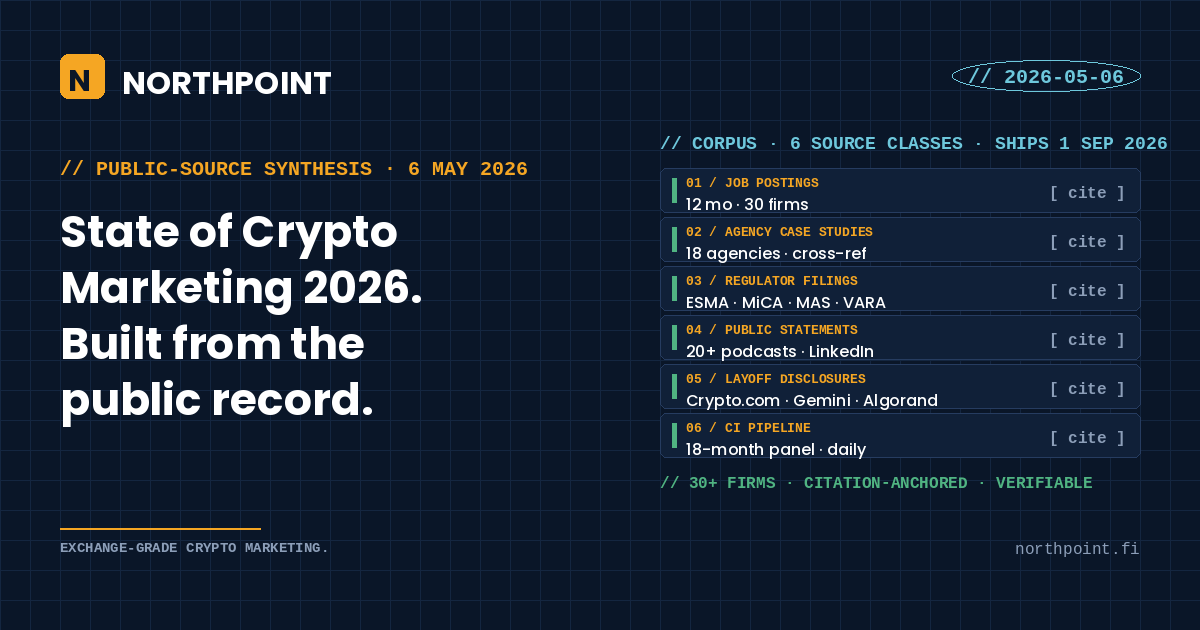
The corpus draws from six source classes.
Job postings, by jurisdiction, by month. Twelve months of senior marketing role postings across thirty firms. The job descriptions describe what the function thinks it needs to hire — and the absences describe the seats the function has decided not to staff.
Agency case studies and press releases. Coinbound’s, Lunar’s, MarketAcross’s, Outset PR’s, RZLT’s, ICODA’s, NinjaPromo’s, Blockwiz’s, and the long-tail. Cross-referenced against the firms they claim. The overlap pattern — which firms have three agencies, which have one, which have none — is its own dataset.
Regulator filings and statements. ESMA’s April 17 statement, the MiCA delegated regulations on marketing communications, MAS and VARA guidance, FCA promotion rules. Plus the public regulator-action register — which marketing-side cases are now in the public record.
Conference recordings, podcast transcripts, public LinkedIn posts. Where the senior operators themselves have spoken on the record about the function. Twenty-plus podcast episodes already in the corpus.
Layoff announcements and earnings disclosures. Every public 2026 marketing-team contraction, with the public AI-cover-narrative versus the cyclical-reset reading from outside the firm.
Eighteen months of competitor-intelligence signal. NorthPoint runs a daily intelligence pipeline tracking eighteen crypto-marketing agencies and their content. That gives a longitudinal read most one-shot research projects do not have.
The five themes
The corpus is organised around the same five themes any senior operator would ask under MiCA enforcement.
1. The shape of the marketing function today. Built from job postings and LinkedIn org charts. Where the gate-stack seat lives, and where it is missing.
2. AI in the stack. Built from job postings that ask for AI tooling experience plus public statements about adoption. The gap between claimed adoption and verifiable adoption is itself a finding.
3. The agency stack. Built from agency case studies cross-referenced against firm announcements. Multi-agency overlap mapped firm by firm.
4. MiCA and regulated-marketing readiness. Built from public marketing copy audited against ESMA’s April 17 statement and the delegated regulation requirements. The exposure surface, by firm, by jurisdiction, by language.
5. The next twelve months. Built from layoff announcements, hiring direction, agency-relationship endings, and public restructure signals.
Why a public-source synthesis is the right shape
Three reasons.
First, every claim is independently verifiable. A reader who disagrees can open the source. A reader who agrees can use the source in their own work. The report becomes a piece of operator infrastructure the way a well-cited regulator filing does.
Second, the visibility filter is the analysis. In the MiCA era, what is publicly visible about a firm’s marketing function is what the regulator can verify. The firms that fail their first audit in Q3 will not fail it because of what they said off the record; they will fail it because of what they shipped publicly without auditing it. A report built only on what is publicly visible is the regulator’s reading of the same surface.
Third, the report ships faster, holds longer, and updates cleanly. Interview-based research is captive to scheduling, anonymisation politics, and quote-clearance loops. Public-source research compounds — every new piece of competitor-intelligence signal added to the corpus updates the underlying read without renegotiating an interview.
What this report is not
It is not a vendor comparison. It is not a “best agency of 2026” award. It is not a benchmarking exercise where NorthPoint is the benchmark-setter. NorthPoint’s commercial offering appears in the report only in the appendix, in one paragraph, with one link. The report is a synthesis of practice as the public record reveals it, with no party to the practice having editorial control over the reading.
How to influence it
If your firm has shipped a public signal that belongs in the corpus — a post-mortem, a conference talk, an open-source asset, a regulator filing, a press release, a job posting that names a structural decision, an executive statement worth citing — write to [email protected] with the link. Nominations are read every Friday and the corpus is updated weekly through August.
The corpus and methodology are public on GitHub: github.com/jukkablomberg/state-of-crypto-marketing-2026. MIT licensed; updated weekly through August. The companion repo ships alongside the report on September 1.
The corpus opens publicly with this post and grows weekly. Ships September 1, 2026, in a regulator-readable PDF and an interactive HTML version on northpoint.fi.
— Jukka Blomberg, Helsinki, 6 May 2026
— -
Originally published at northpoint.fi/resources/writing/state-of-crypto-marketing-2026.
NorthPoint runs the seat above the gate-stack for one CASP-licensed crypto firm at a time. Fractional Crypto CMO from €15,000/mo. CMO Operating System — 90-day install from €55,000.
