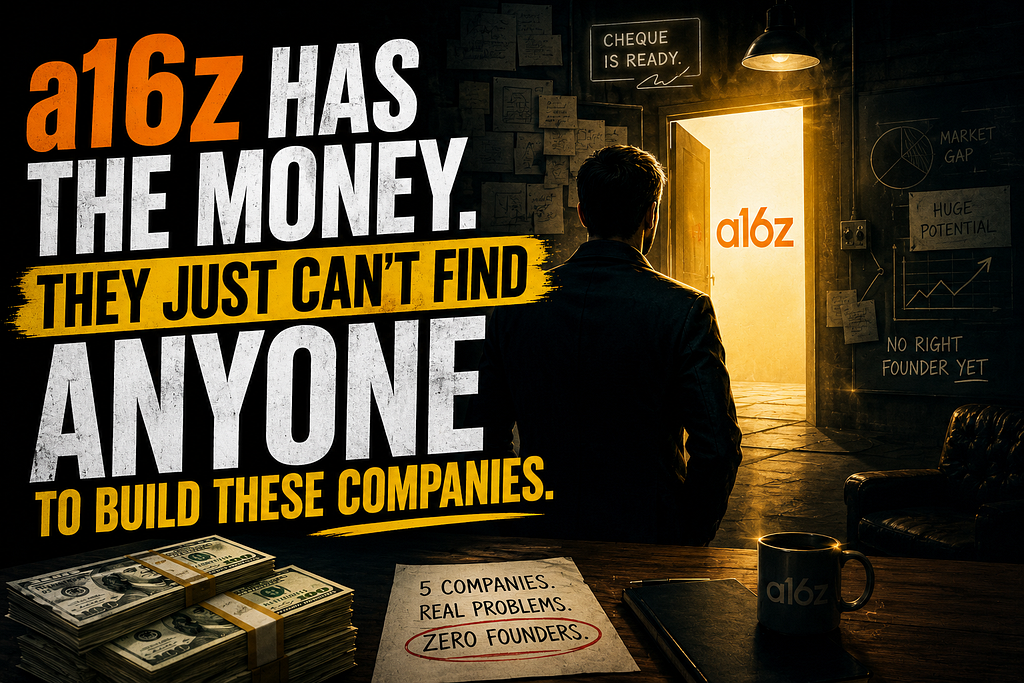
a16z Has the Money. They Just Can’t Find Anyone to Build These Companies.
My five pick from the a16z startup list
I don’t usually pay much attention to VC “thesis” posts. They’re mostly written to sound smart at conferences, big words, vague markets, no real commitment to anything.
But this one stopped me.
a16z , the firm that backed Airbnb, Stripe, and GitHub has published a specific list of companies they want to fund but can’t find one. It is not sectors they’re watching, nor the trends they’re excited about. Actual businesses, described in plain terms, with one uncomfortable admission underneath all of it: the cheque is ready. They just don’t have a founder yet.
I went through the full list. Here are the five I keep thinking about.
1. AI Tools That Put Compliance First, Not Last
Every hospital, law firm, and bank I have heard about wants to use AI. The budgets are real. The interest is genuine.
What keeps killing the deals is the legal team.
The AI tools weren’t built with audit trails or regulatory documentation as real requirements, those got bolted on later, usually badly. So the evaluation gets to the security review, someone asks where the data goes and whether they can prove it, the answer falls apart, and the deal dies.
Nobody has built AI tooling where compliance is the foundation. Whoever does will sell into customers who are slow to sign but almost impossible to lose. Regulated industries don’t churn. Once they find something that works, they stay.
2. Real-Time Monitoring for Factories and Physical Infrastructure
Most factories still find out something is wrong when the machine stops.Not before.
Software teams have had real-time observability for years, alerts, dashboards, anomaly detection that catches problems before any user notices. Physical infrastructure has almost none of the equivalent. The monitoring tools that exist are shockingly basic given what a single unplanned line stoppage actually costs.
The gap between what’s technically possible and what’s actually deployed on factory floors is enormous. The bar for “better than what exists” is surprisingly low.
3. AI That Acts Without Waiting to Be Asked
Every AI product right now follows the same loop: you notice a problem, you write a prompt, it responds.
Which works. But it also means the AI is only ever as useful as your ability to catch things yourself and remember to ask about them. The burden never actually shifts.
AI is only ever as useful as your ability to catch things yourself and remember to ask about them.
The version nobody’s built well is the one that watches alongside you. The project tool that quietly flags the dependency about to slip before you realize it. The email client that drafts the follow-up before you remember you forgot it. An assistant that notices you’ve been stuck for an hour and surfaces something relevant.
Getting this right is mostly a product judgment problem , knowing when to act and when to stay out of the way. That’s the hard part, which is why it hasn’t been solved yet.
4. Infrastructure for AI Agents That Actually Work Together
Companies are running AI agents now from small, autonomous systems that each handle a specific task. The technology is good enough that adoption is real and growing.
The problem nobody warned them about: agents are bad at sharing.
One agent updates a record another one is mid-process on. Tasks get duplicated or dropped. Nobody’s sure what each agent is actually allowed to touch. What started as automation turns into a coordination mess faster than expected.
The problem nobody warned them about: agents are bad at sharing.
What’s missing is the layer that makes agents work together i.e., memory, task routing, conflict resolution, permissions. The market for this is forming fast. The tooling is not keeping up.
5. Software Built for Startups That Started With AI
Companies that launched five-plus years ago had to figure out how to add AI to infrastructure that wasn’t designed for it. Hard problem, expensive to solve.
Companies starting today don’t have that problem. AI is there from day one. Which also means the old tools like Salesforce, Jira, the whole legacy stack weren’t built for how these teams actually work. The workflows are different. The data is structured differently. The operating assumptions are different.
Nobody’s built the operations layer for this generation yet. That’s a customer base that grows every time a new company is founded, and right now they’re mostly stitching things together with whatever’s available.
What These Five Have in Common
None of this sounds exciting at first. Compliance tooling. Factory monitoring. Agent orchestration. But boring-sounding markets with real budgets and genuine pain are usually where the companies that last actually get built. The flashy categories fill up fast. The ones that take some domain knowledge and patience to understand stay open longer.
How to Actually Use a16z list
After going through the list, I start thinking that this list is most useful as a direction, not a destination.
None of these ideas tells you what to build. They tell you where the demand is real and the competition is still thin. Your job is to find the specific, painful sub-problem inside one of these spaces that you’re actually positioned to solve.
Here are the few filters worth applying before you commit:
- Is this painful enough that people already spend money on it? If the problem is real, someone’s already paying for a bad solution. Find that spending.
- Is it specific enough to build a sharp first version? “AI for compliance” is too broad. “Automated audit trail generation for health records systems” is something you can actually ship.
- Are you close enough to this world to move fast? The founders who win in industrial AI usually have some relationship to the industry, not necessarily as engineers, but as people who understand how the work actually gets done.
- Can a small number of users pay enough to make it worthwhile? The best early-stage businesses often have 10 customers who each pay $2,000 a month, not 10,000 users on a free tier.
a16z published this list because they’re looking. The companies they’re describing don’t fully exist yet. The founders (YOU) who will build them are probably reading something just like this right now, trying to figure out if their idea has real potential.
The question isn’t whether you can build the biggest company in the category. The question is whether you can solve one expensive problem, build a first version simple enough to ship in the next 90 days, and get close enough to real users to learn whether you’re onto something.
Most successful founders didn’t start with a complete vision. They started with one useful, ugly solution to a real problem and kept improving until people couldn’t imagine working without it.
The future isn’t fully built yet. There’s still room to define these categories. The only thing that actually matters now is starting.
Which of these five ideas would you bet on as a solo founder? And if you’re already building in one of these spaces, I’d genuinely love to hear about it. Drop it in the comments.
Startup Ideas a16z Wants Someone to Build in 2026 was originally published in DataDrivenInvestor on Medium, where people are continuing the conversation by highlighting and responding to this story.