From Phase 1 to Phase 4: Where Starknet Staking Is Headed
 Endur6 min read·Just now
--
TL;DR
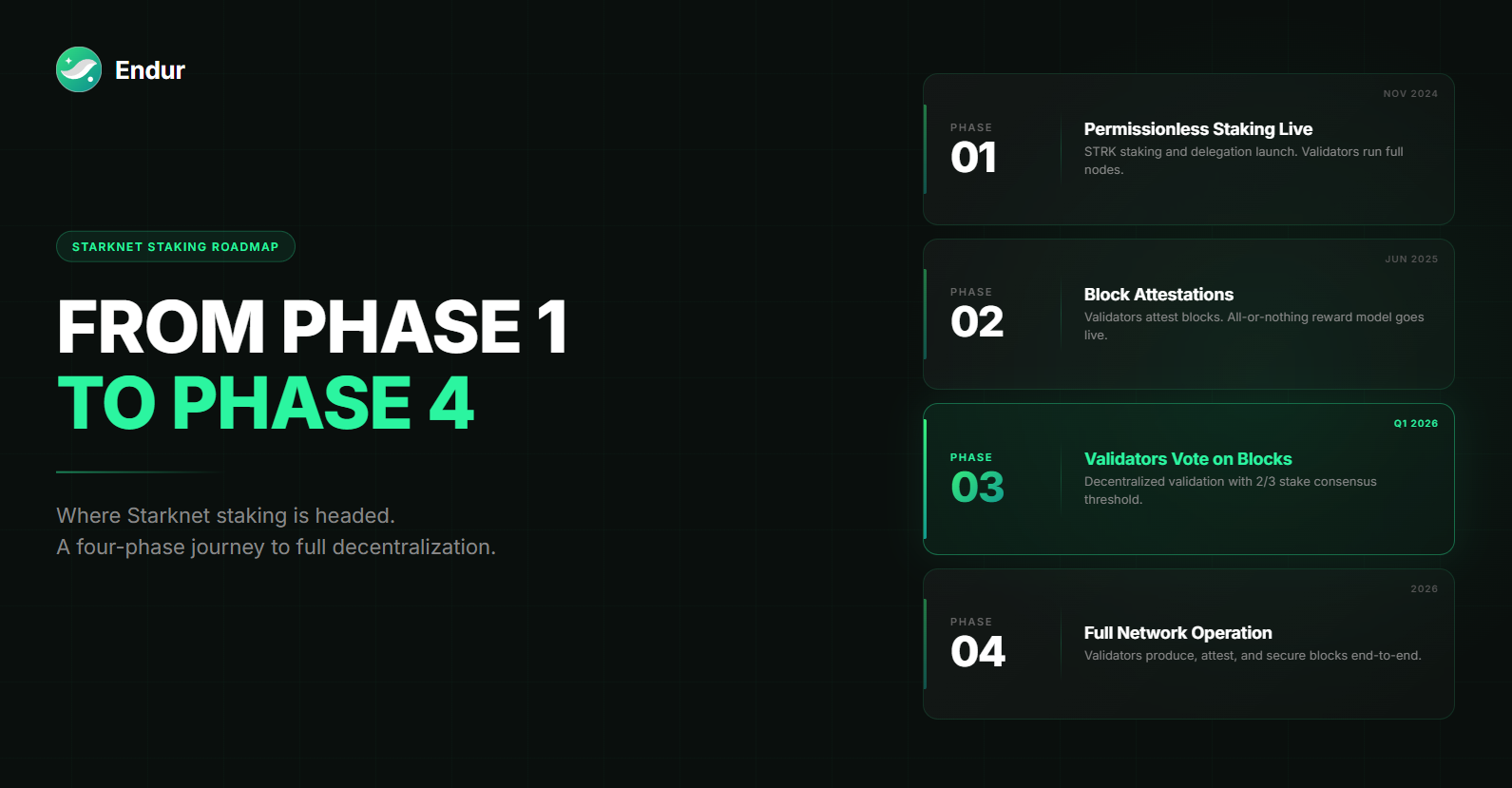
Starknet is rolling out staking in four distinct phases. Phase 1 launched the protocol in November 2024. Phase 2 introduced block attestations and the all-or-nothing reward model in June 2025. Phase 3 brings decentralized block validation in late 2025 to early 2026. Phase 4 hands sequencer operation to validators in 2026. Each phase changes what staking means, what validators do, and how rewards flow to delegators on Endur.
The Multi-Phase Approach
Starknet didn’t ship staking as a single feature. The team broke it into four phases, each adding more responsibility to validators and more decentralization to the network. The reasoning is straightforward: shipping a fully decentralized proof-of-stake L2 in one go is risky. Phasing it lets the protocol stress-test each layer before adding the next one.
The phases also map to a clear economic story. Phase 1 was about bootstrapping stake. Phase 2 made staking productive. Phase 3 makes validators consequential. Phase 4 makes them essential.
For anyone holding STRK or xSTRK, understanding where the protocol is in this roadmap matters more than chasing the current APY. The yield you earn six months from now will look different from today’s, because the system underneath it is changing.
Phase 1: The Foundation (November 2024)
Starknet staking went live on mainnet in November 2024. The first phase was deliberately minimal. Validators could register, delegators could stake STRK, and rewards flowed through a fixed minting curve. There were no slashing rules. There were no attestation duties. The protocol just needed stake to show up.
The minting curve itself was the most consequential piece. It follows the formula M = (C/10) × √S, where C is capped at 1.6% annual inflation and S is the percentage of STRK staked. The curve was voted in with 98.94% community approval, making rewards predictable and self-adjusting. As more STRK gets staked, individual yields compress, which prevents runaway inflation.
Phase 1 launched with around 110 million STRK staked. That number has grown to over 1.1 billion STRK as of early 2026, an 11x increase representing roughly 23% of circulating supply. The bootstrap worked.
Phase 2: Attestations Go Live (June 2025)
Staking V2 went live in June 2025 after SNIP 28 passed governance. This was the first phase where validators had real work to do.
The core change: every validator must sign an attestation for one randomly selected block per epoch. The block is chosen pseudorandomly using the validator’s address and the epoch hash, so no validator can game which block they need to watch. Miss the window and you lose the entire epoch’s rewards. Not a percentage. The whole thing.
This is the all-or-nothing model, and it changed validator economics overnight. Operators who used to focus on commission rates suddenly needed bulletproof infrastructure: redundant nodes, monitoring, automated failover, the works. A single missed attestation costs every delegator under that validator a full epoch of yield.
Phase 2 also reduced unbonding from 21 days to 7 days, which made stake more liquid and made delegation more responsive to validator performance. If a validator starts missing attestations, capital can rotate out faster.
For Endur, this phase is what made validator selection the most important job in the protocol. Picking validators who can hit attestations consistently became the difference between predictable yield and dead epochs.
Phase 3: Decentralized Block Validation (Q4 2025 to Q1 2026)
Phase 3 is where validators stop being passive signers and start participating in consensus. The plan is to move block validation from the centralized sequencer to a permissionless set of validators voting with their stake.
Under Phase 3, every new block needs sign-off from validators representing at least two-thirds of total staked weight. This is the standard BFT threshold. It means the Starknet sequencer can no longer unilaterally finalize a block. Validators have veto power.
The Grinta upgrade is the technical milestone here. It’s scheduled for March 18, 2026, and it includes a brief 12-minute mainnet pause to roll out the new sequencer client. This isn’t a hard fork. It’s a coordinated upgrade to the infrastructure that lets validators eventually take over consensus.
Phase 3 also introduces the dual-asset consensus model. Voting power becomes 75% STRK plus 25% BTC. Bitcoin holders staking through providers like Endur’s xyBTC products earn a real voice in network security. As of now, over 1,700 BTC are already staked on Starknet, all in just three months since BTC staking opened.
This is the phase where missed attestations stop being a yield problem and start being a security problem. A validator who can’t attest reliably can’t participate in consensus, and they can’t help finalize blocks. The economic punishment in Phase 2 becomes a structural exclusion in Phase 3.
Phase 4: Validators Run the Sequencer (2026)
Phase 4 is the endgame. Validators stop just voting on blocks and start producing them. The Starknet sequencer, currently operated by StarkWare, gets handed to the validator set.
This means validators are responsible for ordering transactions, building blocks, and feeding them into the proving pipeline. Proving itself stays centralized for now because STARK proof generation requires specialized hardware and cryptographic expertise that doesn’t yet generalize across many operators. But everything upstream of proving becomes the validator network’s job.
For delegators, Phase 4 is when staking yield becomes fully tied to validator operational quality. A validator who can’t run a sequencer reliably won’t earn block production rewards. A validator who can will earn substantially more than just the base attestation reward. The spread between top validators and average ones widens.
This is also when MEV becomes a real consideration on Starknet. Validators ordering transactions get the same kinds of opportunities (and risks) that Ethereum proposers have today. How Starknet handles MEV redistribution back to delegators is one of the open design questions still being worked through.
What This Means for Endur
Each phase shifts what Endur is optimizing for.
In Phase 1, the job was simple: aggregate stake, mint xSTRK, compound rewards. There were no real performance differences between validators because there was no work to fail at.
In Phase 2, the job became validator curation. Picking Karnot, Twinstake, and Unwrap Labs wasn’t about commission rates. It was about which operators could hit attestation windows without fail.
In Phase 3, the job extends to consensus reliability. A validator who can’t show up for two-thirds voting can’t be in the active set, so Endur’s curation matters even more.
In Phase 4, the job becomes operational depth. Validators who can run sequencers, manage MEV responsibly, and produce blocks at scale will earn outsized rewards. Endur’s role is to make sure delegators are pointed at validators who can do that work, not just at validators who happen to be cheapest today.
Looking Ahead
The phased rollout is what makes Starknet staking different from most L2 staking models. Most L2s either don’t stake their token at all or staking is purely symbolic. Starknet is building toward genuine decentralized validation, and each phase has tested whether the previous one held up under real economic pressure.
1.1 billion STRK staked, 1,700 BTC, 23% of circulating supply, attestation reliability becoming the dominant validator metric: these are signals that the model is working. Phase 3 will test whether validators can handle consensus responsibility. Phase 4 will test whether they can run the network.
For anyone staking through Endur, the takeaway is that the protocol underneath your xSTRK is going to change shape several more times. The yields you earn will increasingly reflect not just how much stake is in the system, but how good the validators backing your position actually are at doing the work the protocol asks of them.
The question for the next year isn’t whether Starknet staking grows. It clearly is. The question is which validators stay in the active set as the bar keeps rising.