Solana’s Alpenglow Is Live on Testnet. Here’s What 150ms Finality Changes for Token Creators.
 J Tools6 min read·Just now
--
Solana just started testing the biggest upgrade in its history. Proof of History is going away. Block finality is dropping from 12 seconds to 150 milliseconds. And if you’re building on this chain, it changes more than you think.
On May 11, 2026, Anza (Solana’s core development firm) announced that Alpenglow is live on a community test cluster. Validators are now running the new consensus software in a real testing environment, one step away from mainnet.
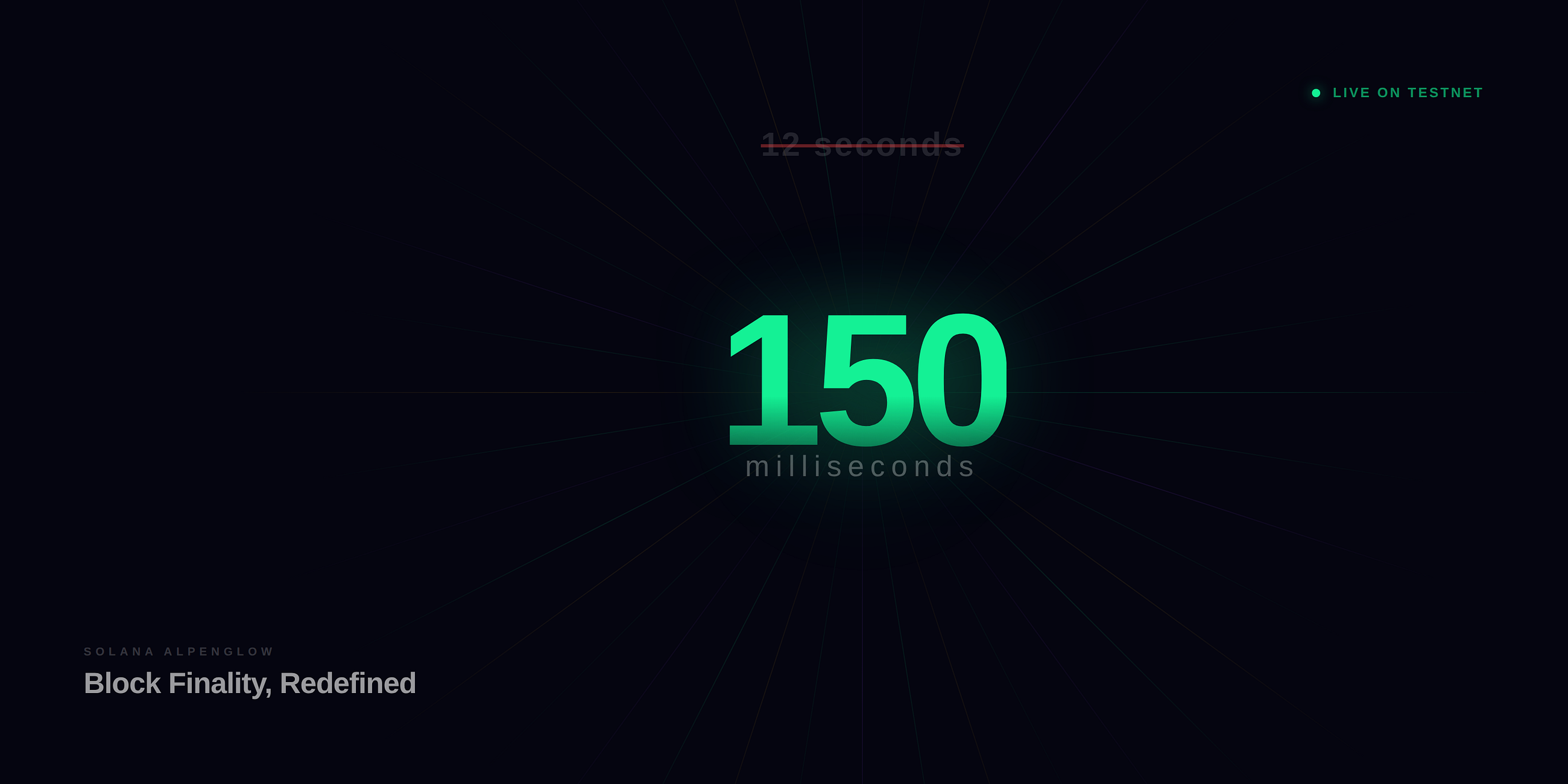
This isn’t a minor patch. Alpenglow (SIMD-0326) replaces two foundational pieces of Solana’s architecture that have been there since day one: Proof of History and TowerBFT. The new system, called Votor, handles consensus in a completely different way. Block finality drops from roughly 12 seconds to about 150 milliseconds. In ideal conditions, it could go as low as 100 milliseconds.
To put that in context: a human eye blink takes about 300 milliseconds. After Alpenglow, a Solana transaction will be confirmed and irreversible in less time than it takes you to blink.
The upgrade passed validator governance with 98.27% approval. Solana co-founder Anatoly Yakovenko said at Consensus Miami that mainnet deployment could happen as soon as next quarter. This is happening.
What’s Actually Changing Under the Hood
If you’re a token creator or project operator, you don’t need to understand every technical detail. But knowing the basics helps you grasp why this matters for your day-to-day operations.
Proof of History is being removed. Since Solana launched, Proof of History (PoH) has been its signature innovation: a cryptographic clock that timestamps transactions before consensus happens. It’s what made Solana fast. But it also created complexity and contributed to network instability during high-demand periods. Alpenglow removes PoH from the core consensus process entirely.
TowerBFT is being replaced by Votor. TowerBFT is how Solana validators currently agree on which blocks are valid. It works, but it’s slow by modern standards: validators have to go through 32 incremental confirmation steps, and every vote is published as an on-chain transaction. Votor replaces this with one or two rounds of direct off-chain voting. Fast path (80%+ validator approval in round one): block is final in about 100ms. Slow path (60%+ approval across two rounds): final in about 150ms.
Validator votes move off-chain. This is the sleeper change. Currently, validator votes account for roughly 75% of all Solana block space. That’s right: three quarters of every block is consumed by the consensus mechanism itself, not user transactions. Votor moves all voting off-chain using direct messaging and BLS signature aggregation. This frees up massive block space for actual transactions.
Validators get cheaper to run. On-chain voting currently costs validators about 1 SOL per day. Alpenglow replaces this with a Validator Admission Ticket (VAT) of about 0.8 SOL per day, which is burned. The minimum profitable stake drops from roughly 4,850 SOL to about 450 SOL, potentially making validation accessible to more operators.
Why This Matters for Token Creators
Let’s translate the technical changes into what actually affects you if you’re launching tokens, managing liquidity, or running a project on Solana.
Your Swaps and Transactions Become Near-Instant
Right now, when you execute a swap on Jupiter or interact with a Raydium pool, you wait a few seconds for the transaction to confirm. Sometimes longer during congestion. After Alpenglow, that confirmation happens in 100 to 150 milliseconds. You click, it’s done.
For token creators using tools like Swap or Multi Swap, this means faster execution with less uncertainty. For anyone running Bundled Trades, the tighter finality window reduces the risk of partially executed bundles.
Liquidity Pool Management Gets More Reliable
If you’ve managed a concentrated liquidity position on Raydium CLMM or Meteora DLMM, you know the frustration of rebalancing during volatile moments. Slow finality means your rebalance transaction might execute at a different price than you intended. With 150ms finality, the gap between “what you see” and “what executes” shrinks dramatically.
For anyone using Create LP or Liquidity Add/Remove, this is a meaningful operational improvement. Less slippage on LP operations, fewer failed transactions, more predictable outcomes.
Bundle Buys Become Tighter
If you’re launching tokens through Pumpfun Create & Bundle Buy, the speed of finality directly affects how tightly your coordinated buys execute. Faster finality means tighter bundles, which means better anti-frontrun protection during launch.
Failed Transactions Should Decrease
A significant portion of Solana’s failed transactions stem from timing issues in the consensus process. When blocks take seconds to finalize, there’s more room for conflicts, timeouts, and dropped transactions. Alpenglow’s tighter timing should reduce these failures across the board.
If you’ve ever had a Revoke Mint Authority or Update Metadata transaction fail and needed to retry, this improvement directly helps.
75% More Block Space for Everyone
When validator votes move off-chain, three quarters of current block space becomes available for user transactions. This is like suddenly having a highway that was 75% full of maintenance vehicles clear out and open all lanes to regular traffic.
More block space means lower fees during peak activity, less congestion, and higher throughput. For token launches (which often happen during peak activity windows), this is significant.
What This Doesn’t Change
Alpenglow is a consensus layer upgrade. It doesn’t change:
Your token’s structure. SPL Token and Token-2022 tokens work exactly the same before and after Alpenglow. Your metadata, authorities, and supply mechanics are unaffected.
How you interact with tools. Every tool you use today (token creation, LP management, snapshots, airdrops) will work the same way. The transactions just confirm faster.
DeFi protocol mechanics. Raydium, Meteora, Orca, Jupiter, Pump.fun, PumpSwap: they all continue to work as they do now. They’ll just run on a faster, more reliable base layer.
Your responsibilities as a project operator. You still need to revoke unnecessary authorities, keep metadata updated, monitor liquidity, and track holders. Alpenglow makes the infrastructure better, but it doesn’t do the work for you.
The Timeline
Here’s where things stand as of May 2026:
May 11, 2026: Alpenglow live on community test cluster. Validators can test the “Alpenswitch” (transition from old to new consensus) in a real environment.
Q3 2026 (expected): Agave 4.1 release, which includes the Alpenglow client software. More extensive testing and security audits.
Late 2026 (expected): Mainnet activation, assuming testing goes smoothly. Anatoly Yakovenko has suggested it could be as early as next quarter, but the official timeline says late 2026.
This is not live on mainnet yet. The tools you use today work on the current consensus system. But when Alpenglow does activate, everything gets faster automatically. You won’t need to change anything about your workflow.
The Bigger Picture
Alpenglow isn’t happening in isolation. In the past few months, Solana has also seen Western Union launch its USDPT stablecoin on the network, Visa processing USDC settlements, ETF inflows hitting $1.08 billion cumulative, and Q1 2026 processing $1.1 trillion in economic activity with 4.6 million daily active users.
The pattern is clear: Solana is being rebuilt for institutional-grade performance while simultaneously seeing institutional-grade adoption. Alpenglow is the infrastructure piece of that puzzle. The 150ms finality isn’t just a nice number for marketing. It’s what makes Solana competitive with traditional payment rails, high-frequency trading systems, and real-time settlement networks.
If you’re building a token project on Solana today, you’re building on a chain that’s about to get dramatically faster, more reliable, and more efficient. The projects that treat this transition seriously (clean metadata, revoked authorities, well-managed liquidity, healthy holder distribution) are the ones that will benefit most from the attention Alpenglow brings.
The upgrade does the infrastructure work. You do the operations work. Together, that’s how projects survive and grow.
This content is for educational purposes only and does not constitute financial advice. Always do your own research.
Tools referenced in this article are available at j.tools. Non-custodial, no private keys required.