Solana Swap API for Quotes and Routing
 Vybe Network5 min read·Just now
--
Learn how the Vybe Solana Swap API handles quotes and routing, builds unsigned transactions, controls slippage, and supports smart DEX and aggregator paths.
The swap experience most users see in a wallet or trading interface hides a lot of complexity. There is route discovery, price impact, slippage thresholds, fee handling, account creation, and finally a transaction that has to be signed and sent successfully.
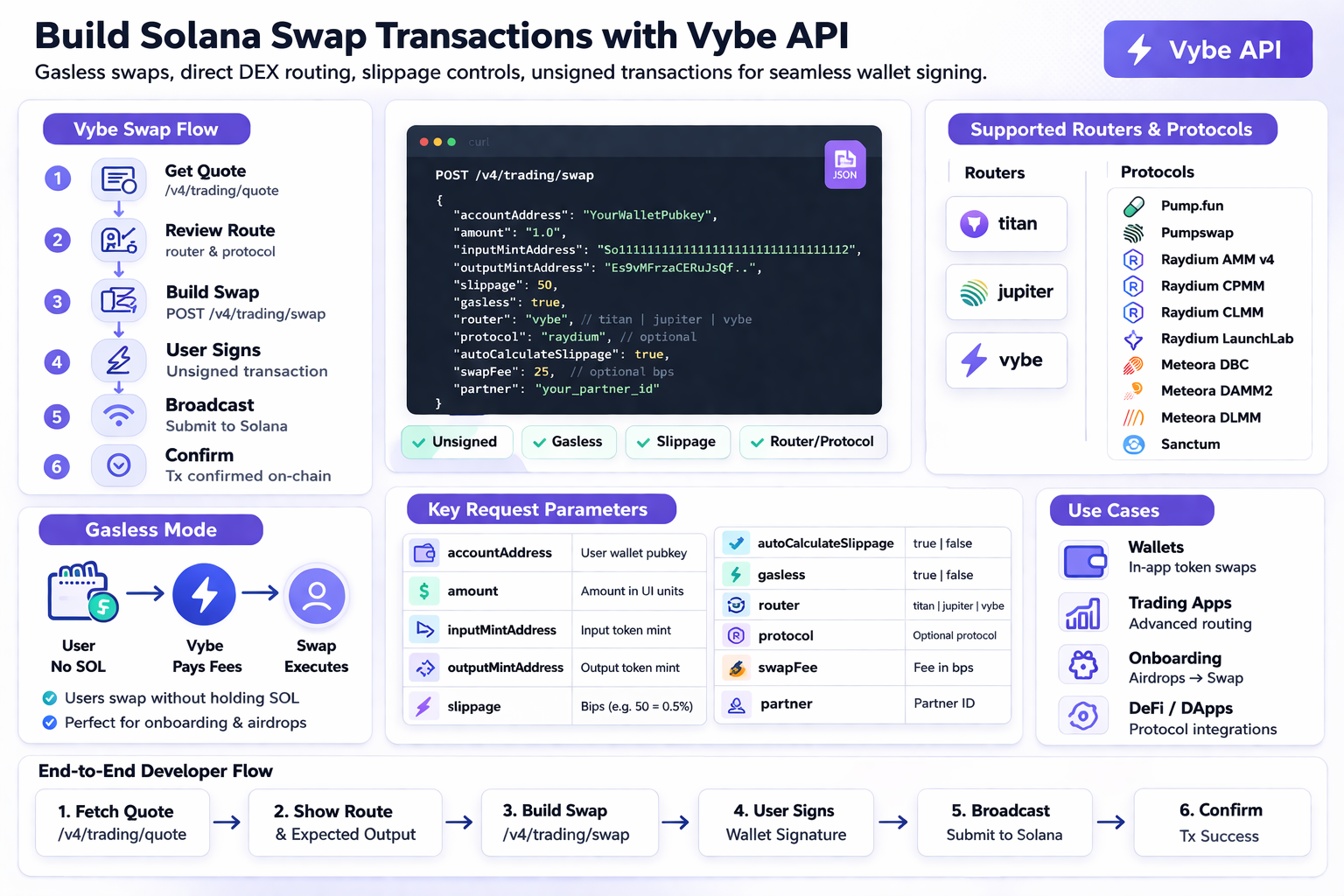
Vybe splits that lifecycle into a clean API flow documented across five pages:
Put together, they form a complete article about how a Solana swap API should behave when you care about transparency and execution quality rather than just “did I get some output amount back?”
Swap flow at a glance
Quote
- Call get_swap_quote_proxy” to inspect price, route, and impact.
- Why it matters: You can reject bad routes before building anything.
Build
- Call do_swap_proxy to assemble the unsigned transaction.
- Why it matters: The wallet signs a transaction that already reflects the route and policy you chose.
Sign
- The user signs client-side.
- Why it matters: Custody stays with the wallet, not the API.
Submit
- The signed transaction lands on Solana.
- Why it matters: Slippage, fees, and route choice finally meet real market conditions.
Why the routing model matters
The biggest claim in the source docs is simple: Vybe prefers direct DEX program calls where possible. That matters because route architecture is not just an implementation detail. It changes cost, transaction size, and failure surface.
The Swap overview explains the critique of aggregator-heavy flows:
- extra intermediary accounts
- more instructions
- more rent overhead
- less intuitive fee handling
Vybe’s pitch is not “aggregators are always bad.” It is that direct routes should be preferred when they are viable, and fallback aggregators should be used only when needed for coverage.
That is a much more useful frame for developers than a simple “ours is better” slogan, because it helps you design routing policy explicitly.
Step 1: quote the route before you build anything
A strong swap API should tell you more than just the output amount. The get-quote doc is valuable because it shows that the quote response includes:
- expected output
- exchange rate
- price impact
- slippage threshold
- route plan
- protocol and pool details
That route plan is the difference between a black-box quote and an inspectable trading path.
The official endpoint is documented as:
- guide: get-quote
- reference: get_swap_quote_proxy
If you are building a serious trading product, that reference link belongs in the body, not only in a footer. It is the operational contract behind the article.
Why route transparency matters in practice
Without route-level data, you cannot answer basic execution questions such as:
- Is this a single-hop or multi-hop trade?
- Which DEX is being used?
- Which pool address is responsible for execution?
- Does the liquidity profile make sense for this trade size?
That is why the get-quote page is really more than a pricing guide. It is a route-inspection guide.
Step 2: build an unsigned transaction
Once the route is acceptable, the next step is not “execute immediately.” It is “assemble a transaction the wallet can sign.”
That is the role of build-transaction. The endpoint is:
- guide: build-transaction
- reference: do_swap_proxy
The transaction builder handles more than a raw swap instruction. It can:
- choose the route
- create ATAs if needed
- apply fees
- enforce slippage thresholds
- return a base64 transaction ready for signature
This is an important distinction for product teams: Vybe is not custody. The docs are explicit that signing remains on your side. That keeps the API in the right security boundary for wallets, embedded wallets, and self-custody flows.
Fees are part of execution design, not a footnote
One of the strongest parts of the source material is the explanation in slippage-fees and swap-overview that fee handling changes UX.
The docs emphasize fee deduction from swap tokens rather than relying on separate temporary fee accounts. Whether or not a team agrees with every comparative claim, the implementation takeaway is clear: fee design affects both cost and reliability.
That matters especially for:
- smaller wallets
- onboarding flows
- memecoin and high-slippage environments
- bots making many repeated trades
Slippage is not just a settings field
Most teams treat slippage like a UI toggle and move on. The slippage-fees doc is useful because it explains slippage in the context of actual failure prevention.
You are balancing two risks:
- too low: good trades fail during volatility
- too high: users get worse fills than they expected
The quote and build flow need to be read together. A quote tells you what should happen; slippage defines how much deviation you tolerate by the time the transaction lands.
Supported protocols are a product feature
The supported-protocols page is not just reference clutter. It shapes what kinds of trading products you can build.
The docs call out direct integrations with protocols such as:
- Raydium
- Meteora
- Pump.fun / Pumpswap
- Sanctum
This matters because protocol specialization affects route behavior. A launch token route is different from a concentrated liquidity route, and both are different again from liquid staking liquidity. Developers need those distinctions when debugging trades or forcing specific routing constraints.
A practical way to think about the full flow is:
- Call get_swap_quote_proxy
- Inspect route plan, price impact, and protocol choice
- Build with do_swap_proxy
- Apply slippage and fee policy from the slippage-fees guide
- Sign client-side
- Submit to Solana
That is the whole operational story, and it is much more compelling than treating quote and build as disconnected endpoints.
Related guides worth opening next
- Gasless mode: https://docs.vybenetwork.com/docs/gasless-mode
- Privy integration: https://docs.vybenetwork.com/docs/privy-integration
- Supported protocols: https://docs.vybenetwork.com/docs/supported-protocols
Those links belong inside the narrative because they answer the next implementation questions developers actually ask.
Final takeaway
A real Solana swap API should do three things well:
- show you the route before you trade
- build a transaction you can trust and sign yourself
- give you enough control over slippage, fees, and protocol choice to match your product
That is the value of reading the Vybe docs as one connected execution flow instead of as five isolated pages.
Further reading
Guides
- https://docs.vybenetwork.com/docs/swap-overview
- https://docs.vybenetwork.com/docs/get-quote
- https://docs.vybenetwork.com/docs/build-transaction
- https://docs.vybenetwork.com/docs/slippage-fees
- https://docs.vybenetwork.com/docs/supported-protocols
- https://docs.vybenetwork.com/docs/gasless-mode
- https://docs.vybenetwork.com/docs/privy-integration