How the way we build software is being quietly rewritten and why “antigravity” might be the best metaphor we have for it
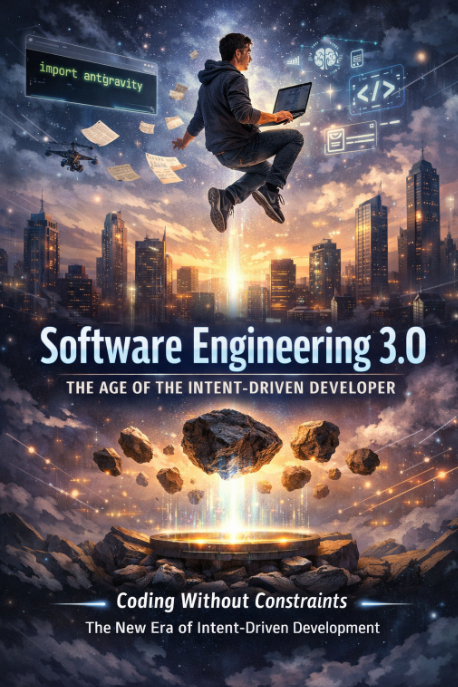
There’s a scene I keep thinking about. It’s from a 2007 webcomic strip by xkcd. A character opens a terminal, types import antigravity, and the next panel shows them floating above the city skyline. The caption reads: "You can do anything."
It was a joke. A love letter to Python’s philosophy that importing a module should feel like having a superpower. But nearly two decades later, that strip has aged into something strangely prophetic. Because what we’re calling Software Engineering 3.0 is, at its core, the moment that joke started becoming real.
A Quick History Lesson (Bear with Me)
To understand where we are, it helps to know where we’ve been.
Software Engineering 1.0 was the era of craftsmanship. You wrote every line. You managed memory. You knew the machine. The developer was a translator between human intention and binary instruction and the gap between those two things was enormous. Think C, assembly, mainframes, punch cards. The computer did exactly what you told it. No more, no less. Genius was scarce, and programs were hand-sculpted artifacts.
Software Engineering 2.0 arrived with abstraction. Object-oriented design. Frameworks. Version control. Agile methodologies. Package managers that let you stand on the shoulders of giants. Suddenly, a solo developer could build things that would have required whole teams a decade earlier. The craft didn’t disappear, it just climbed a level. You were no longer talking to the machine directly. You were talking to other people’s abstractions of the machine.
And then something cracked open.
Software Engineering 3.0 is what’s happening right now, and it doesn’t look like what people expected “the future of coding” to look like. It’s not robots writing code while humans sip coffee. It’s messier, stranger, and more human than that.
What Actually Defines Software Engineering 3.0
The simplest way to describe it: the unit of programming has shifted from syntax to intent.
In previous eras, the developer’s primary job was translation, converting a human idea into something a machine could execute. That translation layer required deep technical knowledge, and most of the friction in software development lived inside it. Misplaced brackets. Wrong data types. Race conditions you spent three days hunting.
In Software Engineering 3.0, large language models, code-generation tools, and AI-augmented IDEs have absorbed enormous chunks of that translation burden. The developer’s primary job has shifted toward something harder to quantify but far more interesting: deciding what to build, why to build it, and whether the output is actually correct.
This is not a small shift. It’s a change in the locus of intelligence in the development process.
But let’s be precise. SE 3.0 isn’t just “use ChatGPT to write your code.” That’s a surface-level reading. The deeper transformation is about how we structure entire development pipelines, how we think about system design, and how we evaluate success.
How SE 3.0 Actually Works: The New Method
The SE 3.0 developer operates in a fundamentally different loop than their predecessors. Here’s how that loop looks in practice:
1. Specification as a First-Class Artifact
In SE 1.0 and 2.0, specifications were often informal, a Jira ticket, a Slack message, a whiteboard photo. In SE 3.0, the specification is the code, in a real sense. Prompt engineering, structured requirements, and precise articulation of intent become technical skills. A fuzzy spec produces fuzzy output. A precise spec produces working software. The developer who writes a brilliant prompt is doing engineering.
2. Generate → Evaluate → Refine
The development cycle now looks less like “write, debug, ship” and more like “generate, critically evaluate, guide toward correctness.” This requires a new kind of discipline: the ability to read generated code skeptically, spot hallucinated APIs, catch logical errors that look syntactically clean, and know when the 80% solution is enough and when it absolutely isn’t.
3. Orchestration Over Implementation
Senior engineers in SE 3.0 increasingly spend their time designing systems that connect components, AI-generated modules, third-party APIs and cloud primitives rather than implementing those components line by line. The skill is orchestration. Think of it as the difference between a chef who can cook everything from scratch and a culinary director who designs menus, sources ingredients, and ensures everything comes together.
4. Testing as Proof of Intent
When you don’t write every line yourself, testing becomes even more critical, not just for correctness, but as documentation of what you intended. In SE 3.0, tests are often written before generation, as a specification to which the generated code must conform. Test-driven development, long preached and often skipped, becomes genuinely natural in this paradigm.
5. Continuous Human Judgment in the Loop
None of this replaces the engineer. It reframes the engineer as a curator, critic, architect, and domain expert. The hard problems is understanding user needs, making ethical tradeoffs, designing resilient systems, debugging emergent behavior and remain deeply human.
The Antigravity Pipeline: A Concrete Example
Let me show you what this actually looks like. We’ll build a small but complete feature using SE 3.0 principles. Our goal: a Python microservice that detects whether a user-submitted image contains a real physical object defying gravity (think levitating products, floating food photography) — because, well, antigravity.
Here’s the pipeline, SE 3.0 style:
Step 1: Intent Specification
Before touching a keyboard for code, the SE 3.0 developer writes a precise specification in natural language:
“Build a FastAPI endpoint that accepts an image upload, sends it to a vision model, and returns a confidence score (0–1) indicating whether any objects in the image appear to be floating or defying gravity. Include error handling, a health check route, and a structured JSON response.”
This spec is not a comment in a file. It’s an engineering artifact. It’s specific, testable, and carries the full intent of the feature.
Step 2: Generate the Skeleton
With this spec, you prompt your tool of choice (Copilot, Claude, Cursor, whatever’s in your stack):
# Generated skeleton — SE 3.0 style
from fastapi import FastAPI, UploadFile, File, HTTPException
from pydantic import BaseModel
import anthropic
import base64

app = FastAPI(title="Antigravity Detector", version="1.0.0")
client = anthropic.Anthropic()

class GravityAnalysis(BaseModel):
    confidence: float          # 0.0 = firmly grounded, 1.0 = full antigravity
    explanation: str
    objects_detected: list[str]

@app.get("/health")
def health_check():
    return {"status": "ok", "service": "antigravity-detector"}

@app.post("/analyze", response_model=GravityAnalysis)
async def analyze_image(file: UploadFile = File(...)):
    if file.content_type not in ["image/jpeg", "image/png", "image/webp"]:
        raise HTTPException(status_code=400, detail="Unsupported image format")

    image_data = await file.read()
    b64_image = base64.standard_b64encode(image_data).decode("utf-8")

    response = client.messages.create(
        model="claude-opus-4-5",
        max_tokens=512,
        messages=[{
            "role": "user",
            "content": [
                {
                    "type": "image",
                    "source": {
                        "type": "base64",
                        "media_type": file.content_type,
                        "data": b64_image
                    }
                },
                {
                    "type": "text",
                    "text": (
                        "Analyze this image for objects that appear to defy gravity "
                        "(floating, levitating, suspended mid-air without visible support). "
                        "Return JSON with keys: confidence (float 0-1), explanation (string), "
                        "objects_detected (list of strings). Only return valid JSON."
                    )
                }
            ]
        }]
    )

    import json
    result = json.loads(response.content[0].text)
    return GravityAnalysis(**result)
This code was not hand-typed from memory. It was generated, guided by the spec. The developer’s job now is to evaluate it.
Step 3: Critical Evaluation
Reading this output, an SE 3.0 engineer asks:
- Is the error handling sufficient? (Not really — the JSON parse can fail.)
- What if the vision model returns unexpected structure?
- Is base64 encoding the right approach for large files?
- Are there security concerns with raw file uploads?
Each of these is a refinement prompt, or a targeted manual fix. The developer isn’t rewriting from scratch — they’re steering.
Step 4: The Test-as-Spec Layer
# Tests written to enforce intent
def test_health_endpoint(client):
    response = client.get("/health")
    assert response.status_code == 200
    assert response.json()["status"] == "ok"

def test_floating_object_detected(client, sample_levitation_image):
    response = client.post("/analyze", files={"file": sample_levitation_image})
    data = response.json()
    assert 0.0 <= data["confidence"] <= 1.0
    assert isinstance(data["explanation"], str)
    assert len(data["explanation"]) > 10

def test_invalid_format_rejected(client):
    response = client.post("/analyze", files={"file": ("test.gif", b"fake", "image/gif")})
    assert response.status_code == 400
The tests don’t care how the code works. They care whether the intent was honored.
Step 5: Deploy and Observe
SE 3.0 pipelines lean heavily on observable, iterative deployment. Feature flags. Gradual rollouts. Logging that captures not just errors but model behavior. Because when your system includes a language model, classical debugging tools, step through, inspect variable are only half the story. You also need to know: is the model reasoning well in production?
The Philosophical Thread: From Typing to Thinking
There’s a deeper evolution happening beneath all of this, and it echoes something that’s been true in every major engineering paradigm shift.
When spreadsheets arrived, accountants didn’t disappear. When high-level languages replaced assembly, low-level programmers didn’t vanish. When frameworks abstracted away boilerplate, architects didn’t become redundant. Each wave of abstraction liberated practitioners to work at a higher level, solve harder problems, and build things previously out of reach.
SE 3.0 is that same wave, just steeper.
The import antigravity strip was funny because the idea of software that could just do impossible things on command was absurd. Now we have models you can prompt in plain English and get working code. That gap between what you can imagine and what you can build has narrowed dramatically. It hasn't closed. It probably never will. But narrowing it changes everything about who can build, what gets built, and what problems get solved.
What This Means for You, Right Now
If you’re an engineer reading this, the question isn’t whether SE 3.0 is happening. It is. The question is whether you’re adapting the right skills:
Strengthen: System thinking, specification clarity, prompt craft, critical code review, architecture design, domain expertise, testing discipline.
Deprioritize (but don’t abandon): Memorizing syntax, writing boilerplate from scratch, manually implementing well-known algorithms.
Watch carefully: How AI-generated code can look correct and be subtly wrong. How model behavior can change with versions. How to build systems robust to probabilistic components.
The developer who thrives in SE 3.0 is not the one who types the fastest. It’s the one who thinks the clearest, questions the most rigorously, and knows the difference between a working system and a merely plausible one.
The terminal is open. The library is loaded.
import antigravity
Now the real work begins.
Thanks for reading. If this resonated, follow me for more writing at the intersection of software craft and the future of how we build things. I’d love to hear how your own workflow is changing.
Software Engineering 3.0: The Age of the Intent-Driven Developer was originally published in Level Up Coding on Medium, where people are continuing the conversation by highlighting and responding to this story.