Socialism Isn’t Here Because of Late-Stage Capitalism. It’s Late-Stage Fiat
 Adam14 min read·Just now
--
Why the rise of socialism may reveal a deeper crisis in monetary trust
New York’s election of Zohran Mamdani, its first democratic socialist mayor, shocked some people.
In other ways, it should not have.
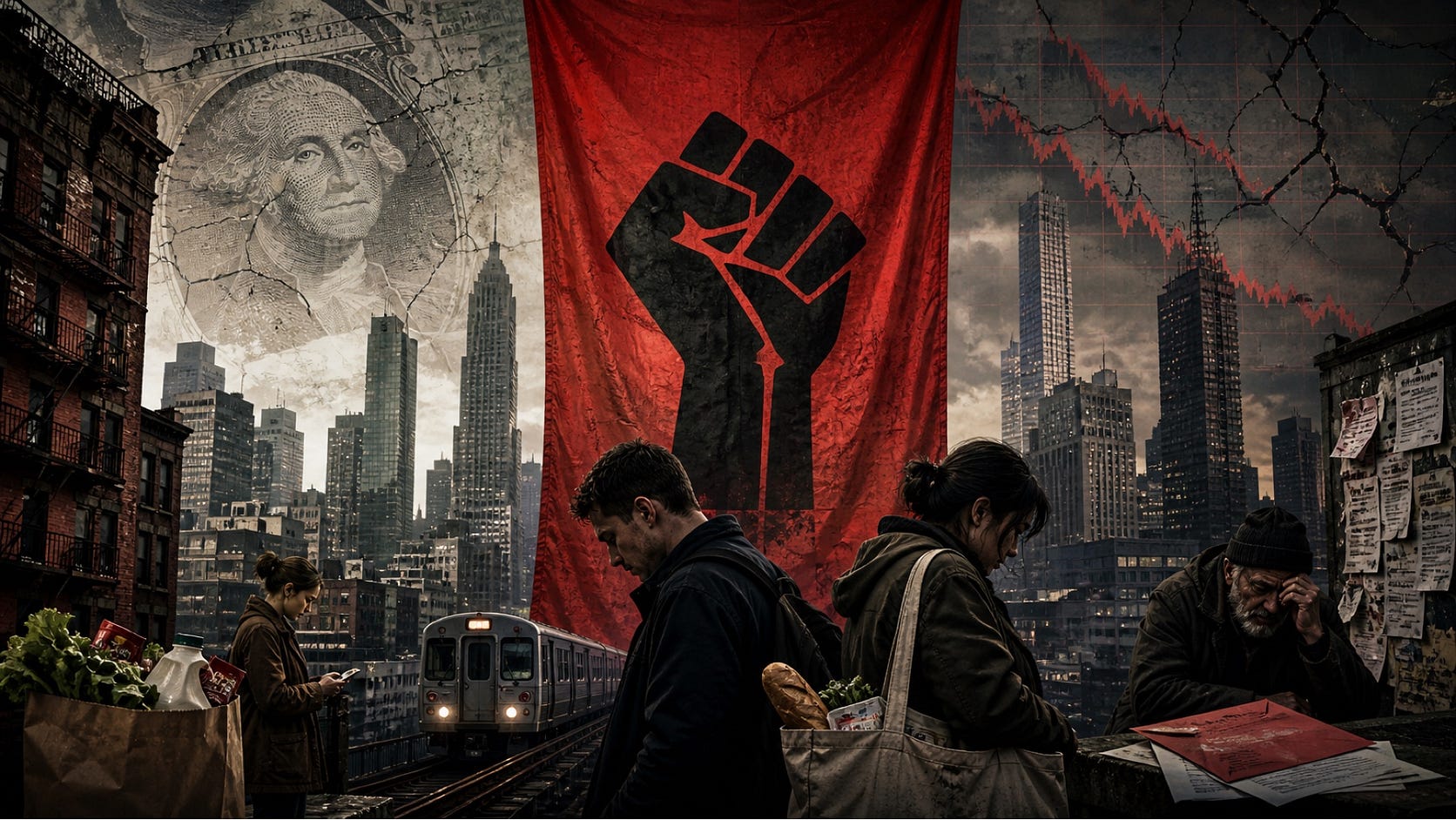
His campaign centered heavily on affordability: rent, groceries, transit, child care, housing, wages, and the cost of simply trying to live in one of the most expensive cities in the world. Some of his proposals included rent freezes, fare-free buses, universal child care, city-owned grocery stores, affordable housing, and a higher minimum wage.
In other words, Mamdani did not rise in a vacuum.
He rose during an affordability crisis.
And that matters.
Because the rise of socialism is usually explained through one phrase:
Late-stage capitalism.
But I’m not sure that goes deep enough.
Maybe what people are calling late-stage capitalism is actually something closer to late-stage fiat currency.
The Affordability Crisis Beneath the Politics
Most people are not sitting around thinking about monetary architecture.
They are thinking about rent.
Groceries.
Transportation.
Child care.
Healthcare.
Debt.
Retirement.
Whether they can stay in the city they live in.
Whether work still buys a future.
When those basic parts of life become harder to afford, people naturally look for someone or something to intervene.
That does not mean they suddenly became ideological.
It may mean they became financially exhausted.
And financial exhaustion changes political psychology.
When people feel squeezed long enough, they stop asking abstract questions about systems and start asking much more immediate questions:
Who is going to help me?
Who is going to lower the cost?
Who is going to protect me from this?
Who is going to make life feel livable again?
That is where socialist politics often becomes emotionally attractive.
Not necessarily because people have studied Karl Marx.
Not necessarily because they want a complete restructuring of society.
But because the current arrangement no longer feels like it is protecting them.
The Strange Paradox
Here is what makes this moment fascinating.
Trust in government remains extremely low.
And yet, in some places, people are turning toward political movements that ask government to do more.
That seems contradictory.
But psychologically, it makes sense.
Because when people are under stress, they do not always search first for the system that requires the least trust.
Sometimes they search first for the system that promises the most relief.
That distinction matters.
The Caretaker Anchor
When people feel like they are drowning financially, they may not first audit the lifeguard’s long-term competence.
They reach for the hand.
That is not irrational.
It is human.
If rent is too high, groceries are too expensive, child care is unaffordable, and wages no longer feel like enough, then a political figure promising direct relief can become psychologically powerful.
Free buses.
Rent freezes.
City-run grocery stores.
Higher wages.
Universal child care.
These are not just policies.
They are promises of containment.
They say:
Someone sees your pain.
Someone is going to step in.
Someone is going to make the system feel less brutal.
That is the emotional appeal.
Socialism, in this sense, can function as a caretaker anchor.
It offers protection when the existing economic system feels unsafe.
And that matters because nervous systems seek safety and orientation.
When people feel economically stable, they may be more willing to tolerate abstraction, complexity, and long-term tradeoffs.
But when people feel financially threatened, the nervous system begins looking for containment.
Something predictable.
Something protective.
Something that says:
“You are not alone in this.”
That does not mean the proposed solution will work long term.
It means the appeal makes psychological sense.
But Caretaker Systems Require Trust
This is where the deeper problem appears.
A socialist response may feel stabilizing in the short term.
But structurally, it still requires a high degree of trust.
You have to trust the planners.
Trust the administrators.
Trust the budgets.
Trust the tax base.
Trust the enforcement mechanisms.
Trust that productive people and businesses will not leave.
Trust that public systems can manage scarcity better than markets can.
Trust that political incentives will not distort the whole thing.
That does not mean every socialist policy is automatically bad.
It does mean socialism does not escape the trust problem.
It often intensifies it.
The solution being offered is not:
Remove the need for institutional trust.
The solution is:
Trust better institutions.
Trust more democratic institutions.
Trust more compassionate institutions.
Trust a different group of people to manage the system more fairly.
That may sound appealing during a crisis.
But it is still a trust-heavy answer.
This is the deeper bind of late-stage fiat: people seek protection from the same system whose monetary rules keep destabilizing their sense of safety. The caretaker is also part of the alarm. And when the source of relief and the source of instability begin to overlap, the nervous system has trouble knowing where to orient.
The Parallel With Fiat
This is where socialism and fiat begin to rhyme.
Fiat money depends on trust.
Trust the central bank.
Trust the Treasury.
Trust Congress.
Trust policymakers.
Trust that inflation will be managed.
Trust that debt will remain sustainable.
Trust that the currency will continue to hold psychological weight.
Trust that the system will still work tomorrow.
Socialism, at least in its more state-managed forms, asks for a similar kind of confidence.
Trust the planners.
Trust the political process.
Trust the distribution mechanism.
Trust that centralized intervention will solve the problem better than the system it is replacing.
Both systems depend heavily on human discretion.
Both depend on confidence in management.
Both require people to believe that the people in charge can coordinate complexity without breaking the very system they are trying to fix.
That is the parallel.
Socialism may critique the failures of capitalism.
But if it tries to solve those failures through more discretionary control, it may repeat the same deeper trust problem that fiat already has.
The Layer Marx Did Not Fully See
Marx deserves credit for noticing something real.
He understood that economic systems shape human behavior. He understood that class conflict, ownership, labor, and production are not side issues in society. They are central forces.
And in many ways, his analysis still explains part of what we see today.
When people feel exploited, priced out, overworked, underpaid, or structurally trapped, it makes sense that they begin looking for political systems that promise to rebalance power.
That part should not be dismissed.
Marx understood how economic pressure can become resentment. But he did not have the modern nervous-system language to explain how instability is felt before it becomes ideology.
In simplified form, Marx’s emphasis could be described as:
ownership structure → labor exploitation → class conflict
But there is a deeper layer Marx did not fully account for.
Maybe he could not have.
He analyzed conflict within the economic structure.
But he did not fully analyze the monetary base layer underneath it.
The money itself.
How it is created.
How it expands.
How purchasing power changes.
How debt accumulates.
How asset prices rise.
How wages lag.
How the unit of account quietly shapes the behavior of everyone using it.
Marx analyzed the struggle inside the economic structure.
But late-stage fiat asks us to analyze the structure of the money underneath the struggle.
In simplified form, my framework asks whether the sequence may sometimes look more like:
monetary confidence → economic pressure → somatic uncertainty → political intensity / ideological conflict
That does not make Marx entirely irrelevant.
It suggests his analysis may have been one layer too high for the present monetary era.
And in many ways, that is what I am trying to do in these pieces.
I am trying to examine how societal trust mechanisms work.
How they shape incentives.
How they influence belief.
How they affect the human nervous system itself.
Because money is not only an economic object.
It is a psychological coordination system.
Most people do not question money at that level.
They treat it like gravity.
A thing that is simply there.
You throw something into the air, it falls back down.
Of course it does.
But once you understand how gravity works, once you study its mechanics, acceleration, and equations, a new world opens.
You can calculate orbits.
Launch rockets.
Navigate space.
Explain forces that were previously just assumed.
Money is similar.
Once you begin understanding the processes underneath money, especially the trust mechanisms it depends on, a new layer of social behavior becomes visible.
You are no longer only asking what people believe politically.
You begin asking what systems they still trust.
What systems they no longer trust.
What systems feel unsafe.
What systems feel predictable.
And where behavior may begin migrating when existing systems no longer feel reliable.
If trust mechanisms can be understood, then trust migration can be observed.
And maybe, to some degree, anticipated.
Not perfectly.
Not mechanically.
But directionally.
Because when the systems people are asked to trust keep failing them, they eventually begin looking for systems that require less trust.
Most people use dollars at face value.
They earn them.
Spend them.
Save them.
Borrow them.
Measure their lives in them.
But they rarely ask what the dollar actually is as a system.
How it is created.
What it requires.
What it distorts.
What kind of trust it depends on.
And once you begin looking at the mechanics of fiat, social behavior starts to look different.
The issue is no longer only workers versus owners.
It is also everyone living inside a monetary system that quietly changes the rules of measurement over time.
Rent rises.
Assets inflate.
Savings weaken.
Debt expands.
Wages chase prices.
The future feels harder to reach.
Then people blame capitalism.
And sometimes, they are partly right.
But they may also be reacting to something deeper:
A fiat monetary system that has made the entire economic game feel unstable.
Maybe This Isn’t Late-Stage Capitalism
The phrase “late-stage capitalism” suggests that capitalism itself is reaching some kind of terminal contradiction.
Maybe that is partly true.
But what if the deeper issue is not capitalism alone?
What if much of what people are reacting to is the long-term consequence of fiat distortion?
Housing becoming financialized.
Assets rising faster than wages.
Debt expanding faster than productivity.
Savings losing purchasing power.
Work feeling less connected to stability.
The future becoming harder to plan.
When money becomes less reliable as a measuring stick, people may blame the market they interact with every day.
And that makes sense.
They experience rent.
They experience grocery prices.
They experience debt.
They experience wages not keeping up.
They experience the feeling that no matter how hard they work, the future keeps moving further away.
But beneath all of that may be a monetary layer.
If the unit of account itself is unstable, then everything priced in that unit begins to feel unstable too.
Housing.
Food.
Labor.
Retirement.
Time.
Life planning.
So maybe people are not only reacting to capitalism.
Maybe they are reacting to capitalism under late-stage fiat.
A market system operating on top of a currency that has been slowly losing credibility, purchasing power, and psychological seriousness.
Why Socialism Rises in Crisis
Historically, socialist, communist, and other state-centered movements have often gained strength during periods of hardship, inequality, war, inflation, economic breakdown, or institutional failure.
That should not surprise us.
When people feel abandoned by the current order, they look for an alternative order.
And if the current system feels cold, unequal, extractive, or indifferent, then a system promising collective care can feel morally and emotionally compelling.
Again, this does not require people to become ideological scholars.
It only requires pain.
When enough people feel that the current system no longer offers a livable future, they become open to something that promises protection.
That is the crisis-stage appeal of socialism.
It says:
The market failed you.
The rich captured the system.
The cost of living is crushing you.
Government can step in.
We can make life affordable again.
That message can land very powerfully when people are financially exhausted.
But the deeper question remains:
Does the proposed solution reduce the trust burden?
Or does it simply move the trust burden somewhere else?
When Crisis Makes People Trust More, Not Less
In previous pieces, I’ve explored a running hypothesis:
When trust declines, humans migrate toward systems that require less trust.
But this moment adds an important refinement.
The long-term pattern may still be migration toward systems that require less trust.
But the short-term crisis pattern can look different:
When people are scared enough, they may first migrate toward systems that promise protection, even if those systems require more trust.
That does not disprove the larger trend.
It adds a phase.
The nervous system may first look for relief.
Only later, after enough disappointment, does it begin looking for constraint.
In other words:
People may first ask:
Who will protect me?
Before they ask:
Why does any group have this much control over the system in the first place?
That distinction matters.
Socialism may rise during affordability crises because it offers a caretaker response to economic pain.
But if that response fails, or if it requires even more trust in discretionary management, then the deeper migration may continue.
Not necessarily toward socialism.
But toward systems that require less permission, less interpretation, less centralized discretion, and less institutional belief.
The Problem Is Not Just Who Governs
A lot of political arguments focus on who should control the system.
Should markets control more?
Should government control more?
Should workers control more?
Should corporations control less?
Those questions matter.
But there may be a deeper question underneath them:
How much trust does the system require to function?
That question cuts across ideology.
A capitalist system can become trust-heavy if it depends on bailouts, monetary expansion, regulatory capture, debt-fueled asset inflation, and institutional credibility.
This is why the issue cannot be reduced to left versus right. The caretaker impulse does not only appear in socialist politics. It also appears in corporate capitalism when banks, corporations, or financial markets become dependent on rescue. Bailouts, emergency liquidity, and too-big-to-fail logic are also forms of trust-heavy coordination. They ask the public to trust that special intervention is necessary, that losses must be socialized to preserve stability, and that the same institutions that benefited during the upside should be protected during the downside. In that sense, fiat-era capitalism can become its own kind of caretaker system, not for the working class, but for the financial elite.
A socialist system can become trust-heavy if it depends on planners, administrators, political discretion, and collective buy-in.
The question is not only:
Who should manage the system?
The question is:
Why does the system require so much management in the first place?
That is where Bitcoin and other rule-based systems become interesting, not because they solve every social problem, but because they represent a different category of coordination.
They do not ask people to trust better managers.
They ask people to verify rules.
Two Different Searches for Safety
This may be the deeper split underneath the moment.
Some people are seeking safety through protection.
Others are seeking safety through predictability.
The socialist impulse often says:
Someone needs to step in.
Someone needs to make the system fairer.
Someone needs to protect ordinary people from being crushed by rent, groceries, debt, and wages that no longer keep up.
That is the caretaker search.
It seeks relief.
And relief matters.
If people cannot afford rent, groceries, transportation, or child care, dismissing their need for relief is both politically naïve and morally careless.
But temporary relief and long-term predictability are not the same thing.
That may be the question underneath this entire moment:
Are people seeking relief?
Or are they seeking long-term change?
Because those two are not always the same.
The Bitcoin impulse is different.
At its best, it is not simply anti-society.
It is not necessarily about getting rich.
It is not merely a rejection of compassion or collective responsibility.
It is a search for a system whose rules do not depend on someone’s judgment.
Bitcoin does not promise care; it offers consistency.
Socialism needs enough people to keep believing in the construct.
Bitcoin needs participants, but it does not need collective belief in the same way.
That is the difference between a political system and a protocol.
You do not have to believe in gravity for gravity to work. You simply live inside its rules.
Bitcoin is not gravity, of course, but it carries a similar psychological lesson: a rule-based system does not need your belief in order to keep operating.
You may choose whether to orient around it.
But the rules are not waiting for your permission.
That distinction matters.
In a fiat system, whether managed by a capitalist central bank or a socialist planning committee, the constant is always human discretion.
The rules can be changed.
The money can be expanded.
The goalposts can be moved.
And the justification is usually the same:
The crisis is serious enough.
For a nervous system already exhausted by instability, that kind of flexibility may not feel safe.
This is where the therapy analogy becomes useful.
When a therapist helps someone ground during a moment of distress, the therapist usually does not say:
“Just trust me. I promise I will make you feel safe.”
Instead, the therapist helps the person orient toward something more stable.
Their feet on the floor.
Their breath.
The chair beneath them.
The room around them.
An object they can see or touch.
At first, that may seem important only because those things are physical.
But there is another layer.
They are predictable.
Your feet do not disappear every few minutes.
The floor does not hold you one moment and then change the rules the next.
The chair does not suddenly decide that, because there is an emergency, it will become something else.
Grounding works because the nervous system can orient around something stable enough to return to.
That raises a deeper monetary question:
How does a nervous system ground itself in a monetary anchor whose rules keep changing?
How does it relax into a system where the supply can expand, the goalposts can move, emergency exceptions can become normal, and the people managing the system can always decide that this crisis requires another adjustment?
This is why Bitcoin may become psychologically attractive, even before people fully understand it technically.
The price moves.
The protocol does not.
The volatility is visible on the surface.
But underneath that volatility, the rules remain unusually predictable.
The supply schedule does not change because a committee feels pressure.
The issuance rules do not adjust because an election is coming.
The protocol does not become more flexible because the crisis feels serious enough.
In that sense, Bitcoin may function as a different kind of monetary grounding object.
Not because its dollar price is calm.
But because its underlying rules are.
When people no longer trust the people managing the scale, they begin looking for a scale that no one can tip.
This is not just financial.
It is psychological.
It is somatic.
The nervous system is looking for ground that does not move every time a committee, emergency, bailout, stimulus package, or political coalition decides the rules need to change again.
In that sense, Bitcoin is not necessarily a rejection of society.
It may be a search for a more reliable foundation underneath society.
A system where fairness does not depend on trusting better managers.
But on rules that apply the same way to everyone.
Why This Matters
The rise of socialism may be telling us something important.
Not that socialism is necessarily the future.
Not that capitalism is simply over.
Not that every person supporting affordability policies wants total state control.
But that the current system is failing to provide enough felt stability for ordinary people.
People are looking for relief.
They are looking for protection.
They are looking for someone to make life feel affordable again.
That is worth taking seriously.
But it is also worth asking whether the proposed solutions actually address the deeper trust problem.
If late-stage fiat is creating the conditions for affordability crisis, then treating the symptoms with more discretionary intervention may only delay the reckoning.
It may provide temporary relief.
It may even help some people in the short term.
But if the underlying monetary system continues to distort prices, weaken savings, inflate assets, and erode planning horizons, then the same crisis may keep returning in new forms.
The Caretaker Before the Constraint
Maybe socialism rises because people are hurting.
Maybe it rises because the current system no longer feels fair.
Maybe it rises because rent, groceries, transportation, and child care have become too heavy for ordinary people to carry.
But maybe it also rises because people are still in the caretaker phase of trust collapse.
They know something is wrong.
They know the current system is not working.
They want relief.
They want protection.
They want someone to step in.
That is understandable.
But it may not be the final destination.
Because if the caretaker system also depends on trust people no longer have, then the deeper migration continues.
At first, people ask for better managers.
Eventually, they may ask for systems that need fewer managers.
That may be the deeper transition underneath the rise of socialism.
Not late-stage capitalism alone.
Late-stage fiat.
And the search for something stable beneath both.