Social Media Knows More About You Than You Know About Yourself
It is a topic that has been proven to us many times, yet we ignore it and continue living our lives normally. But today, let’s talk about it deeply, not as a conspiracy theory, but as a hidden truth that most people already know somewhere in their minds.
Social media knows almost everything about us.
From our location, the food we eat, what we order online, what we search for, and sometimes even what we talk about in real life. In thousands of discussions and reports across the world during recent years, users of mobile phones, laptops, and computers complained about one strange thing happening repeatedly: they talk about something near their device, and within minutes advertisements related to the same topic begin appearing on their screens.
People have experienced this so many times that it no longer feels like a coincidence.
But honestly, that is not even the real danger.
The real danger is becoming emotionally dependent on these systems and sharing personal details with AI chatbots and social media platforms without thinking twice. Today, people ask AI for emotional advice, personal guidance, relationship solutions, and life decisions because the responses feel intelligent and friendly.
But very few people stop and think about where all that information goes.
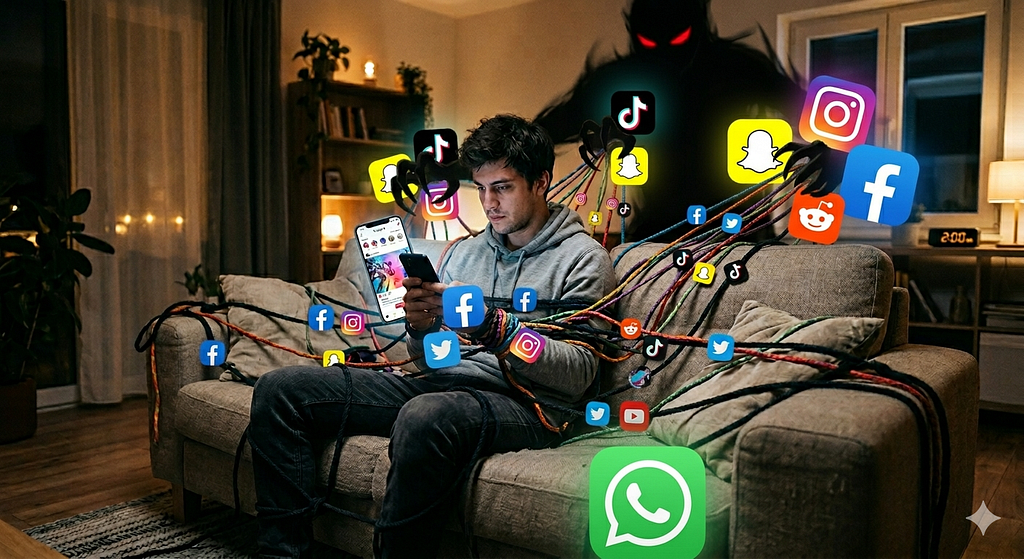
Every single word you type, every search you make, every photo you upload, every video you watch, and every second you spend scrolling becomes data. Your behavior is constantly studied, and your algorithm is adjusted according to your interests, emotions, fears, and reactions.
These are no longer myths.
A well known research paper from Cambridge University Psychometrics Centre by Michal Kosinski, David Stillwell, and Thore Graepel (PNAS, 2013) showed that digital footprints like Facebook Likes can predict personality traits with high accuracy, sometimes outperforming human judgment.
Many people have even done experiments where they intentionally talked about random products near their phones, and shortly after, advertisements related to those exact products appeared on social media applications.
Large scale advertising systems from companies like Meta have also been widely studied in academic research, showing how engagement patterns, watch time, and interaction signals are used to build extremely precise behavioral profiles for ad targeting.
Even features like Siri on iPhone raise uncomfortable questions. When you enable “Hey Siri,” your device instantly responds even while appearing inactive. This clearly shows that modern devices are always waiting and listening for specific triggers. Similar concerns exist regarding cameras, microphones, and application permissions that remain active most of the time.
When your words, behavior, interests, and reactions are constantly monitored, how can people believe these systems do not influence them?
Today, human actions are heavily shaped by what people consume online. Opinions, emotions, trends, and even personal decisions are now affected by social media algorithms. And social media itself is controlled by systems that prioritize attention and engagement above everything else.
From a data science perspective, this is not speculation, it is measurable behavioral prediction. Modern algorithms do not rely on what you say you are. They rely on what you actually do, building a gap between self-perception and behavioral reality.
In today’s modern era, you already know better than me how social media addiction has increased anxiety, isolation, manipulation, misinformation, and many serious online issues. People are spending more time online than ever before, yet mentally becoming more distracted and emotionally disconnected.
Research in computational psychology and behavioral analytics has repeatedly shown that even small interaction patterns like scrolling speed, pauses, clicks, and dwell time can reveal deep personality traits and emotional states, often more accurately than self reported data.
In the end, the purpose of this article is not to scare anyone or tell some mysterious story. It is simply a reminder to stay aware.
Reduce social media and mobile phone addiction. Make your own decisions consciously. Do not let algorithms manipulate your thinking and emotions.
Because your data, your conversations, your searches, your interests, and even your private moments are far more valuable than most people realize.
Stay alert.
Stay safe.
Thanks for reading.
M. Ahmad
Social Media Knows More About You Than You Know About Yourself was originally published in Coinmonks on Medium, where people are continuing the conversation by highlighting and responding to this story.