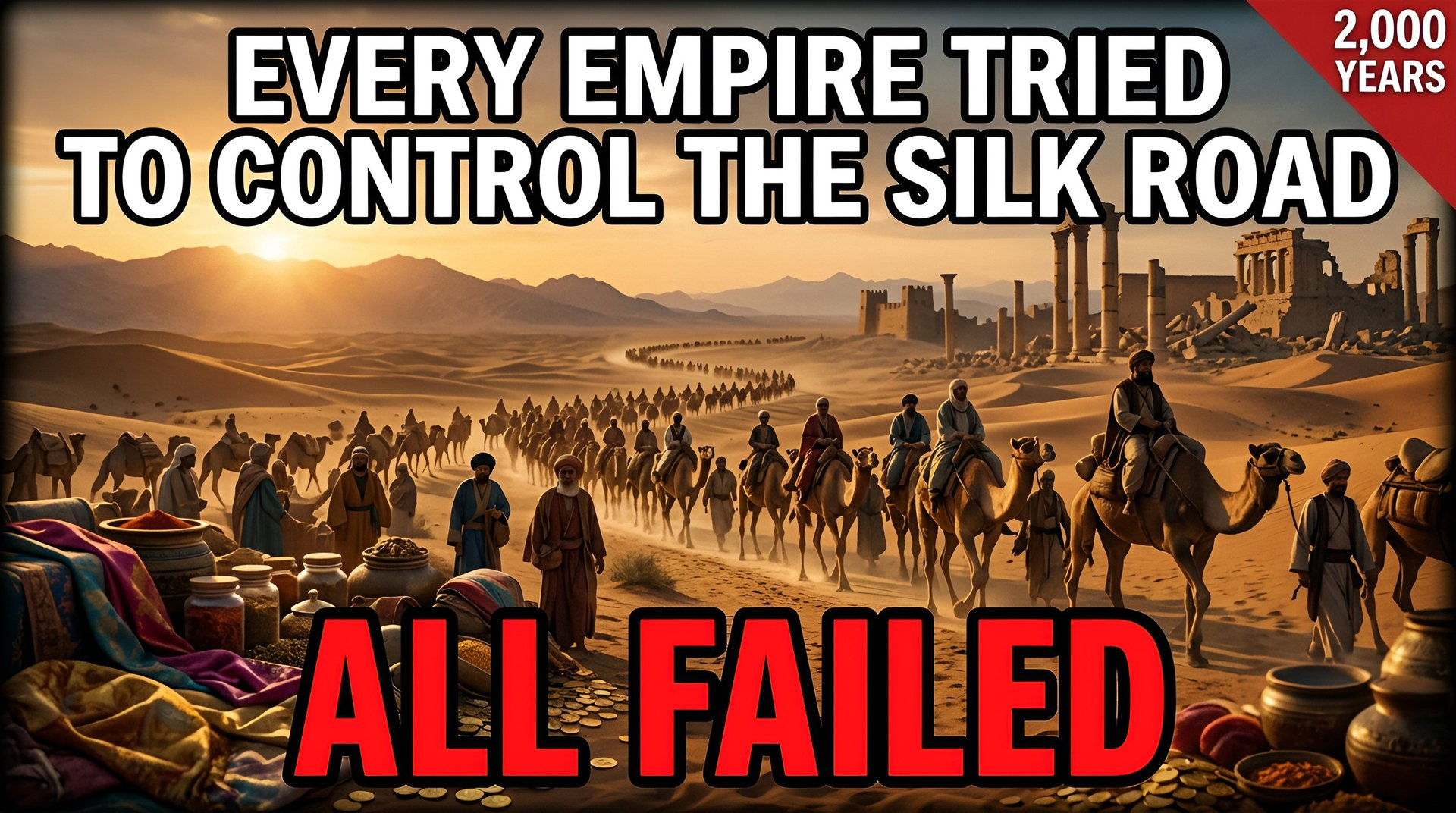
Silk Road Connected Three Continents for 2,000 Years. Every Empire Tried to Control It. All Failed.
 Chuck8 min read·Just now
--
The ancient distributed network logic that defeated Persian, Roman, Mongol, and Ottoman empires is running your internet right now.
By History’s Hot Takes
Here’s something that should bother you.
The Persian Empire tried to monopolize the Silk Road. Failed. The Roman Empire tried. Failed so badly their treasury drained westward paying for Chinese silk they couldn’t stop buying. The Mongol Empire the largest contiguous land empire in human history, controlling more Silk Road territory than anyone before or since tried. Still failed.
The Ottoman Empire controlled every major chokepoint after 1453. Perfect geographic position. Genuine monopoly leverage. European response: they didn’t negotiate. They didn’t fight. They sailed around the entire continent of Africa to avoid Ottoman control entirely.
The Silk Road outlasted every empire that tried to monopolize it by centuries.
And the reason why is the same reason governments can’t permanently censor your internet, the same reason China has declared Bitcoin dead multiple times and it keeps running, and the same reason COVID destroyed centralized supply chains while distributed ones absorbed the disruption and recovered.
Distributed networks don’t fight centralized control. They route around it.
It Was Never One Road
The first thing to understand about the Silk Road is that the name is misleading on both counts.
It wasn’t primarily about silk. And it was never one road.
The Silk Road was a network of thousands of routes desert paths across Central Asia, mountain passes through the Himalayas, sea lanes across the Indian Ocean constantly shifting, constantly adapting, connecting China to Rome across three continents for roughly 2,000 years.
No government planned it. No single empire managed it. No international organization coordinated it.
It emerged organically from demand, built by independent merchants from dozens of cultures who needed to move goods between east and west and figured out how to do it without asking anyone’s permission.
The infrastructure caravanserais, the rest stops built every 25 30 miles along routes wasn’t constructed by central government either. Local rulers built some. Merchants built others. Religious organizations built others. Nobody planned the caravanserai network. It appeared because merchants needed it.
This is the first and most important insight:
the Silk Road was self-organizing.
It didn’t need central authority. It didn’t need imperial management. It emerged from the bottom up, adapted to disruption automatically, and outlasted every top-down institution that tried to capture it.
How It Actually Started:
A Spy Mission Gone Sideways
The formal origins trace to 130 BC and a Chinese diplomat named Zhang Qian, sent westward by Emperor Wu of the Han Dynasty to find military allies against the nomadic Xiongnu tribes threatening China’s northern borders.
Zhang Qian was captured almost immediately. Held prisoner by the Xiongnu for ten years. He married a local woman. Had children. Eventually escaped, continued his mission westward, reached Central Asia and found no military allies whatsoever.
What he found instead was evidence of thriving trade networks already operating between east and west. Routes that existed informally. Goods moving between cultures that had never formally met.
He returned to China after thirteen years and reported back. Emperor Wu recognized the commercial potential immediately. The Han Dynasty began formalizing western trade routes military escorts for merchants, diplomatic relationships with western kingdoms, official infrastructure.
Nobody invented the Silk Road. Zhang Qian discovered it was already happening and told his emperor.
Chinese silk reached Rome shortly after. Romans had never seen anything like it — impossibly thin, lustrous, unlike any fabric their civilization had produced. Worth its weight in gold. The Roman Senate actually debated whether silk clothing was moral, given how much gold was flowing eastward to pay for it.
They never resolved that debate satisfactorily. Romans kept buying silk regardless.
The Control Attempts: A Study in Institutional Failure
Every major power that encountered the Silk Road eventually attempted to monopolize it. Every single one failed. The failures are instructive.
The Persian Problem: Persia controlled western sections of overland routes and taxed merchants heavily. Logical strategy. Except merchants are adaptable. Within months of new Persian taxes or restrictions, alternative routes emerged around Persian territory. The network didn’t fight Persian control. It routed around it.
The Roman Obsession: Rome’s failure was more embarrassing. They never controlled any significant portion of routes Persian middlemen sat between Rome and China but they couldn’t stop buying Chinese silk regardless. Emperor after emperor tried to limit silk purchases through legislation. None of it worked. Roman consumers ignored the laws. Gold kept flowing east. The Roman treasury hemorrhaged wealth toward China for centuries for goods sourced from a place Romans couldn’t find on a map.
The Chinese Secret: China’s control attempt was the most dramatic. They kept silk production sericulture secret for roughly 500 years. The penalty for revealing how silk was made outside China was death. This actually worked, briefly, making silk uniquely valuable precisely because its origin was mysterious.
It ended when two Byzantine monks smuggled silkworm eggs out of China hidden inside hollow walking sticks around 550 AD.
Five centuries of the world’s most jealously guarded trade secret, protected by death penalty, ended by two monks with modified walking sticks. Centralized control always has a vulnerability. Someone always finds it.
The Mongol Paradox: The Mongol Empire at its peak controlled more Silk Road territory than any power before or since. They made routes safer the Pax Mongolica allowed Marco Polo to travel overland to China under Mongol protection. Trade volumes actually increased under Mongol control.
And still they couldn’t monopolize. Sea routes operating independently across the Indian Ocean bypassed Mongol land control entirely. Arab and Indian merchants controlled sea lanes the Mongols couldn’t project power onto. The network simply used water when land became controlled.
The Ottoman Lesson: Perhaps the clearest example of all. After 1453, the Ottoman Empire controlled every major land chokepoint between Europe and Asia. Constantinople. Levantine ports. Perfect position.
European powers didn’t fight Ottoman control. Didn’t negotiate better terms. Didn’t accept the monopoly.
They hired Portuguese sailors to find an alternative route. Vasco da Gama reached India by sailing around Africa in 1498. The Ottoman land monopoly was bypassed entirely by moving the network onto the ocean.
The Silk Road didn’t defeat the Ottoman chokehold. It rerouted around it onto a different medium entirely.
Why Distributed Always Beats Centralized
The pattern across every control attempt reveals something fundamental about network design.
Centralized networks have a fatal weakness: single points of failure. Control the hub, control the network. Destroy the hub, destroy everything.
Distributed networks have no hub to control. No single point of failure anywhere. Block one route, traffic reroutes through remaining routes automatically, without coordination, without permission, without delay. The network self-heals faster than any centralized authority can respond.
The Silk Road was maximally distributed. Thousands of independent merchants. Hundreds of routes. Dozens of languages, cultures, and commercial traditions. No single group controlled enough of it to create leverage. No single route was essential enough that blocking it stopped trade.
Speed was the decisive advantage. Merchants could find new routes in weeks. Imperial response to close those routes took months or years. The network was always operating ahead of the control apparatus trying to capture it.
Compare empire lifespans to the network’s lifespan:
- Persian Empire: approximately 200 years
- Roman Empire: approximately 500 years
- Mongol Empire: approximately 150 years
- Silk Road: approximately 2,000 years
The network outlasted every empire that tried to control it. Not because merchants were militarily stronger than empires. Because distributed networks are structurally more resilient than centralized hierarchies.
Your Internet Is a Silk Road
In 1969, the US military funded ARPANET the predecessor to your internet with a specific design requirement: it had to survive a nuclear attack.
Their solution was a distributed network. No central hub. Traffic routed automatically around destroyed nodes. Any node could be eliminated and the network would continue functioning through remaining nodes.
The engineers who designed ARPANET had probably never studied the Silk Road. They arrived at the same design principle independently, because it’s the correct answer to the same problem: how do you build a network that cannot be destroyed by eliminating any single component?
Same answer, 2,000 years apart. Distributed.
China’s Great Firewall is the most sophisticated internet censorship system ever built. Thousands of engineers. Billions of dollars in infrastructure. Significant effectiveness. And yet: VPNs work. Tor routes around censorship. Mirror sites appear. Information finds paths. The network routes around the blockade, exactly as Silk Road merchants routed around Persian tax collectors.
Russia’s internet controls after 2022 produced identical results. Blocking platforms generated immediate adoption of alternatives. Telegram. VPNs. The harder the suppression, the more creative the routing.
COVID-19 exposed the same vulnerability in supply chains that empires discovered on the Silk Road. Single-source manufacturers — companies relying on one factory, one supplier, one geographic location — faced catastrophic disruption when that single point failed. Semiconductors. Medical equipment. Basic consumer goods.
Companies with distributed supply chains absorbed the same disruption locally and recovered faster. Multiple sources meant alternatives. No single point of failure meant no single point of collapse.
Toyota had learned this lesson earlier, the hard way. A 1997 fire at the Aisin factory sole supplier of a critical brake component halted Toyota’s global production within days. They switched to distributed suppliers afterward. Never made the same mistake again.
The Silk Road principle, applied to manufacturing logistics.
Cryptocurrency is perhaps the most explicit modern Silk Road. Bitcoin has no central server to seize. No central bank to shut down. No headquarters to raid. Distributed across thousands of nodes globally, it cannot be destroyed by eliminating any single component.
China has banned Bitcoin multiple times. Multiple governments have attempted shutdowns. Mainstream media has declared it dead over 400 times. It continues operating. The distributed network survives every centralized attack, because there is no center to attack.
The Lesson Empires Keep Refusing to Learn
The Silk Road’s 2,000-year run produced an unambiguous verdict on centralized versus distributed control.
Every empire that attempted monopoly eventually collapsed. The network that no one owned, that no government managed, that required no central authority to function survived them all.
The institutional lesson is clear: you cannot permanently monopolize a distributed network. You can disrupt individual nodes. You can control specific routes temporarily. You can make trade more expensive and dangerous in specific areas. But you cannot capture the whole.
Modern governments and corporations are still learning this. They keep assuming central control is possible over distributed networks internet, financial systems, supply chains, information flow because it was possible over centralized systems.
The Silk Road spent 2,000 years demonstrating why that assumption is wrong.
The merchants who built it never asked permission. Never needed central authority. Self-organized around demand and kept trading through the collapse of every empire that tried to own what they had built.
Distributed networks outlast every empire that tries to control them. They always have. The internet is just the latest proof.
Watch the Full Story
This article covers the framework. The full History’s Hot Takes documentary-style video goes deeper Zhang Qian’s thirteen-year mission, the Byzantine monks with hollow walking sticks, the complete Ottoman bypass story, and modern parallels from ARPANET to open source software that prove this pattern is running your daily life right now.
Watch: “Silk Road Connected Three Continents for 2,000 Years. Every Empire Tried to Control It. All Failed.”
👉 History’s Hot Takes on YouTube
History’s Hot Takes examines institutional failures and pattern recognition across history. New videos every Tuesday (Shorts) and Thursday (Main videos).
Tags: Silk Road, Distributed Networks, Ancient History, Trade Routes, Pattern Recognition, Internet, Cryptocurrency, Supply Chain, Roman Empire, Mongol Empire, Institutional Failure