What if we never reach AI Utopia because the pathway there destroys its chances?
I’ve been interested in technology since I was old enough to engage with it. It has been a driving force in my life that ultimately led me into the world of Digital Product Development. For more than 17 years I spent my career trying to understand: how businesses work, how to make the best and most desirable digital products, and how people think and act. I wouldn’t say it’s an obsession, but as someone with attention challenges, this is the one consistent area of focus that has persisted throughout my life. I always looked toward the future and dreamt of witnessing sci-fi level technological advancements. I remember having a poster on my wall in the 80s suggesting that by the end of the 90s we’d all have 3D hologram domes in our living rooms.
After the paradigm-shifting release of LLMs, I finally felt that we were reaching that crescendo of technical achievement. Perhaps, I thought, we can now begin to create whatever we desire by using this technology. In order to understand it as best as I could, being a non-technical person, I decided to join a course at Oxford University studying Artificial Intelligence for Business. It didn’t take long before my worldview shifted, and not in the way you’d expect.
Whilst the course, which was excellent by the way, delved into the mechanics and history of AI, it was very much an open question as to what impact it was going to have, not just on business, but on society and the world as a whole. It appeared that there was this gaping chasm between what it can do now and what it is expected to do in the future. It was like, “here we are….and now we’re there, in a world of dystopian abundance”. It just didn’t make sense.
What’s happening now?
Cementing ourselves in here and now, the truth about AI is that it is exceptional at presenting knowledge, but is prone to invention. Ironic considering it is actually incapable of true creative invention. It is capable of conjuring up fiction. That is the function of its design. To eliminate it, requires something else, and all the bleeding-edge AI firms are frantically trying to figure that out. They may never figure it out. But for now, things like AI agents, that profess to eventually be able to automate our lives away, will be prone to error when presented with something it wasn’t expecting.
So right now, a useful technology, but limited from reaching the age of abundance. As a career product manager, one thing I know is that humans will not accept errors as par for the course. Everything needs to work as expected. If it doesn’t, they’ll abandon it. They’ll lose faith and trust. Now, in an age of abundance, where lives and health will be at stake, error would have to be a thing of the past. It’s a fundamental pre-requisite and don’t let anyone tell you otherwise. The current research is focused on “self-improvement” to solve this problem, but they have to escape the echo chamber and find some level of abstract consciousness to determine what’s going on in the world. That’s quite a stretch. For AI research to continue, it needs to receive vast sums of money to keep it going. And in order for that money to flow, it needs BELIEF. Belief that this “future” is coming, and soon.
Now I’m not going to say they won’t achieve what they’re setting out to do. But what we do know is that no-one actually knows how they’re going to achieve it, or if any of their ideas will work. There’s no experiment that outlines evidence of a solution. So, could be 1 year, could be never. That’s the truth. They’re hoping the money doesn’t run out before they can solve it.
The subtle changes
One of my other interests is global macroeconomics and trading. What we’re hearing right now is that companies are apparently laying off their staff due to AI. That is both true and untrue.
If AI wasn’t here, there would be layoffs anyway. Businesses and economies are struggling with the fallout of decisions made after the global financial crisis. We’re fractured, we’re indebted, and we’re isolating ourselves in a persistently inflationary environment. Companies need to cut costs, and they do that to save money, and they also use tools to automate as much as possible, usually because human labour is the greatest expense.
LLMs and AI agents as they currently stand are enough to improve processes and shorten delivery. They will have an impact, but I wouldn’t say at this point it’s revolutionary. They can’t do everything, but they can help fewer people do the same workload or perhaps the same people do more workload. Is this inflationary or deflationary? This is a paradox we’ll talk about a bit later.
Low hire, no fire. Ultimately, if more profit isn’t made, then wages won’t rise and people won’t spend, and this, in the end, leads to a recession which causes high fire, no hire and automation.
If companies are struggling, they will accelerate permanent cost saving measures, by automating work as much as possible. Jobs won’t come back and tax revenues drop. But remember, we’re not at full “utopia” yet. This is where we’re all headed now, and it’s dark. Governments and businesses will state “it’s all fine, keep calm and carry on” even when it’s blatantly not, so don’t trust what they say. Judge by looking at the facts. They’re not even matching layoffs with robot tax, so this only goes in one direction.
So now we’re getting to the meat and bones of where this rabbit hole goes…
The bridge or the chasm?
The one thing we need to make clear here is that AI is a cognitive replacement. It’s not a tool designed to make us super and improve our lives (although it does in many cases). Ultimately, it’s a tool designed to replace us. Thanks to Sam Altman we’ve been launched into this democratised knowledge society because it apparently “shares the wealth”. But by doing so, the cat is out of the bag. We are now self-perpetuating our own replacement.
The dream the AI researchers purport to have is to create a world free of work and sickness. I dream of going to Mars, maybe one day it might happen, but most likely not in my lifetime. But still, let’s say for argument’s sake that they achieve this tomorrow. Let’s talk about what happens to society.
Back to today. If we’re in a low fire, no hire situation and then the technology gets better, there’s two things that could happen.
The first is that people will scramble to build as many businesses as they can. But, this has an economic problem. If there’s too much supply of anything and everything, then it becomes worthless. So, they won’t make money.
The second thing that will happen is that companies will increase layoffs. If they have a way to run a business with fewer people they’ll take it immediately. Not because it’s an immoral choice, but because Capitalism demands it. They’ll have to compete against others making products and services cheaper.
But here’s the “utopia paradox”. If people get laid off, who’s buying stuff? It won’t be the government because they’re busy paying benefits to the growing number of unemployed. Where does the money come from? How is the system working at this point? But wait, we’ve not reached utopia yet.
Economies start to collapse as only shareholders benefit from the remaining circular businesses. Money becomes worthless. White-collar workers are losing their jobs and the government won’t pay for their £2,000/month mortgage. Banks won’t lend. House prices drop as people struggle to stay afloat. Governments can’t print money because hyperinflation has kicked in. Taxing businesses to death destroys the capitalism engine, and they have no alternative system to replace it with.
Robots haven’t reached the mass market yet so blue-collar workers have to keep working while white-collar workers start to fill their vacant jobs. Their pay rises and blue-collar workers get pushed out by former white-collar workers. Anger starts to rise as the poorest and least agile lose their freedom. The government tries debt forgiveness and equal benefits but it ends up with those that have land and those that don’t. People question why they’re working at all so they down tools. Water stops pumping, electricity stops flowing, elderly stop being cared for.
People start to weaponise the technology to gain an advantage in a collapsing world……
Where’s the bridge?
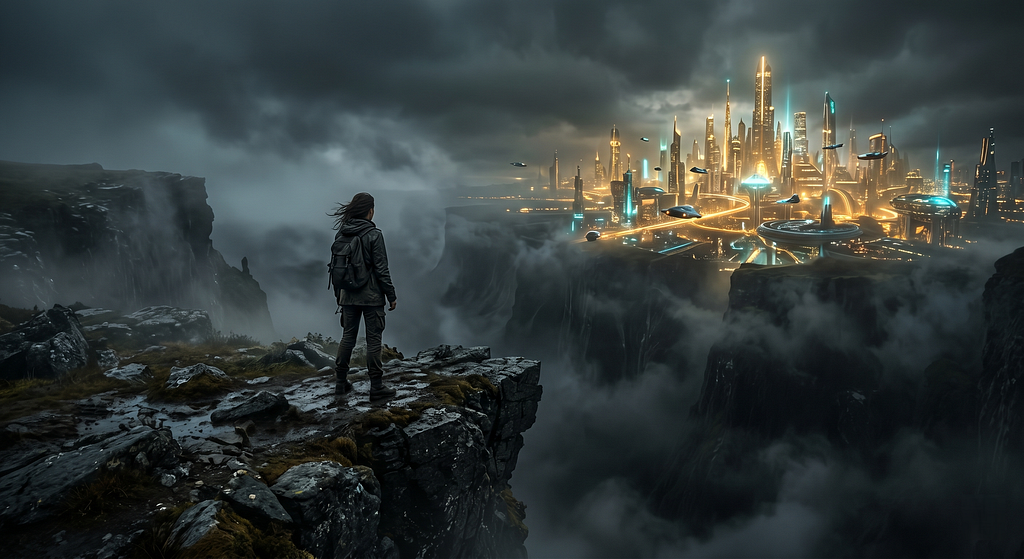
This is the crux of this piece. Can you name anyone at all who can explain what the bridge looks like? What’s the pathway to this utopia? Do we even want to endure it? Do we even have a choice? Is our choice to say “no”? I don’t want this. Yes I want the energy crisis and cancer cured, but not at the cost of societal collapse. Should it be closed off for those purposes alone and not commercialised? Has capitalism eaten itself?
“But they’ve offered a bridge”
Let’s take a look at what our current thought leaders think is our answer, without ever paving a path.
It seems they only have thoughts about what happens when we’re there. They don’t stop to articulate whether the pathway there actually destroys their chance of ever arriving.
Sam Altman — $13,500 a year of “universal basic wealth.” Funded by taxing companies and land that no longer make money — funds the bridge with planks ripped from the bridge, Mr Altman?
Dario Amodei — Machines of Loving Grace sketched the destination. The Adolescence of Technology finally admitted mass unemployment and wealth concentration as risks. Then offered AI alignment research as the answer — this doesn’t pay anyone’s mortgage, Mr Amodei.
Demis Hassabis — “Radical abundance” in 5–10 years. Says the transition will be “ten times bigger and ten times faster” than the Industrial Revolution — you forget to mention the Industrial Revolution gave us slums, child labour and two world wars before the upside arrived, Mr Hassabis.
Elon Musk — AI means no-one needs to work — what’s the funding, mechanism and timing for this utopia, Mr Musk?
They need you to BELIEVE to keep THEIR DREAM alive. You are the collateral damage. The cost of progress. In their story, the richest survive.
Who else plays in their park but talks differently? Geoffrey Hinton. The Nobel laureate, godfather of the technology, who resigned from Google so he could speak freely. He openly says capability is doubling every seven months, white-collar work is going first, gains will concentrate to capital holders, and UBI is necessary but not enough because income doesn’t replace meaningful work. He’s the only one of them telling the truth.
I know this all sounds extreme, and it is meant to be because most believe governments will just figure it out and look after them. I’m afraid they can’t and they won’t. They can’t risk to even have the discussion unless it’s right in front of them.
I want you to ask your leaders one question repeatedly. WHAT DOES THE BRIDGE LOOK LIKE? WHAT’S THE DETAILED TRANSITION PLAN? SHOW IT TO ME.
No bridge, then the chasm it will be. Utopia is unreachable without a controllable plan. Order will not rise out of chaos.
They are treating societal evolution like a playground game: One, two, skip-a-few, ninety-nine, one-hundred. But you cannot skip the transition.
Do not go gently into that good night.
You have a choice. Wake up!
Show me the bridge to an AI utopia was originally published in DataDrivenInvestor on Medium, where people are continuing the conversation by highlighting and responding to this story.