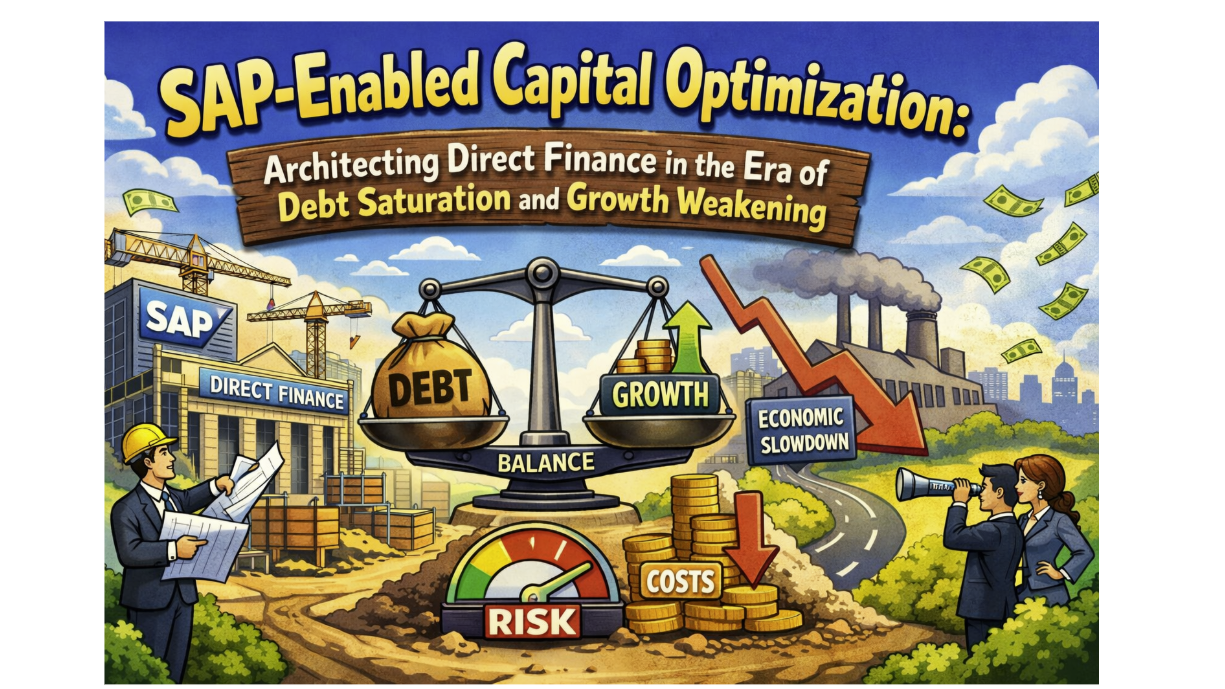
SAP-Enabled Capital Optimization: Architecting Direct Finance in the Era of Debt Saturation and Growth Weakening
 Ferran Frances-Gil9 min read·Just now
--
The Existential Reckoning of Traditional Intermediation
The global financial ecosystem is reaching a critical inflection point. With global debt levels reaching unsustainable heights and international organizations forecasting a persistent weakening in long-term growth, a systemic capital crisis is no longer a hypothetical risk — it is an impending reality. The traditional banking model, built on the foundations of 20th-century intermediation, is facing an existential reckoning. For decades, the structural lag between risk inception and risk transfer has acted as a silent drain on global liquidity, a luxury the modern economy can no longer afford.
As capital adequacy requirements tighten and liquidity dries up under the weight of sovereign and corporate debt, the “Risk Maturity Gap” has become the primary bottleneck for survival. The solution lies in a fundamental architectural shift: a decentralized, peer-to-peer (P2P) financial nexus powered by the world’s most dominant enterprise operating system, SAP. By leveraging the fact that SAP systems manage approximately 70% of the world’s real-economy GDP, a new paradigm of financial disintermediation is emerging. This transition moves away from the opaque and capital-intensive world of synthetic securitizations toward a transparent, direct association of assets and liabilities. This is a strategic imperative for capital optimization in an era where information velocity is the only true defense against market systemic failure.
“The solution lies not in refining 20th-century banking mechanics, but in a fundamental architectural shift toward a decentralized, peer-to-peer financial nexus.”
I. The Fragility of Synthetic Securitization and the Debt Trap
Traditional finance relies heavily on securitization — pooling contractual debt and selling cash flows to third-party investors. While this provided a veneer of liquidity, it introduced multiple layers of fees and “middleman” spreads that inflate the cost of capital. Synthetic securitizations, specifically, were designed to allow banks to transfer credit risk without selling the underlying assets.
In an era of unsustainable debt, the inherent fragility of this model is exposed. The complexity of these instruments often masks the true nature of underlying collateral, creating a “transparency tax.” The fundamental risk lies in a reliance on counterparty performance and subjective valuation. When the global debt bubble experiences a shock, these synthetic bridges collapse, leaving the initiating bank holding the very risk it sought to offload. This opacity is the antithesis of the “Financial Twin” concept, where every ledger entry must be a perfect, verifiable reflection of a physical economic reality.
“Synthetic securitization remains a sophisticated veil that obscures the true location of risk, creating a systemic fragility that the modern enterprise can no longer afford to subsidize.”
II. Eliminating the “Intermediation Lag” in a Low-Growth Economy
The core problem of the traditional banking model is the temporal gap between risk assumption and risk endorsement. When a bank originates credit, it assumes the full weight on its balance sheet. There is a significant time delay — often weeks or months — before that risk can be bundled and sold. During this “Intermediation Lag,” the bank must hold regulatory capital against the asset.
In an environment of weakening growth, this consumption of capital is a structural inefficiency that the real economy can no longer sustain. It ties up billions in liquidity that should be fueling innovation. As long as the bank acts as a central clearinghouse for risk, the velocity of capital is restricted by bureaucratic latency. Disintermediation is the only way to reclaim the time-value of money and ensure that capital flows where it is most productive.
“Capital consumption is the inevitable tax on financial latency; as long as risk sits on a bank’s balance sheet, the real economy remains starved of liquidity.”
III. SAP as the Global Economic Ledger
The primary challenge to any P2P financial model has always been scalability and trust. SAP provides the answer by managing the core business processes for the vast majority of the world’s largest corporations.
- The Source of Truth: SAP is the “DNA” of global commerce, containing real-time data on inventory, purchase orders, and fulfillment.
- The Universal Journal: The data required to validate an asset or a liability already exists within the ACDOCA tables. There is no need for third-party audits because the transaction history is natively immutable.
- The Financial Twin: Every physical move in the supply chain is reflected as a digital ledger entry. This allows investors to fund specific invoices with total certainty that the underlying economic event is occurring exactly as recorded.
By utilizing SAP as the underlying architecture, the system gains immediate, unparalleled scale. SAP is not just an ERP; it is the infrastructure upon which a disintermediated financial world is being built.
“The scalability of P2P finance is guaranteed by the fact that the world’s economic DNA is already encoded within the SAP Universal Journal.”
IV. Direct Capital Optimization: Releasing the Regulatory Brake
The shift to SAP-enabled P2P finance transforms capital from a dormant regulatory requirement into an active operational resource. In the traditional model, capital is “consumed” because banks must set aside safety buffers (Basel III/IV) for every loan. This creates a massive drag on global liquidity, acting as a brake on an already weakening global economy.
By utilizing the SAP digital nexus, this consumption is bypassed. Because the financial obligation is matched directly between the provider and the user of capital the moment it is created in the ERP, the risk never sits on an intermediary’s balance sheet. This “Zero-Holding” state frees capital to be reinvested into core operations. This represents a democratization of corporate finance where capital is allocated based on the efficiency of the “Financial Twin” rather than the size of a bank’s balance sheet.
“When the ledger breathes in unison with the warehouse, capital optimization shifts from a theoretical goal to an automated operational reality.”
V. The Great Compression and Systemic Pathogens
The contemporary global economy is defined by “The Great Compression” — a convergence of geopolitical chokepoints and energy volatility. In this environment, an energy shock destabilizes production costs and inflates financing requirements, acting as a systemic pathogen that migrates through the financial circulatory system.
First, the impact on Production Costs erodes gross margins. Beneath it lies the second wave: Financing Cost escalation. As margins shrink, internal cash generation weakens, forcing a greater reliance on external credit exactly when central banks are raising rates to combat inflation. This “double squeeze” is the primary driver of the impending capital crisis. Organizations must move beyond siloed management and adopt a holistic orchestration of both tangible and intangible assets.
“An energy shock is not a line item in a budget; it is a systemic pathogen that infects margins and exposes the hidden fragilities of the supply chain.”
VI. Contagion of Credit Risk and Supply Chain Fragility
The third manifestation of this pressure is the degradation of the Counterparty Risk Profile. When energy and debt pressures soar, suppliers face margin compression. If a Tier-2 supplier lacks the financial resilience to absorb these costs, the entire production schedule is at risk. This is the “Supply Chain Chokepoint” made manifest.
In a P2P environment, the “Financial Twin” becomes the ultimate instrument of capital optimization. SAP provides a real-time, valuated reflection of every physical move, making the financial instruments derived from them 100% accurate. An investor can fund an invoice with the certainty that the “Financial Twin” validates the customer’s ability to pay based on their own real-time SAP inventory and sales data, bypassing the lagging indicators of traditional credit ratings.
“A high-fidelity Financial Twin turns systemic pressure into structural advantage by providing the ultimate proof of economic reality.”
VII. Digital Resilience as the Ultimate Intangible Asset
In a world of localized scarcity, “Digital Sovereignty” and “Data Fluidity” become the ultimate intangible assets. The transition to “Just-in-Case” resilience requires a re-evaluation of how we value assets. An intangible asset, such as a proprietary risk-scoring model built within SAP IBP (Integrated Business Planning), is more valuable during a crisis than the physical machinery it controls.
These digital assets allow a firm to anticipate which nodes in their network will fail and proactively re-route capital. In a world of physical chokepoints, the ability to re-route capital through smart data is the only true competitive advantage. This “Smart Data” provides the “Optionality” needed to pivot strategies in days rather than quarters.
“Digital sovereignty is the ultimate intangible asset. In a world of physical chokepoints, information fluidity is the only true defense.”
VIII. The Foundations: Smart Incoterms as the Digital Notary
As established within the architecture of SAP S/4HANA Advanced Intercompany Sales, the Smart Incoterm is far more than a logistical label; it is the technical executor of the Sales and Purchase Agreement (SPA). In the legacy era of trade, Incoterms were static text strings, frequently misinterpreted, leading to accounting limbo.
The SAP ecosystem eliminates this ambiguity. Ownership transfer is hard-coded to transfer at precise milestones, verified by real-time data. The Valuated Stock in Transit (VSIT) logic shifts the asset value from the seller’s balance sheet to the buyer’s the moment the criteria are met. This eradicates “accounting limbo,” providing the Proof of Title required for immediate financing.
“While international frameworks provide the legal skeleton, the Smart Incoterm provides the digital nervous system.”
IX. SAP Global Track and Trace (GTT): The Oracle of Reality
If the Smart Incoterm is the “Notary,” SAP Global Track and Trace (GTT) is the “Witness.” To utilize SIT (Stock in Transit) as collateral, treasuries require unfiltered truth. SAP GTT acts as the premier Oracle for the Real Economy.
- Geospatial Verification: Confirms that assets are exactly where they are claimed to be, turning a static invoice into a “living” asset.
- Condition Monitoring: Integrates IoT data (temperature, shock) to ensure assets haven’t been compromised.
- Predictive Milestones: Uses machine learning to provide ETAs, enabling precise interest rate calculations and maturity matching for P2P lenders.
“SAP is evolving beyond the traditional ERP framework to become the world’s most sophisticated ‘Oracle’ for the real economy.”
X. The Value Chain Monitor (VCM): Command Center for Liquidity
The SAP Value Chain Monitor (VCM) serves as the “brain” of this architecture. It provides a holistic visualization of both logistical and financial statuses across multi-tier intercompany chains. For a Group Treasurer, the VCM serves as a Liquidity Cockpit by identifying where capital is “stuck” and highlighting “liquidity leaks” where physical progress has been made but financial documentation is stalled.
By providing lenders with a “Visibility Window” into the VCM, enterprises replace manual PDFs with a live feed of validated logistical events. This reduces Information Asymmetry, leading to lower interest rates and higher borrowing bases.
“The transition to managing a ‘Value Chain’ via the SAP ecosystem represents a fundamental shift from operational tracking to balance-sheet optimization.”
XI. The SAP Financial Services Data Management (FSDM) Layer
The integration of SAP S/4HANA and the SAP FSDM layer is non-negotiable for creating a Financial Twin. This layer enables:
- Supply Chain Finance (SCF): Programs triggered by real-time logistics data, ensures supplier survival.
- Basel IV Alignment: Proving to regulators that risk exposure is mitigated by real-time monitoring rather than broad, inefficient buffers.
- Dynamic Re-prioritization: Recalculating SKU profitability in real-time as energy or debt costs fluctuate.
This architectural fusion ensures that the organization remains anti-fragile, knowing its financial exposure in seconds, not weeks.
“The future of finance is found in the seamless, peer-to-peer flow of value across the SAP-enabled global network.”
XII. Conclusion: The Strategic Mandate for Capital Optimization
The transition from synthetic, intermediated risk models to a transparent, SAP-driven P2P financial architecture is the most significant evolution in corporate finance in centuries. By matching assets and liabilities directly at the source, we eliminate the unnecessary consumption of capital and the dangerous opacity of traditional banking.
As the global economy faces the headwinds of debt and stagnation, organizations that rely on the slow, capital-hungry models of traditional banking will be at a severe disadvantage. The mandate for the modern CFO is clear: optimize capital by eliminating intermediation. The tools — the Universal Journal, Advanced Intercompany flows, and Global Business Networks — are already in place. Resilience is not about having a bigger buffer; it is about having better information. A high-fidelity Financial Twin turns systemic pressure into a structural advantage.
“The future belongs to those who can see the invisible threads linking a gas pipeline to a credit rating, and who have the SAP infrastructure to manage both as one single, integrated reality.”
Connect and Stay Informed:
Join the Conversation: Connect with fellow professionals in the SAP Banking Group on LinkedIn. https://www.linkedin.com/groups/92860/
Stay Updated: Subscribe to the SAP Banking Newsletter for the latest insights. https://www.linkedin.com/newsletters/sap-banking-6893665983048081409/
Join my readers on Medium where I explore Capital Optimization in depth. Follow for actionable insights and fresh perspectives https://medium.com/@ferran.frances
Explore More: Visit the SAP Banking Blog for in-depth articles and analyses. https://sapbank.blogspot.com/
Connect Personally: Feel free to send a LinkedIn invitation; I’m always open to connecting with like-minded individuals. [email protected]
I look forward to hearing your perspectives.
Kindest Regards,
Ferran Frances-Gil.
#FinancialTwin #SAP #S4HANA #UniversalJournal #CapitalOptimization #DigitalFinance #EnterpriseArchitecture #PredictiveAccounting #ContinuousClose #SAPBusinessNetwork #SupplyChainFinance #AssetCollaboration #RealTimeFinance #CFOAgenda #AutonomousEnterprise #GreenLedger #FerranFrances