 Solana Insider5 min read·Just now
--
SamPump: How On-Chain Locked SOL Changes the Rules of the Game
Have you ever lost money on a token launched on Solana? Probably yes. Here’s why it’s not your fault — and how SamPump fixes the problem at its root.
If you’ve spent even a few weeks in the world of Solana tokens, you already know the story.
A new token appears. The chart pumps. The community is electric. The creator promises roadmaps, utility, partnerships. Then, within hours or days, everything collapses. The creator dumps, the price crashes, and investors are left holding tokens worth nothing.
It’s called a rug pull. And it’s so common it’s become almost normal.
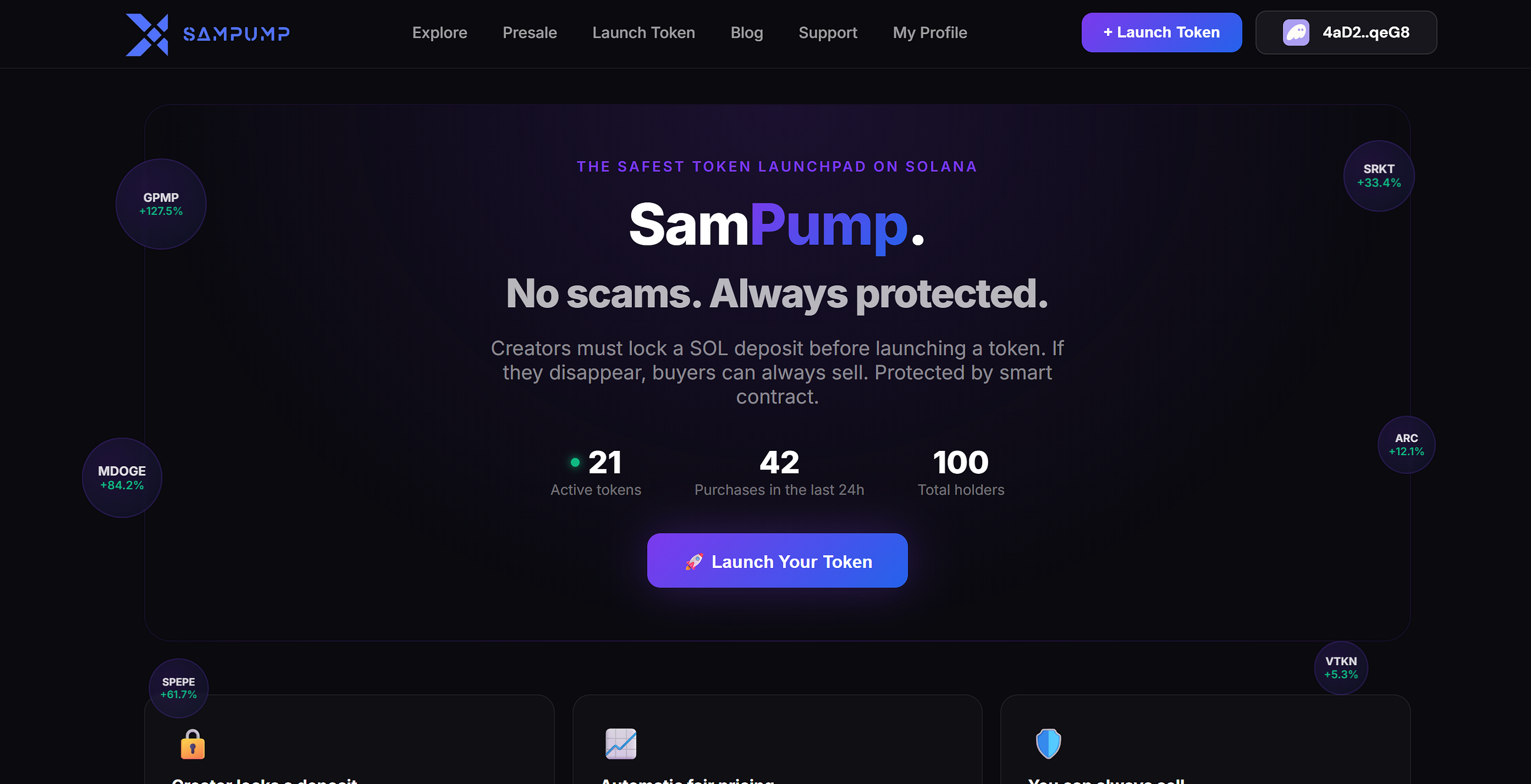
SamPump was built to change this reality — not with rules, not with human oversight, but with a simple and brutally effective mechanism: the creator must put their own SOL on the line before they can even launch.
The Root Problem: Creators Had Nothing to Lose
To understand SamPump, you first need to understand why rug pulls exist.
On traditional platforms like Pump.fun, anyone can launch a token in minutes at minimal cost — often less than 0.02 SOL. The creator risks almost nothing. If the token succeeds, they pocket the proceeds from selling their own tokens. If they want to run, they dump everything in a second and disappear.
The cost of doing a rug pull? Near zero. The incentive not to do one? Also near zero.
In economics, you’d say the incentives are miscalibrated. SamPump recalibrated them with a mechanism called the SOL collateral.
How the SOL Collateral Works
The principle is simple: before launching a token on SamPump, the creator must deposit a SOL collateral into an immutable smart contract.
This collateral is not a fee. It doesn’t go to SamPump. It still belongs to the creator — but it’s locked on-chain and cannot be touched as long as there are token holders.
Think of how a security deposit works when you rent an apartment. The landlord holds it to protect against damages. They don’t use it, don’t spend it — it’s just there as a guarantee. If everything goes well, they return it. If there are problems, they use it to cover them.
SamPump works exactly the same way, except the smart contract replaces the landlord — and unlike a landlord, it cannot be persuaded, corrupted, or bypassed.
The Three Scenarios: What Happens to the Collateral
SamPump’s contract automatically handles every possible outcome of a token launch. No human decisions. No intermediaries. The code handles everything.
Scenario 1: The project succeeds ✅
The token accumulates 85 SOL in real liquidity. The contract automatically migrates the token to Raydium CPMM — the decentralized exchange platform — and returns 95% of the deposited collateral to the creator. The creator only loses a small percentage as a fee. They built something real, and they are rewarded.
Scenario 2: The token doesn’t take off ⏳
No investors show up. The token sits inactive for 30 days. In this case, the creator can request a full 100% refund of the collateral. No penalty for trying. The project didn’t work out, but the creator gets everything back.
Scenario 3: The creator does a rug pull 🚨
The creator abandons the project while there are still holders — people who are holding the token and trusted the project. In this case, the contract automatically uses the collateral to cover the remaining investors’ positions. No claims needed. No appeals. The code does it on its own, immediately and irreversibly.
Why This Changes Everything
The point is not to punish bad actors. The point is to make rug pulls no longer worth it.
Before SamPump, a creator with dishonest intentions had everything to gain and almost nothing to lose. With the collateral mechanism, anyone who already knows they’ll abandon the project also knows they’ll lose the SOL locked in the contract. It’s a real, immediate, non-negotiable cost.
Those with a serious project have nothing to fear. They deposit the collateral, build the token, reach the Raydium migration, and recover almost everything. The deposit is just a temporary signal of commitment.
In behavioral economics, this mechanism is called self-selection: the system naturally attracts those who intend to build, and naturally excludes those who just want to take the money and run. No oversight required.
A Signal That Speaks for Itself
There’s one aspect of the SOL collateral that’s often underestimated: its value as a market signal.
When you see that a creator has deposited a large collateral, you’re seeing something concrete. Not a promise. Not a whitepaper. Not an enthusiastic Twitter post. You’re seeing real SOL, locked on-chain, that the creator would lose if they did a rug pull.
The higher the collateral, the stronger the signal. A creator who deposits a lot is saying, through verifiable actions: “I believe in this project enough to risk my own capital on it.”
And that statement, when it’s written into an immutable contract rather than a Telegram message, means something completely different.
What This Means for Investors
For an investor, SamPump doesn’t eliminate risk — no platform can do that. Markets are volatile. A token might not take off for a thousand reasons that have nothing to do with the creator’s intentions.
But SamPump eliminates one specific category of risk: the creator who deliberately disappears while you’re still holding their tokens.
Before investing on SamPump you can see the deposited collateral. You can evaluate it. You can use it as one of the criteria to decide whether to trust a project. And if things go wrong in the worst possible way — if the creator does exactly what dishonest creators have always done — the contract acts automatically on your behalf.
You don’t need to hope someone intervenes. You don’t need to open a support ticket. You don’t need to hope the creator still has a conscience.
The code has already taken care of everything.
The Difference Between Promises and Mechanisms
The crypto world is full of platforms that promise security. That claim to vet creators. That say they have procedures in place to protect investors.
Procedures can be circumvented. Vetting can be gamed. Declarations cost nothing.
An immutable smart contract with real SOL locked inside cannot be circumvented. It cannot be persuaded. It cannot be corrupted. It doesn’t depend on anyone’s goodwill.
SamPump didn’t promise to solve the rug pull problem. It made it structurally less convenient — and in the Solana token ecosystem, that is already a quiet but concrete revolution.
If you want to dive deeper into anti-rug protection on Solana, you can also read anti-rug-solana.com
SamPump is a token launch platform on Solana. This article is for informational purposes only and does not constitute financial advice. Investing in tokens always carries significant risks.