
Member-only story
Rust Made Our Python ML System 7.4× Faster — Then Our Team Started Falling Apart
--
The benchmark was a win. The aftermath wasn’t.
The benchmark result landed in our Slack at 2:47 PM on a Tuesday.
7.4×.
Nobody replied for sixty seconds. Then our CTO sent one word: “Ship it.”
That number was real. Earned. Measured carefully on identical hardware with every layer of overhead included — tokenization, feature extraction, output serialization, all of it.
And it nearly broke our team.
This is a postmortem of both things at once.
The Profiler Told Us Something Embarrassing
We were running a real-time fraud scoring model in production. Every payment request hit our inference API, got scored, and either cleared or flagged — ideally under 150ms end-to-end.
Ideally.
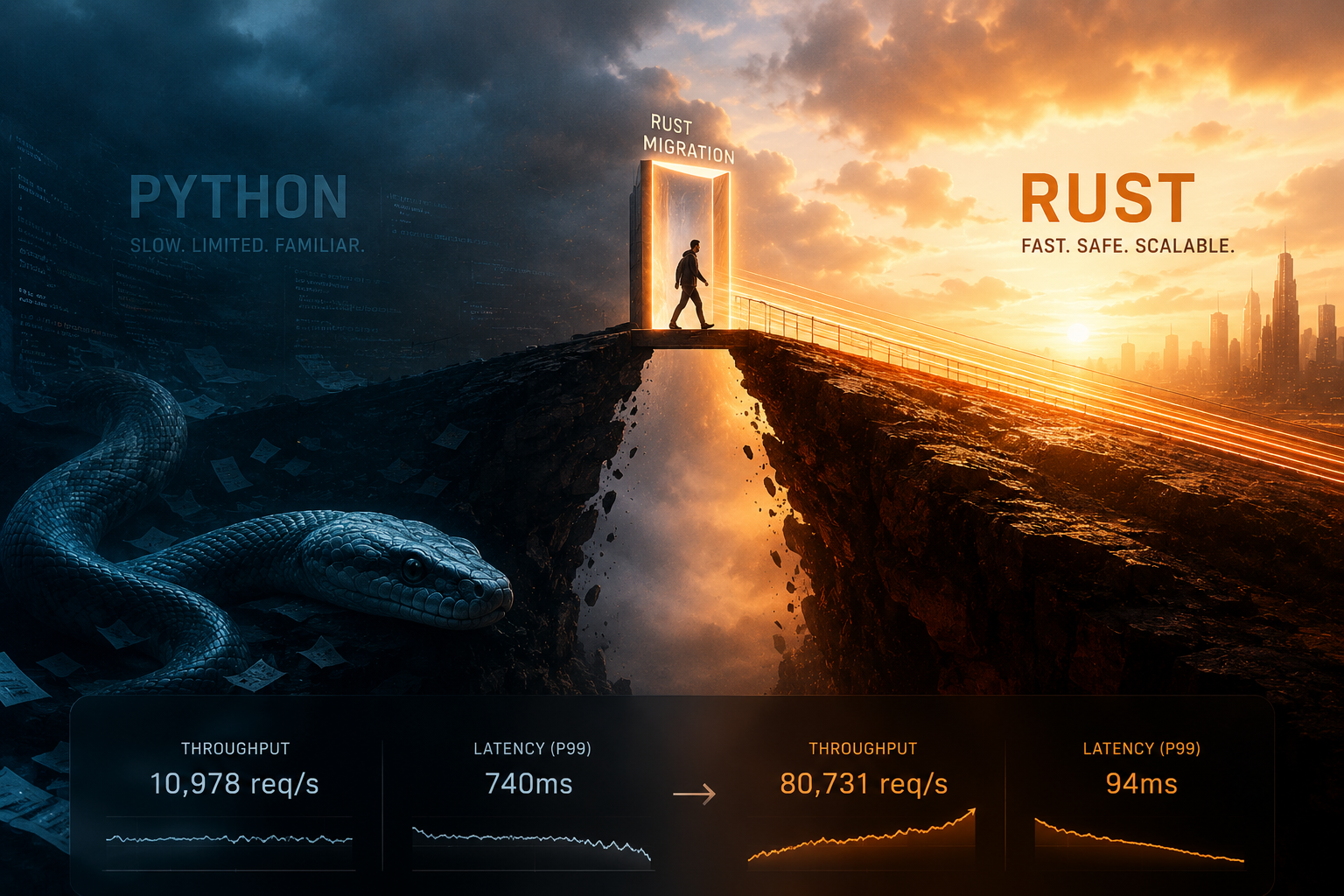
Under load, our Python serving layer was averaging 310ms at p50 and pushing 740ms at p99. The SLAs were slipping. Customer complaints were climbing.
The obvious assumption — shared by most of the team — was that the model was the problem. Too many parameters. Too slow a forward pass. Maybe we needed to quantize.