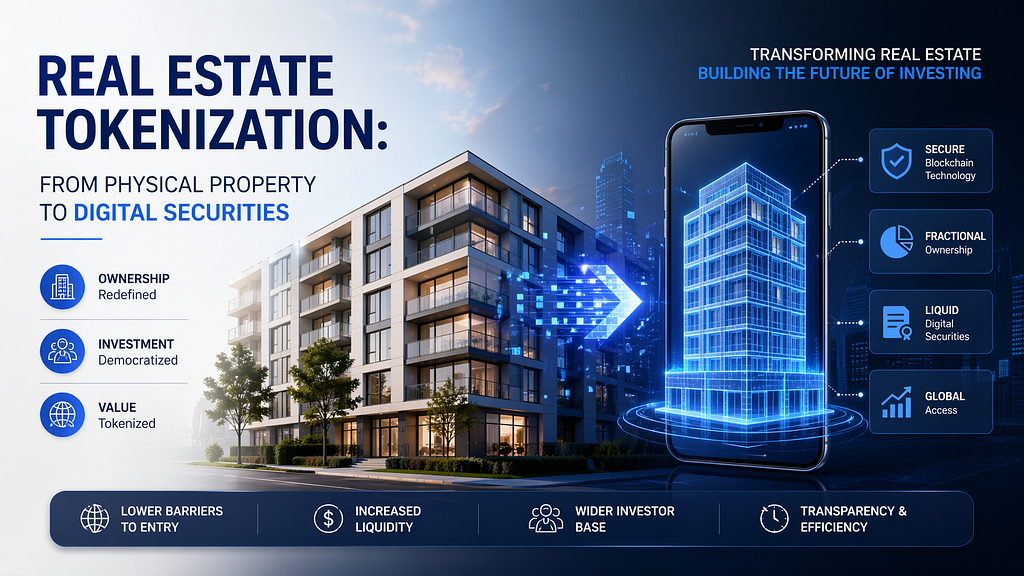
The intersection of real estate and blockchain technology is creating a transformative opportunity in the global investment landscape. Traditionally, real estate has been one of the most illiquid asset classes, requiring significant capital, long transaction times, and reliance on intermediaries such as brokers, banks, and legal teams. Real estate tokenization is changing this paradigm by converting physical properties into digital securities, allowing investors to buy, sell, and trade fractional ownership in real-time.
What is Real Estate Tokenization?
Real estate tokenization converts physical properties into blockchain-based digital tokens, allowing fractional ownership, enhanced liquidity, and broader investor access. These tokens are backed by tangible, revenue-generating assets, providing a secure bridge between traditional real estate and modern digital finance.
Key features include the following:
- Fractional Ownership: Investors can buy a portion of a property without purchasing it entirely, lowering entry barriers.
- Smart Contract Automation: Ownership, rental income, and voting rights are managed securely and automatically on the blockchain.
- Transparency & Security: Blockchain ensures immutable records, reducing fraud risk and improving trust in transactions.
- Global Accessibility: Digital tokens enable cross-border investment, opening markets to international investors and increasing portfolio diversification.
Benefits of Tokenizing Real Estate
1. Fractional Ownership
Tokenization allows investors to own a fraction of a property, which was previously impossible or cumbersome with traditional investment methods. This lowers the entry barrier for retail investors, enabling diversified real estate portfolios even with modest capital. Fractional ownership also spreads risk across multiple investors, reducing exposure for any single party.
2. Liquidity and Secondary Markets
Unlike traditional real estate, which can take months or years to sell, tokenized properties can be traded on secondary marketplaces almost instantly. Investors can liquidate portions of their holdings, creating a dynamic market where property shares are continuously valued. Enhanced liquidity attracts more investors and facilitates active price discovery for real estate assets.
3. Global Access
Real estate tokenization opens local properties to global investors. Cross-border investments are simplified through blockchain, with transparent ownership records and automated compliance via smart contracts. This enables international investors to diversify their portfolios without the complexities of foreign property acquisition, such as legal requirements, currency exchange, and local intermediaries.
4. Reduced Costs and Increased Efficiency
Blockchain reduces reliance on intermediaries, cutting transaction costs related to brokers, lawyers, and clearinghouses. Automated processes for compliance, rental income distribution, and voting minimize administrative burdens, while smart contracts ensure that transactions are secure and error-free.
5. Transparency and Security
Tokenized assets benefit from blockchain’s immutable ledger, which records every transaction and ownership transfer. Investors can independently verify property ownership, revenue, and historical data. Smart contracts enforce predefined rules, reducing the risk of fraud or mismanagement and providing confidence to both investors and property owners.
Types of Real Estate Tokens
Real estate tokenization can take several forms, depending on the rights and benefits allocated to token holders:
- Equity Tokens: Represent a share of ownership in the property, granting holders the right to profits and sometimes voting rights on property-related decisions.
- Debt Tokens: Represent a loan or bond secured by the property, where holders receive interest payments instead of equity.
- Revenue-Sharing Tokens: Entitle holders to a portion of income generated by the property, such as rental revenue, without direct ownership rights.
Each structure can be tailored to attract specific investor profiles, ranging from high-net-worth individuals to retail investors seeking passive income streams.
The Tokenization Process
Launching a tokenized real estate project involves multiple stages:
1. Asset Selection and Valuation
Properties selected for tokenization should have clear ownership rights, verifiable legal documentation, and reliable revenue streams. Professional appraisals and financial audits determine fair market value, which informs token pricing.
2. Legal and Regulatory Compliance
Real estate tokens often qualify as securities, requiring adherence to local and international regulations. This involves KYC/AML verification, securities registration, and compliance with cross-border investment laws. Legal counsel specializing in digital securities is essential to ensure regulatory compliance.
3. Token Structuring and Smart Contract Development
Developers define token characteristics, including type, rights, and revenue distribution mechanisms. Smart contracts are coded to automate these processes, ensuring secure execution and reducing the need for manual intervention.
4. Token Issuance and Distribution
Tokens are issued on a blockchain platform and sold via Security Token Offerings (STOs), private placements, or digital exchanges. Investor onboarding includes identity verification, regulatory compliance checks, and allocation of tokens.
5. Asset Management and Governance
Ongoing property management is critical to maintain value. Token holders may participate in decision-making processes, approve major property changes, or receive rental income. Smart contracts automate governance and financial reporting, providing transparency and accountability.
6. Secondary Market Trading
Tokens can be traded on secondary markets to provide liquidity. Platforms may offer exchange listings, liquidity pools, or peer-to-peer trading, enabling investors to sell or buy tokens efficiently.
Applications Across Real Estate Sectors
- Residential Properties: Apartment buildings and single-family homes can be tokenized to attract retail investors.
- Commercial Real Estate: Office spaces, shopping centers, and co-working hubs benefit from fractional ownership and global investor reach.
- Industrial and Logistics: Warehouses, fulfillment centers, and infrastructure projects can be tokenized for long-term, revenue-generating investment.
- Hospitality and Tourism: Hotels and resorts can issue revenue-sharing tokens to fund expansions while providing returns linked to occupancy rates.
Challenges in Real Estate Tokenization
While real estate tokenization presents many opportunities, challenges persist:
- Regulatory Uncertainty: Laws governing digital securities vary by region and can evolve rapidly.
- Valuation Complexity: Determining the value of tokenized properties requires ongoing appraisal and market data analysis.
- Market Liquidity: Without active secondary markets, tokenized assets may still face liquidity constraints.
- Technology Adoption: Investors and property owners must adopt blockchain platforms and smart contract systems.
Overcoming these challenges requires collaboration among regulators, technology providers, and industry participants to create secure, efficient, and legally compliant ecosystems.
Future Outlook
The tokenization of real estate is reshaping property investment by combining tangible value with the efficiency of digital financial markets. Fractional ownership, liquidity, global access, and transparency are making real estate more accessible and investable for a wider audience.
As blockchain technology matures, platforms will increasingly integrate artificial intelligence for property valuation, predictive analytics, and automated governance. Integration with decentralized finance (DeFi) will enable tokenized real estate to serve as collateral, participate in yield farming, or be incorporated into diversified digital portfolios.
Conclusion
Real estate tokenization is transforming physical property into digital securities, giving investors fractional ownership, liquidity, and global access. Smart contracts ensure transparency, automation, and security, while evolving regulations provide legal certainty. As technology advances, tokenized real estate will integrate with DeFi, AI analytics, and innovative platforms, making markets more efficient and inclusive. Embracing tokenization is not just a new investment approach; it is a fundamental shift in how property value is created, managed, and traded in the digital era.
Real Estate Tokenization: From Physical Property to Digital Securities was originally published in Coinmonks on Medium, where people are continuing the conversation by highlighting and responding to this story.